Running an ultra through the night is one of those things that sounds cool until you’re out there doing it. The idea is romantic: you, alone with the stars, soft footfall on quiet trails, the meditative rhythm of movement after dark. In reality, night running feels more like wandering through a very long, very confusing escape room where the puzzles are “Stay awake!” and “Don’t trip!” and “Why am I eating quesadillas at 3 a.m.?”
If you’re a little nervous running after dark, welcome to the club. The night can be strange, but it’s navigable, physiologically, psychologically, and logistically, once you understand what’s going on.
This is Your Brain on Dark
The first thing to know is that your brain is not malfunctioning when it resists the idea of running during the hours it believes you should be unconscious. Humans are diurnal animals. We evolved to use daylight to hunt, gather, do chores, and get chased by the occasional predator. Nighttime was for sleep and safety, not after-dark hill repeats.
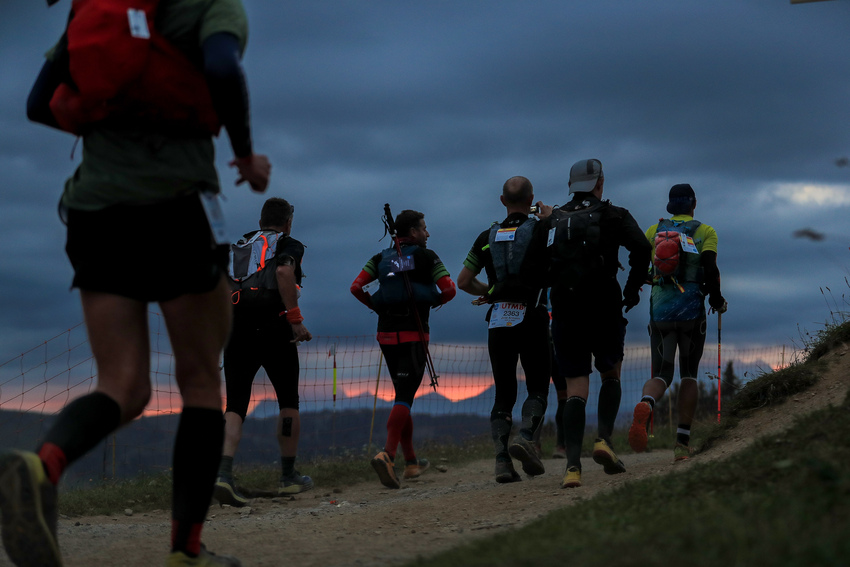
So when you head into an overnight ultra, you’re swimming against a few million years of evolutionary programming. Core body temperature dips, melatonin rises, alertness falls, digestion slows, all perfectly normal circadian processes that, unfortunately, do not care that you have a race to finish.
Those dreaded “witching hours” between 2 a.m. and 5 a.m. line up with the lowest point of your physiological function. Many runners hit their worst mental and physical slump here and think something has gone terribly wrong. Nothing has. It’s just biology. But biology isn’t destiny. You can prepare for the night in a way that helps your brain and body tolerate the weirdness rather than spiral inside it.
There’s actually a fascinating bit of science backing up the idea that moving through the dark genuinely costs more energy, not just emotionally, but metabolically. A study from researchers at Sweden’s KTH Royal Institute of Technology found that when volunteers walked on a treadmill blindfolded, their oxygen use jumped by almost the same amount as when they were loaded with a 56-pound pack.
Even on a perfectly flat surface, people instinctively shortened and widened their steps and lifted their feet higher when they couldn’t see, trading efficiency for stability. Running at night obviously isn’t the same as being blindfolded, but the same mechanisms are at play: reduced visual input forces your stride to become more cautious, and the limited beam of a headlamp speeds up your “optic flow,” making you feel like you’re moving faster and working harder than you actually are.
In other words, if you’ve ever wondered why your easy pace suddenly feels like a tempo effort before sunrise, it’s not in your head, your brain and body are spending real energy to keep you upright in the dark.
One of the most effective strategies is simply practicing after-dark running. You don’t need to pull an all-nighter during training (though some people do this and thrive on the drama). Just go out at dusk or run the last hour of a long run after sunset. Even one or two short night runs help your brain learn that “dark” does not equal “danger.” This familiarity reduces the sensory overload that tends to hit runners during the race. It also gives you a chance to troubleshoot your night gear without the pressure of being 50 miles deep into an event.
Fueling for the Night
Fueling becomes even more essential at night because your brain is fighting that circadian dip and needs glucose to stay coherent. Underfueling is one of the top causes of emotional meltdowns, hallucinations, sudden sleepiness, and that unmistakable sense of doom that creeps in when you’re high on fatigue and low on carbs.
Aim for your usual 60-90 grams of carbohydrates per hour, but start eating well before nightfall. The later it gets, the more sluggish your digestion becomes, so front-loading calories is one of the simplest ways to avoid the 3 a.m. crash. Caffeine can help, but use it like a dimmer switch, not a light switch, small, consistent amounts rather than a single heroic dose that nukes your stomach.
RELATED: 6 Smart Tips to Successfully Navigate Aid Stations
Gear Up
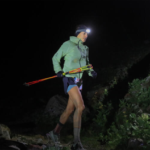
Gear matters more at night than during the day because your world shrinks to the size of your headlamp beam. A good headlamp isn’t a nice-to-have; it’s the most important piece of equipment you’ll carry. Most people obsess over lumens, but what really matters is beam quality, something with a wide flood for peripheral vision and a focused spot to pick up texture and contrast. Depth perception relies on shadows, so the goal isn’t maximum brightness; it’s clarity.
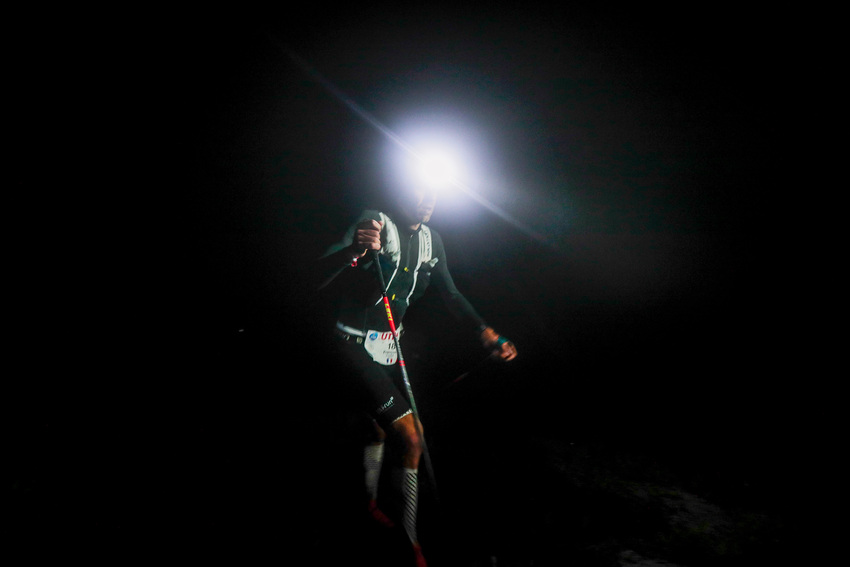
A headlamp on your forehead paired with a waist light creates a two-angled system that illuminates rocks and roots with far better definition. If you’ve ever wondered why elite 100-mile runners seem to float down technical trails at night, this is part of it.
My go-to is the Petzl NAO RL headlamp. It packs down small and has responsive lighting that automatically adjusts to your conditions. The batteries are rechargeable via micro USB and interchangeable, so that you can easily carry a backup. I’ve used this for all my night races, and it doesn’t disappoint.
And since gear failure at night can derail your race faster than a missed gel, treat your light setup like aviation protocol. Fresh batteries or a full charge before the race. Backup batteries in a Ziploc. Know which button does what. Practice switching between settings and angles. If your lamp has a lock function, use it, I’ve seen too many headlamps turn on inside a vest pocket and drain completely before sunset. The night is unpredictable enough; your gear shouldn’t be.
While you’re thinking about equipment, consider what you’ll wear when temperatures drop. Night running often brings a sudden, sharp chill, especially if you’re slowing down, climbing, or coming in and out of exposure. A lightweight wind layer can be magic in the early hours, trapping enough heat to keep your core steady without forcing you to overdress. A beanie or headband goes a long way for temperature regulation, and thin gloves help maintain dexterity when tasks like opening a gel or changing batteries become laughably difficult. Nighttime can make you feel clumsy and slow, so any gear that reduces friction, literally and metaphorically, pays off.
Prep for the Mental Game
The mental side of night running is its own beast. Without visual context, your brain works harder to interpret the world, which can make everything feel bigger, closer, scarier, or more emotional than it actually is. You might cry because you’re tired. You might laugh because a rock looks like a small, judgmental goat. You may experience a full existential crisis because a stump resembled a church pew. This is all normal. Night running strips away external stimuli. You’re left with your own thoughts, your headlamp beam, and the occasional reflective eyeball in the distance (usually a deer, occasionally a volunteer).
The trick is not to fight the weirdness. Name it, acknowledge it, and move forward. Shrink your world to what you can control: the next step, the next calorie, the next landmark. Think of the night as a slow-moving weather system rather than a test of character. It will pass. The sun will rise. Your hormones will shift. Your energy will return. If you have pacers, save them for the low point; human presence does wonders for stabilizing a brain that’s spiraling into nocturnal drama.
And then there’s dawn, the moment every ultrarunner should experience at least once. Dawn during a race is alchemical. Your body temperature rises, cortisol surges, melatonin drops, and your brain clicks back into gear. The world around you brightens and expands. Terrain that felt treacherous becomes runnable again. Many runners clock their fastest miles after sunrise not because they’re physically fresh but because the circadian pendulum has finally swung in their favor.
Running through the night is challenging, yes, but not mystical. It isn’t a matter of being fearless or stoic. It’s a collection of skills: managing physiology, dialing in gear, fueling consistently, and keeping your mind from believing the stories it tells at 3 a.m. With a little practice and a lot of preparation, the night becomes less a threat and more a corridor you move through, with a bright beam, a steady stomach, and a surprisingly durable sense of humor.
The dark always feels long until it ends. And when it does, you’ll be glad you kept going.
About the Author
Zoë Rom is a journalist, writer, and podcast host based in Carbondale, Colorado. She’s the co-host and producer of The Trailhead Podcast and Your Diet Sucks Podcast, and author of the book “Becoming a Sustainable Runner” (2023).
- The Art of Taking Running Seriously, But Not Too Seriously

- 3 Things I Learned from Coming Back From Injury

- Closing the Gap Between Ability and Ambition

- What Causes a UTMB DNF? Here’s What The Data Says

- Nine Lives: My Life in 9 Transcendent Pairs of Shoes

- Race Through the Night: Stay Awake, Alert + Mostly Sane