
Here’s what Western States training data says, and how coaches interpret it.
How do you prepare for the biggest race in ultrarunning? To see how last year’s Western States 100 finishers prepared, we dove into TrainingPeaks data to take a peek under the hood of the final 12 weeks of prep. The data is from 63 athletes, or 21 percent of the field. With 47 men and 16 women, the gender breakdown is roughly equivalent to the field as a whole. It’s not a huge group, and while the data is fairly comprehensive, it’s likely not everything is captured (for instance, athletes doing heat sessions or cross-training without logging it), but it still has some tantalizing threads.
Here’s what trends emerge, and what coaches say that means for runners that want to complete the run from Olympic Valley to Auburn.
Training Volume + Distribution
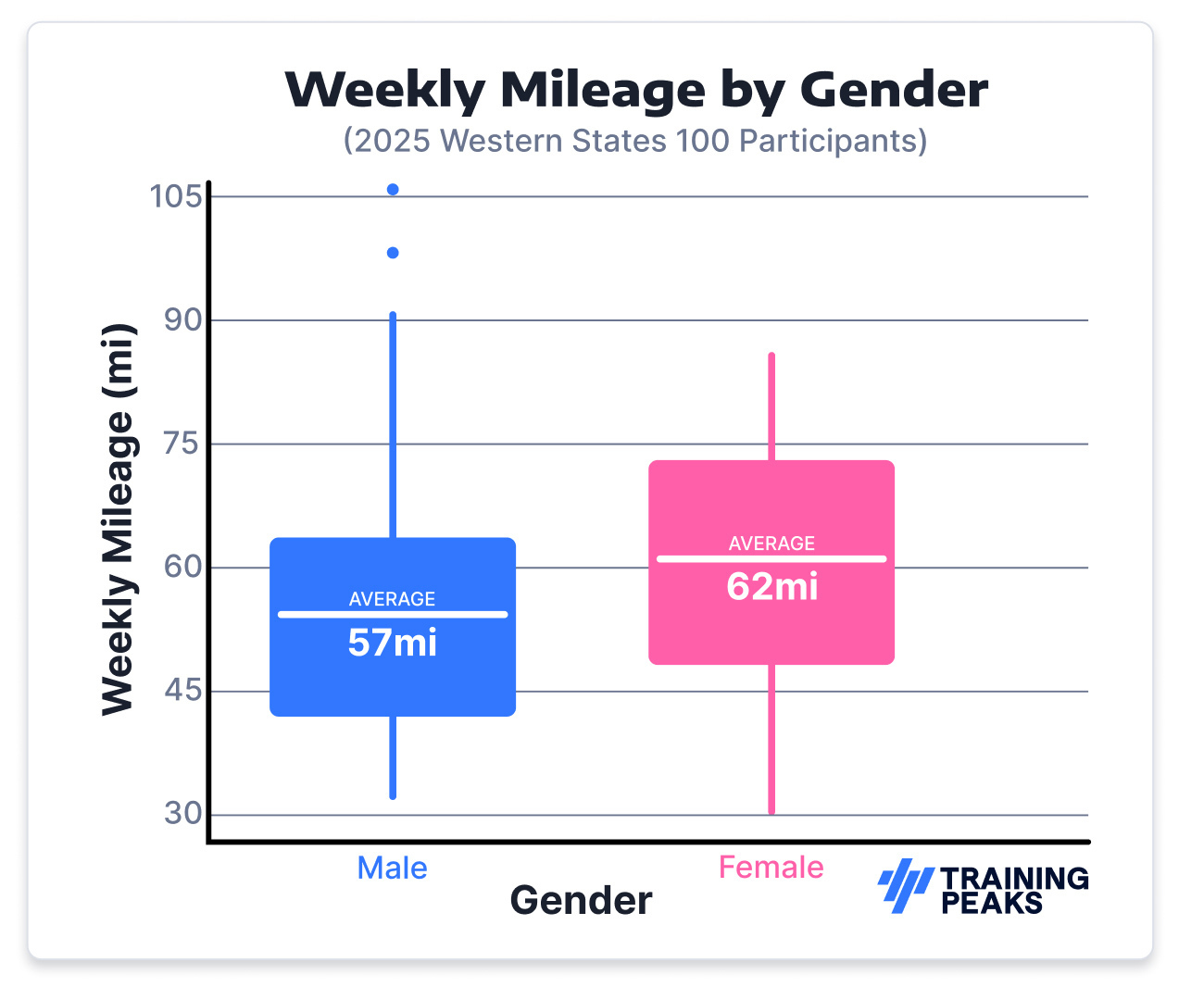
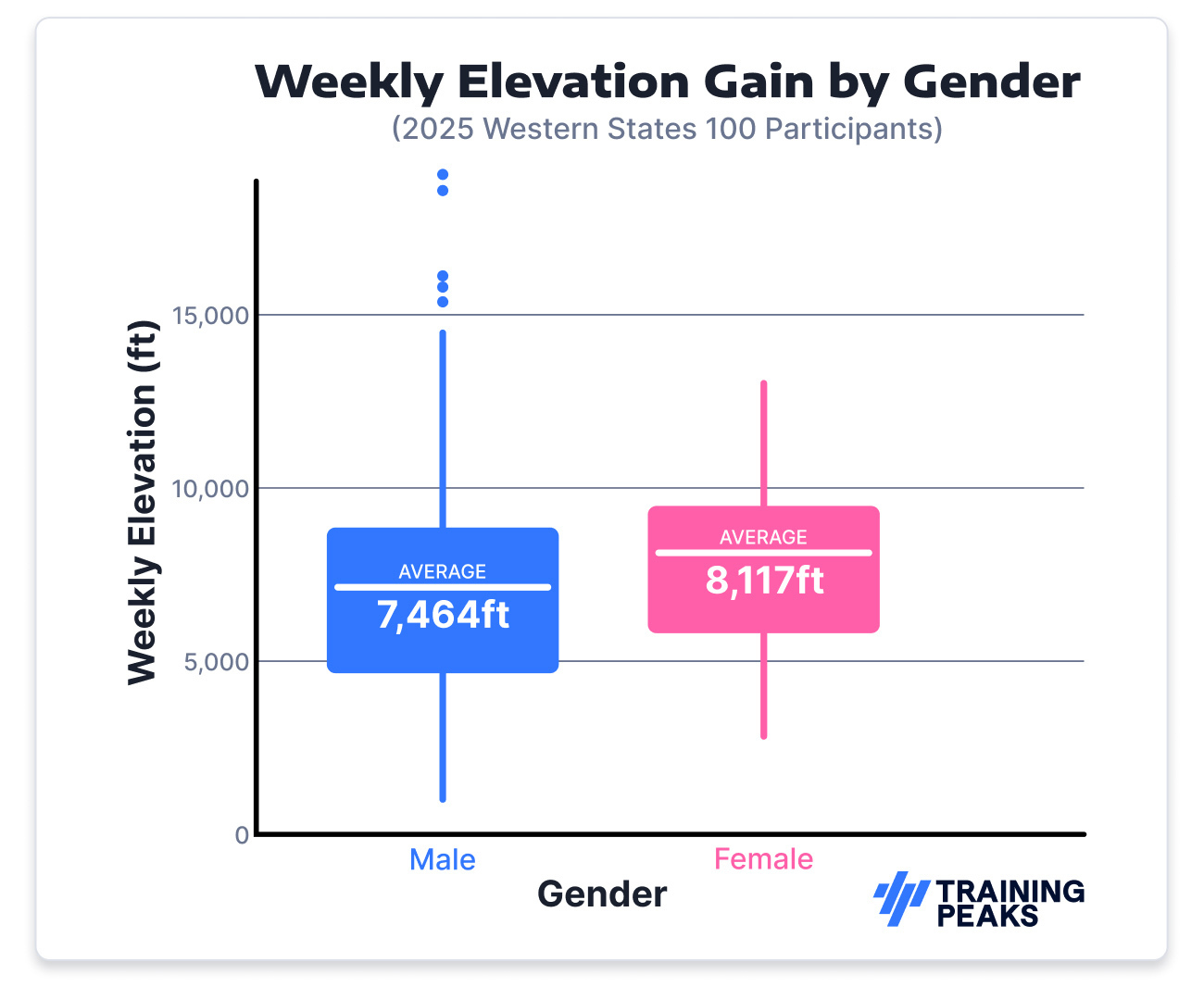
The women in the group averaged 11 hours, about 61 miles a week, and the men averaged 57 miles a week, or 9.7 hours. The discrepancy is more likely a data artifact than an indication of training behavior across genders, but still worth examining. Women logged about 8,100 feet of vert a week, and men got about 7,460 on average. The averages are interesting, and coaches can untangle how they break down at the individual level.
According to Cliff Pittman, who coaches Western States first-timer Molly Seidel and serves as Coaching Development Director at CTS, eight to 12 weeks out from race day, the focus of training should shift to race specificity, higher volume, and lower intensities for longer events. As you get closer, athletes should target analogous terrain and run at lower intensity.
“The final 2-3 weeks are about arriving fresh, not adding fitness,” Pittman says.
John Fitzgerald, who coaches fellow Western States Golden Ticket winner Jenn Lichter, says the most important block is the four to six weeks before race day, and rather than focusing on one heroic week or long run, athletes should find a training load that they can log sustainably.
“I tend to lean more towards climbing and descending for Western states and less emphasis on speedwork or intensity, really making sure that the athletes are really strong so that the canyons don’t beat them up, so that when the terrain opens up they can actually run,” Fitzgerald says.
Heat Training
Western States is infamously toasty, especially the canyons that heat up because of the thermic effect of heat radiating off the canyon walls. Of the TrainingPeaks athletes, 56 percent logged sauna or heat sessions. So, how do you add heat training into an already full program?
“[Heat training] gives you a real edge, but only if implemented correctly,” Pittman says.
Heat helps expand blood plasma, improves cardiac output, and triggers an earlier, more efficient sweat response. Those adaptations range from nice-to-have (blood plasma) to need-to-have (the ability not to become a human puddle at the bottom of a 101-degree canyon).
“Where it gets overhyped is when athletes overcook themselves running long in a heat suit in hot temps,” says Pittman.
Fitzgerald recommends testing your heat protocol in an earlier training block with a B-race to gauge your response and iterate before States, and striving for the minimum effective dose.
Aim to hit the sauna or hot tub (or even your bathtub at home) right after your run, so your core temp is still elevated. Chill (or, more accurately, toast) for 20-30 minutes, aiming for at least 10 consecutive sessions.
“More is not better,” says Fitzgerald. “Heat training can give you an edge, but it can also be overhyped, and unfortunately, I see athletes take it one step too far, and it leads to underperformance.”
Cross-Training and Strength
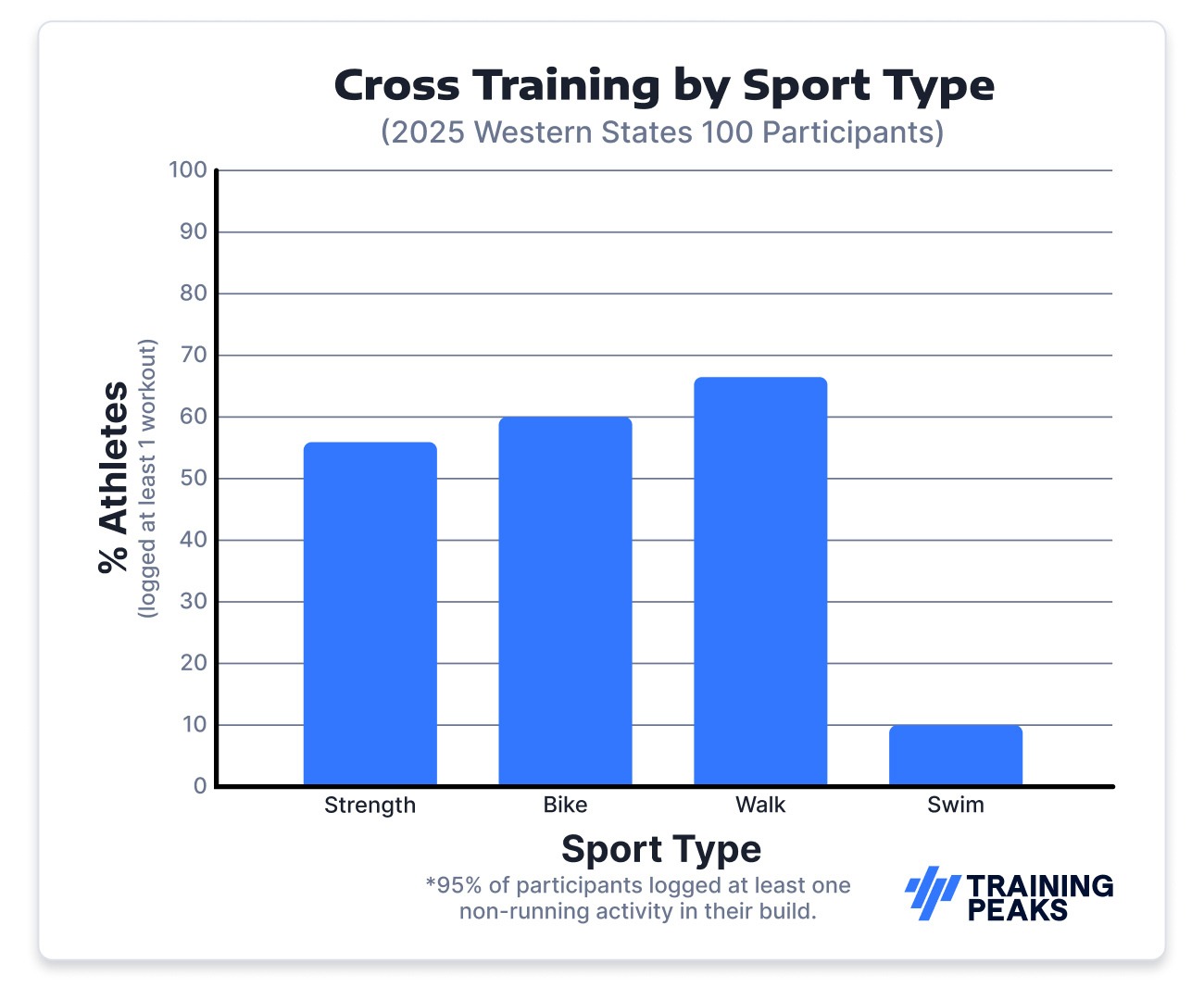
95 percent of the athletes logged some non-running sport in their final training block. 62 percent logged at least one bike or swim, and 44 percent did so regularly, cross-training eight or more weeks out of the 12. The data can’t tell us why they cross-trained, but it does add useful texture. Both coaches caution against viewing this dataset as a training recommendation.
“Just because most people do it doesn’t make it universally good. The goal is to build the aerobic and muscular durability to train as specifically as possible for your event, which is running,” says Pittman.
The report says 57 percent of athletes in the dataset strength trained, averaging about 20 sessions over the 12 weeks. Pittman and Fitzgerald offer their perspectives on what we might actually take away from the data.
“I look at strength training as helping with tissue tolerance, but it’s not gonna be bulletproof,” Fitzgerald says.
You can’t fully replicate the demands of a net-downhill 100-mile race in the gym, and overdoing it on strength, just like heat training, can detract from the actual training. So, athletes need to periodize it to support running, not to substitute for or detract from it. The best way to prepare is to run downhill and mimic the demands of the terrain in your training, rather than trying to cross-fit your way to 100-mile success.
“Just like heat interventions, a minimum effective dose approach is adequate when your ultimate goal is run performance,” says Pittman.
Early in the build, runners should prioritize foundational work like stabilization and load tolerance. As race day gets closer, overall strength volume should come down as you focus on heavier lifts, then move into a maintenance period in the final 4-6 weeks, doing the bare minimum necessary to preserve strength without generating additional fatigue.
Coaching
According to ATRA, 13 percent of trail runners work with a coach. But data from a 2023 WSER finisher survey show that 36 percent of finishers worked with a coach, and 47 percent of sub-24-hour finishers did so. This ladders up to 62 percent of the TrainingPeaks athletes working with a coach.
It’s a striking gap, even if it’s worth untangling. Some of it likely reflects that good coaching helps get people to States in the first place; some that earning a hard-won entry pushes runners to hire a coach and make the most of what’s often a once-in-a-lifetime shot; and some of it is simpler still, TrainingPeaks users, on a platform built around coaching and structured plans, are a more coaching-inclined bunch to begin with, which is worth holding in mind before reading too much into the contrast. What can a coach do that a training plan can’t?
“A spreadsheet is sufficient to optimize a plan. A coach optimizes for the athlete,” says Pittman. Athletes can struggle to be objective about their own training, and a coach can act as a check on misplaced analysis or emotion. Coaches can also analyze data and use that to guide training decisions, interpreting what happened, what it means, and how it should shift the approach going forward.
“That collaborative teamwork side of things can be really beneficial, having a sounding board, someone to bounce ideas off of. When you’re coaching yourself, it’s harder to do that,” says Fitzgerald.
What Shouldn’t You Do?
Running, strength training, cross-training, and heat training. What should athletes skip when it comes to WSER prep?
Pittman says he sees too many athletes fall for interventions with marginal gains, like supplements, ketone shots, fancy cooling headbands, and new shoe tech, before dialing in their foundations.
“At the end of the day, Western States requires you to run 100 miles,” Pittman says. “Within those miles, you need to be prepared for the high country, the heat of the canyons, and an enormous amount of cumulative downhill running. There is no hack for that. You have to run a lot on terrain that prepares you for those specific demands. The athletes who show up having chased every marginal gain while underinvesting in actual run training find out somewhere between Foresthill and the river that the sexy stuff doesn’t carry you. “
For his part, Fitzgerald thinks that some athletes overemphasize speedwork to the detriment of overall training volume and quality, which misses that 100-mile races are run at, well, 100-mile pace.
“Course record pace is essentially maybe an athlete’s easy run. You’ve got to ask yourself, why are we running [pace] on the track if we’re not going anywhere near that?”
What Can’t We See in the Data?
While the data offers interesting insights into how athletes prepare for Western States, it’s most useful in context and inherently can’t capture the full picture. Both coaches stressed the importance of zooming out to take a holistic approach, rather than focusing on data and numbers. Data can’t capture life stress: if you’re running a business, caring for family members, pursuing a home reno, or traveling for work. The training might look good on paper, but without sufficient recovery, it’s essentially meaningless.
Data also can’t capture the mental aspect of running a 100. “Some people have spent years training their ability to stay calm and functional when everything is uncomfortable, and the race still has 40 miles left,” says Pittman. “That’s not in any training log, but it might be the most important variable in the field.”
When the training gets heavy, and preparation feels intense, Fitzgerald likes to remind his athletes about why they’re stoked on WSER, and running, in the first place, and bring them back to the process.
“Let’s be in our process. If we start to jump into the future, remind ourselves, let’s be here, let’s be in our process,” says Fitzgerald.
“At the end of the day, it’s just running, which is actually incredibly simple.”
RELATED: Everything You Need to Know About Western States 2026
- Anatomy of an FKT: How Jane Maus Lowered the Women’s Fastest Known Time on Colorado’s Longs Peak

- 20 Great Fall Trail Running Races You Will Love

- Trail Tested: Teva TrailPeak
- How to Keep Running Ultras as You Age

- Sonoma Fall Classic: The Ultimate Trail Festival

- Behind the Bib: Leavenworth Trail Fest


1 comment
Craig
Thanks for your great articles!
Any chance of being able to easily pull the median mileage and elevation gain?
Being extreme here, but the average net worth of Elon Musk and 99 fast food employees is about $15 billion dollars. The median net worth is probably below $50,000.