
Cocodona 250 got more attention than ever outside of the sport’s niche following. What does that mainstream buzz mean?
Earlier this month, Rachel Entrekin won the Cocodona 250 outright, and not by a little.
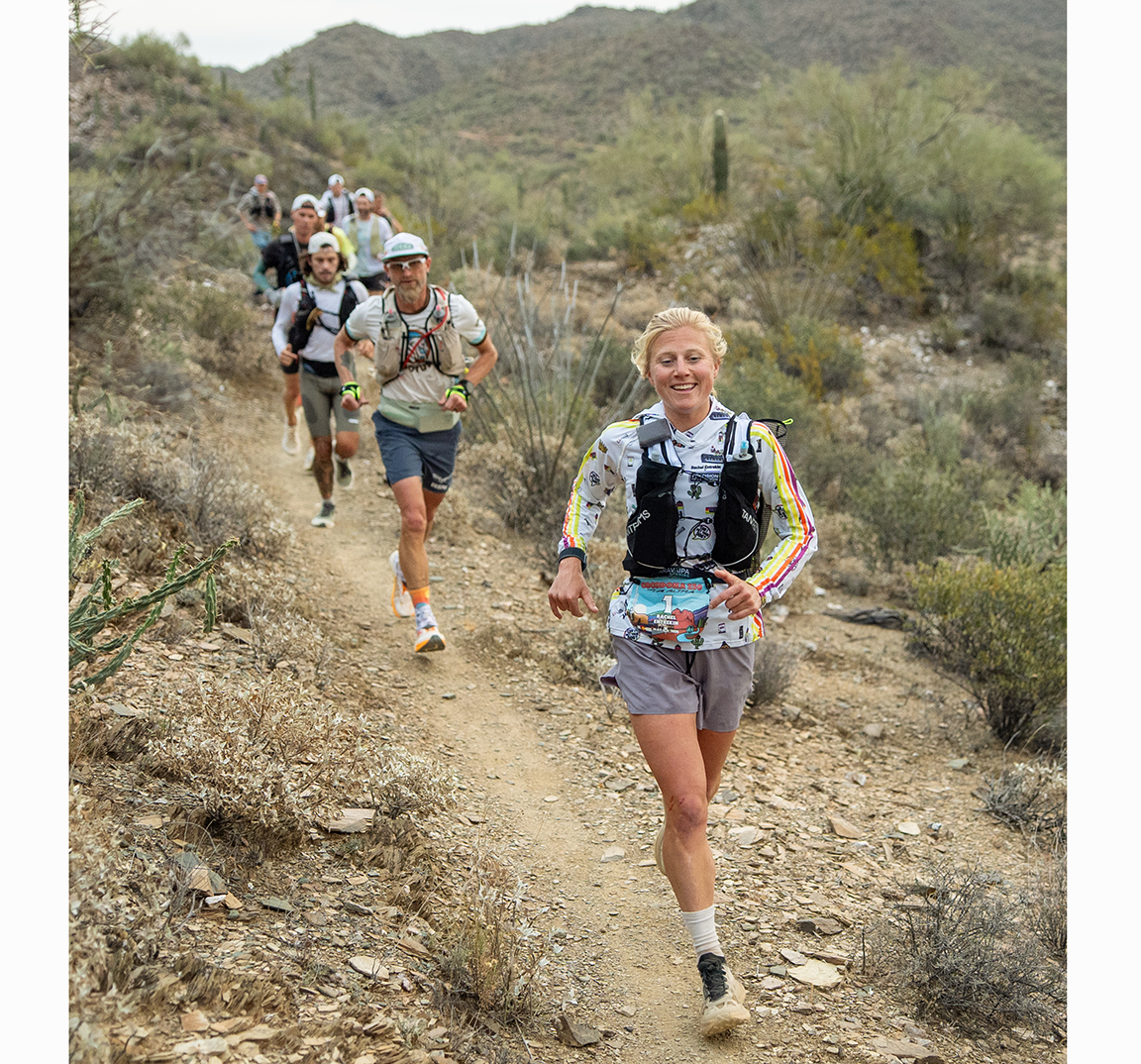
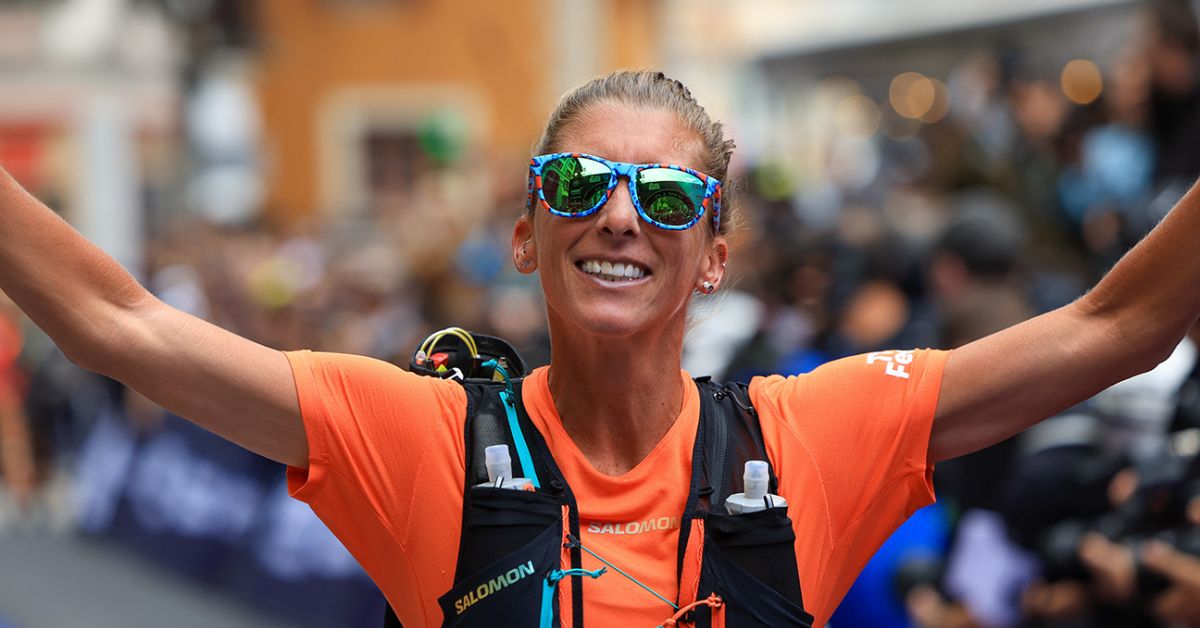
Her 56-hour, 9-minute, 48-second winning effort broke the overall course record by more than two hours and left every other runner, men included, somewhere behind her on the trail. She took the lead around mile 50 and never gave it back, ran two-plus miles ahead of the eventual men’s winner for the better part of a day, and closed it out on a grand total of 19 minutes of sleep and a heroic volume of mashed potatoes. It was her third straight Cocodona title, and the field she beat wasn’t padding: ultra legend Courtney Dauwalter, six-day world-record holder Megan Eckert, and former pro triathlete Heather Jackson all chased her home.
If you accounted for one of the 1.4 million views of the 125-hour livestream of the event (and was one of the 43,000 people glued to a screen at the peak moment watching Rachel finishing), you watched history happen in the glitchy making.
For those less indoctrinated in the church of excessive endurance, the news arrived secondhand. Good Morning America had Rachel on. Bloomberg, BBC Sport, USA Today, and the Guardian ran the historic result (though I get a little squeamish calling a race “historic” when it’s barely old enough for kindergarten). Then came the whole lifestyle-adjacent aggregator tier, My Modern Met, Just Women’s Sports, and the usual TikTok commentariat. Reese Witherspoon and Abby Wambach shared about it on social media. My mom texted me about it!
Going mainstream means being translated, and translation can get things wrong, or fail to capture the nuance. The win wasn’t unprecedented—Ann Trason, Pam Reed, Courtney Dauwalter, and Entrekin (now accepting signatures to make this the new Mount Rushmore) had all won races outright before. But the mainstream needed the narrative to be clean, and so they stripped it of its amazing, messy context. There will always be a gap in how a sport narrates itself, and how the culture must narrate it to make it legible to normal folks who do not spend their lives running around Arizona, soaked in simple carbohydrates and lube.
As ultrarunning’s self-appointed ombudsman, let’s look at what the narratives got right, what they got wrong, and what it all says about where the sport is headed.
It’s Not All Extreme
The 200-mile distance is one of the fastest-growing categories in the sport (partly because of the original number being relatively low, but still worth noting). In the U.S., 200-mile races went from a single event in 2008 to more than 20 within about 15 years. But here’s the thing: most ultramarathons are not, in fact, 250 miles long. The plurality is 50Ks, the most-entered distance in the sport. The flood of coverage this month didn’t happen because someone ran an ultra. It happened because someone ran a 250-miler.
Most of us are used to the dismissive “I don’t even drive that far” at parties, but that reaction is the whole point. Two hundred fifty-three miles is legible to the mainstream in a way a 50K never will be. Thirty-one miles sounds like a long Saturday. Two hundred fifty-three sounds like science fiction: a number big enough to register as superhuman, which is exactly what makes it a story.
We’ve seen this movie before. Literally. In 2014, a documentary called The Barkley Marathons: The Race That Eats Its Young came out, and once it hit Netflix, it turned a deliberately obscure Tennessee event, a race fewer than two dozen people have ever finished, into something anyone with a streaming subscription and 90 spare minutes felt they understood. (When Jasmin Paris became the first woman to finish Barkley in 2024, by 99 seconds, the photo of her collapsed at the gate went viral on an international scale.)
Now tell a stranger you run ultras and, largely because of that mainstream attention, there’s a real chance they’ll ask if you’ve done Barkley. Not Western States, not UTMB, but the one race almost no one gets into, and even fewer finish. The most extreme version quietly became the public definition.
And of course it did. Two hundred fifty-three miles across the Arizona desert, or however many miles Barkley runners log crawling through the southern underbrush, is just more narratively compelling than the races most of us actually run. Tragically, my regional 50K performances have yet to be optioned by Netflix.
To be clear, I’m not bashing the 200. It’s a genuinely great distance: a real test for seasoned runners, and far more approachable than its mythology suggests, what with generous cutoffs and mid-race sleep stations turning it into something like a supported thru-hike with a chance of spotting a Rachel Entrekin or a Courtney Dauwalter in the wild. I cheer it on, albeit from my couch in a pair of sweats.
But when a handful of singular, extreme events come to stand in for the whole sport, the spectacle starts eating the human stories alive—the local 50K series or the 46-year-old crossing her first 100-mile line at 4 a.m. to a finish line with three people—because none of that scans as superhuman. And the attention economy starts steering the sport itself.
Race directors are already floating 300s and 500s; the unspoken suggestion creeps in that you haven’t really gone long until you’ve gone longer. The same 253-mile legibility that carried Etnrekin’s win onto Good Morning America is the thing that risks teaching everyone the wrong lesson about what this sport is. The danger isn’t that extreme races exist. It’s that the cameras only point one way, and eventually the sport starts running toward them.
Beating the Boys
Rachel Entrekin is genuinely reshaping the sport, and I want to sit in that before I complicate anything. Going into this spring she’d won roughly 20 ultras in a row, a streak that ended only when Courtney Dauwalter, the reigning GOAT, came flying past her in the last four miles of the Chianti 120K in Italy to win a sprint finish in which the entire women’s podium landed within 7 minutes after 11½ hours of racing. (“I am hauling ass,” Entrekin wrote afterward. “She is just hauling better ass.”)
Six weeks later, she lined up at Cocodona and beat Dauwalter, beat Kilian Korth, beat everyone, running the fastest anyone has ever covered those 250-some miles. That’s the thing to celebrate, and it has nothing to do with who finished behind her.
Which brings me to the part that makes me itch. Almost every outlet led with the same hook: a woman won outright, and while that’s genuinely thrilling, it smuggles in two different problems, one factual and one philosophical.
The factual one first. A lot of the breathless coverage implied that women are simply built for the long stuff and will eventually pass the men. The evidence doesn’t carry that confidence. The gap between the sexes does shrink as races get longer, from about 10 percent at the marathon to low single digits at the extremes, but shrinking is not reversing. The most thorough review of the question, led by physiologist Nicholas Tiller, found women hold some real advantages out there (fatigue resistance, fat metabolism) alongside real disadvantages (lower oxygen-carrying capacity, more GI distress), and urged skepticism toward tidy conclusions.
When a woman does win outright—something that Entrekin has done 18 times over the past 10 years—it’s almost always the arithmetic of a singular performance meeting a particular field on a particular day, not a law of biology.
The impulse is right: the women’s side of this sport has gone under-celebrated for a long time. Increasingly, people are here for the women’s race. But the reflexive yaaas-kween version—“She beat the boys!”—misses the point. The women’s race isn’t a subset of the real race. It is a race. “First woman to win outright” quietly casts the men’s field as the field, the default, the main event, and Entrekin’s own competition as a carve-out with its own little podium. But there isn’t the field and the women’s field. There are two, parallel and whole, and neither is the warm-up act for the other. The men’s race is faster, on average. That makes it faster. It doesn’t make it superior, and it doesn’t make it the one that counts.
That’s the philosophical problem in miniature. Run it through Rachel’s own résumé: last year she took more than 7 hours off the Cocodona women’s record and finished fourth overall, one of the great rides in recent ultra history, and it earned her a devoted following inside the sport and roughly zero segments on Good Morning America. Same athlete, comparable brilliance. The only thing that changed in 2026 is that this time there were men behind her. If beating the boys is the toll for mainstream attention, we’re going to keep speeding past extraordinary women who didn’t happen to pay it.
None of which dims the win. I hope the wave of coverage, Reese Witherspoon, reaches some kid who decides to lace up and run, however far she wants. I just don’t want the lesson she takes from it to be that it only counted because there were boys to beat.
RELATED: Women Are Getting Faster in Ultras. Here’s Why.
RELATED: 5 Key Takeaways from the 2026 Cocodona 250 and How its Mainstream Attention Could Shape the Future
All About the Humans
The type of coverage and interest this win received is also noteworthy. It went big on morning shows like GMA, human-interest desks, and women’s sports verticals. Not (yet) the front of the sports section in the WSJ or the NYT (a girl can dream!). The race is being packaged primarily as a human-interest curiosity and a women’s story (big sigh!), but nowhere near premier endurance events like marathon majors or a Tour de France stage, as competition, with rivals and tactics and stakes, on the assumption that you already care who wins.
And it is a very human story. Entrekin wore $30 shorts and a button-down “party shirt,” ate mashed potatoes by the fistful, and stopped to pet dogs on the final descent. The coverage loved all of it, the naps, the beige food, the dogs, and ran it as the delightful, can-you-believe-it? garnish on a superhuman feat.
But that’s exactly what the human-interest framing gets backward. The dogs aren’t the garnish. The party shirt isn’t a quirk. The joy is the point. This is a sport where the winner of the hardest race in the country stops, with 50 miles left in her legs, to pet a dog because she’s having the best day of her life, where the aid stations run like block parties and the runner who takes 90-some hours gets the same cowbell as the one who takes 56 hours. The mainstream found the humanity and filed it under “curiosity,” when really it had stumbled onto the entire reason any of us do this. It got the texture and missed the meaning, mashed potatoes and all.
So what did the narratives get right? More than my grumbling admits. They got that something genuinely remarkable happened. They got that women are powering this sport. They got Rachel Entrekin, her grit, her joy, her “why not me?” mostly. And they got the sport a bigger audience than it has ever had, which means more people lacing up, more kids who’ll grow up assuming that 253 miles is simply a thing a person, a woman, can decide to do.
What they got wrong is quieter, and it’s the same thing every time a niche becomes a headline: they kept the parts that translate and dropped the parts that don’t. None of it false, exactly. Just flattened, a logline where there used to be a life.
So, where’s the sport headed? Toward more of this, for better and worse. More cameras, more 300s, more mornings where somebody’s mom texts them asking if they are going to run the Cocodona 250 or the Barkley marathons today. No, Mom!!
I won’t pretend I don’t want the attention; I do. A not-small part of my career has been essentially yelling at the internet about how great trail running is. I just want the version that arrives in the mainstream view to look a little more like the real thing: messier, slower, kinder, funnier. A sport where the best runner in the country stops, fifty miles from the finish, to pet a dog.
Because that’s the part worth getting right.
RELATED: Is that the experiment you tried actually working?
RELATED: Trail and Ultra News Recap for May 25
RELATED: Trail and Ultra News Recap for May 18
Read More By Zoë Rom
- Get to Know the Terroir of the Trails

- The art of accepting abject failure and moving on
- The Art of Taking Running Seriously, But Not Too Seriously

- 3 Things I Learned from Coming Back From Injury

- Closing the Gap Between Ability and Ambition

- What Causes a UTMB DNF? Here’s What The Data Says

1 comment
Mark Tanaka
Loved your nuanced and eloquent response; I think you nailed this one too!