If you’ve been following ultrarunning in the past couple of years, you’ve certainly noticed that women are getting faster. Consider the recent pace of record-breaking in ultras.
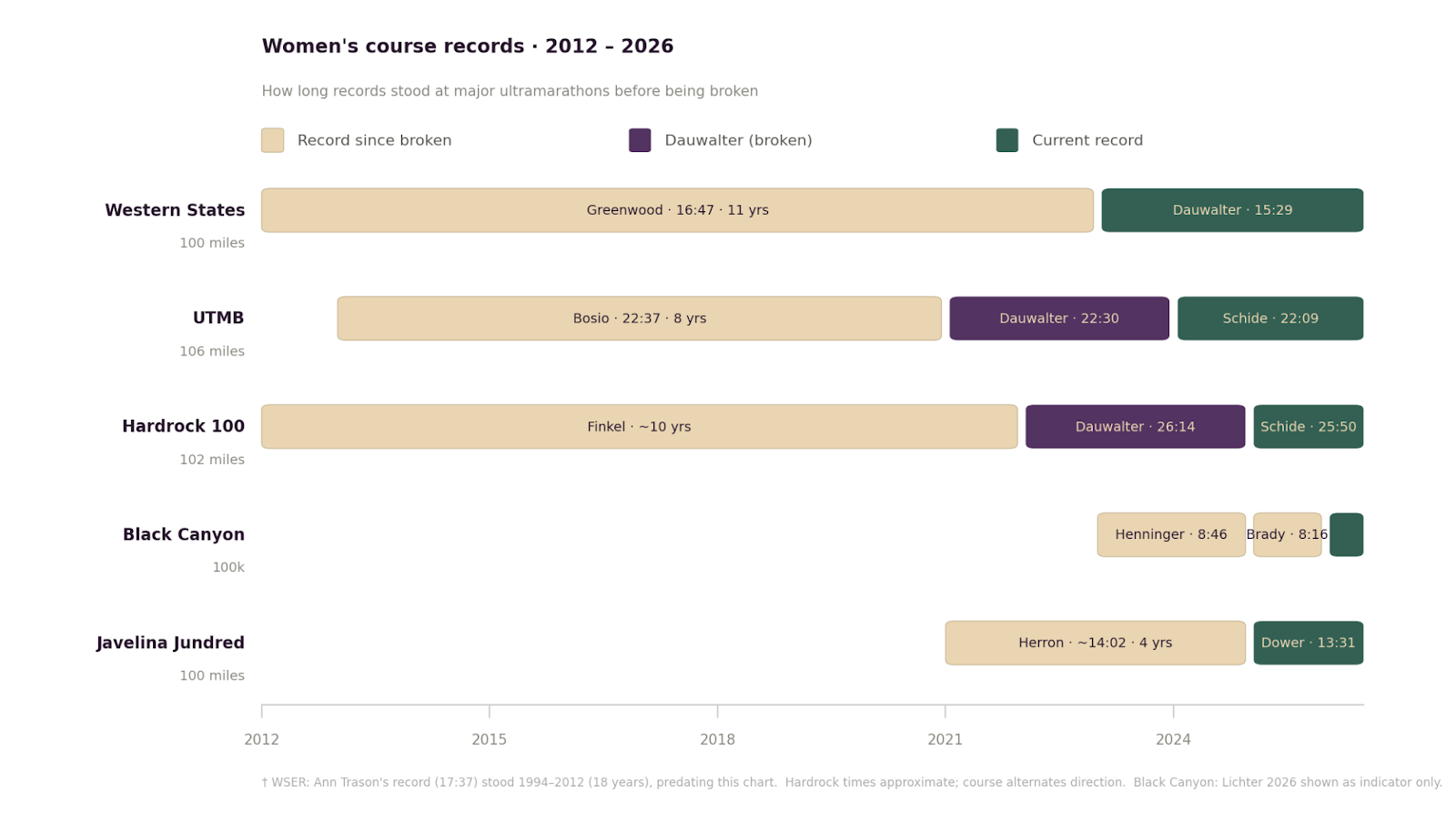
Ellie Greenwood’s 2012 Western States 100 course record stood for 11 years, seemingly untouchable, one of those benchmarks that accrues mythology with age. Then Courtney Dauwalter obliterated it by over an hour in the summer of 2023, on her way to completing the first-ever Western States–Hardrock–UTMB triple crown in a single season.
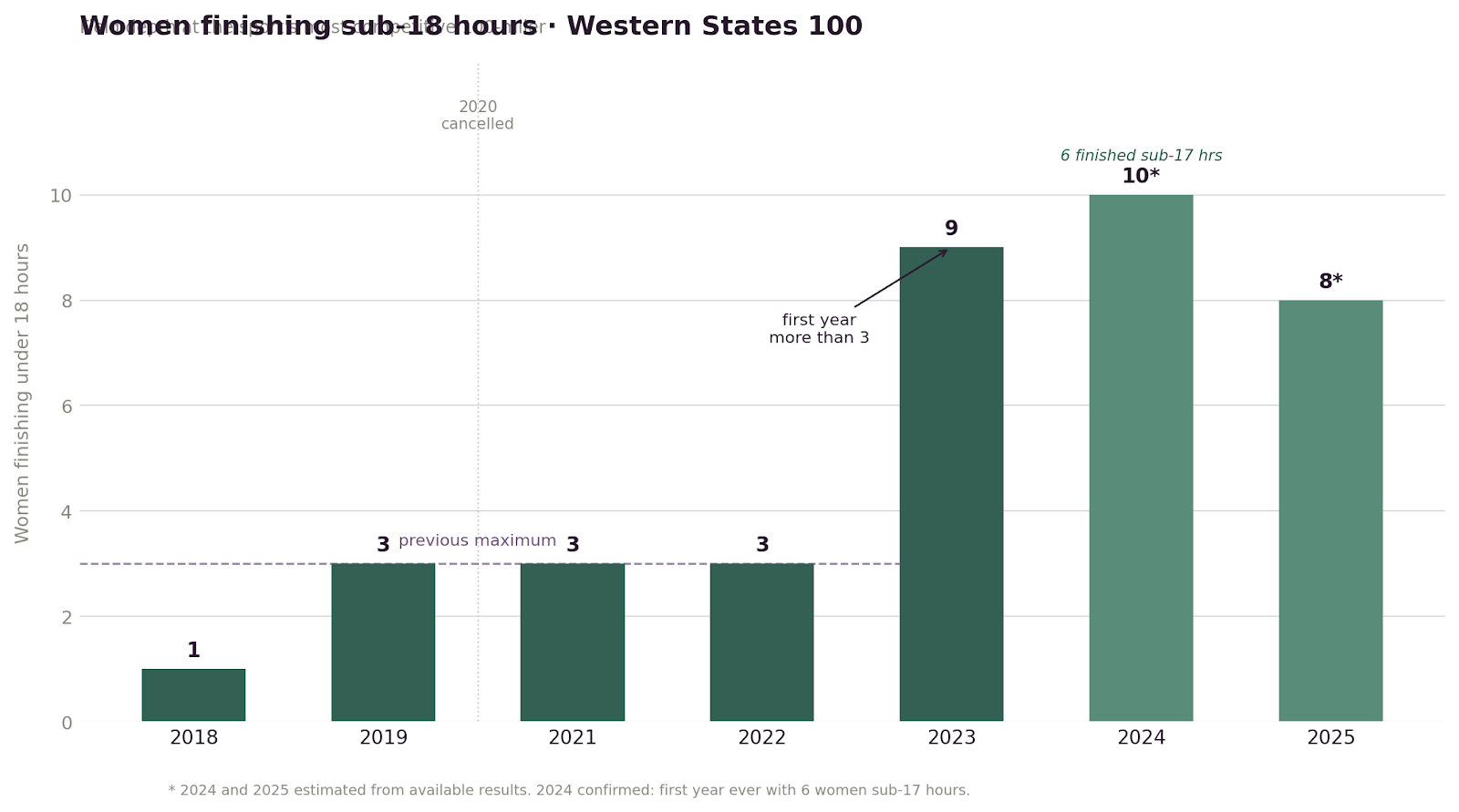
The following year, Katie Schide won UTMB in 22:09, becoming the first athlete to break a Dauwalter course record, and did it by 21 minutes. That same summer, the top six women at Western States all finished under 17 hours for the first time in race history. Tara Dower set the overall supported FKT on the Appalachian Trail in 2024, then last summer lowered the overall supported FKT on the Long Trail and broke the course record at the Javelina Jundred 100 miler in October.
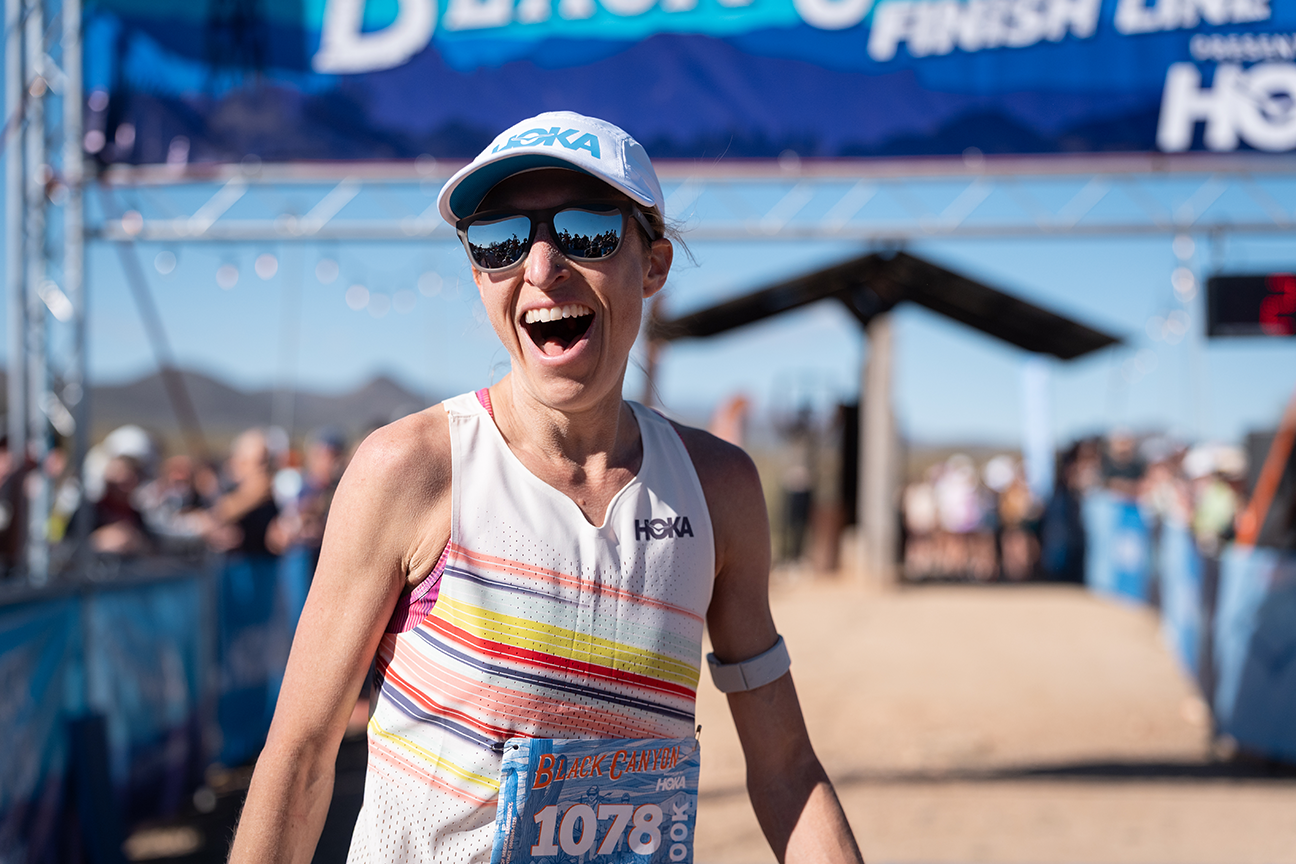
At February’s Black Canyon 100K, Jenn Lichter crossed the finish line in 7:57:05, a new course record, and the first sub-8-hour women’s finish in the race’s history. Behind her, Anne Flower ran 7:58. Dower finished third in 8:11. The previous course record was 8:16, meaning the podium finishers were under the previous CR.
Flower, meanwhile, broke Ann Trason’s 1994 Leadville 100 record last summer, then followed that up in November with a new 50-mile world record at the Tunnel Hill 50, the same day Courtney Olsen broken Trason’s 30-year-old 100K American record.
This is not one person redefining what’s possible or even a few. This is an entire field accelerating.
Why Are Women Getting So Much Faster?
Women’s participation in trail races climbed from 13 percent of the field in 1997 to 46 percent by 2022. In ultrarunning specifically, that number grew from 14 percent to 23 percent over the same period, a massive absolute expansion in a sport that went from roughly 8,400 unique North American finishers in 2000 to nearly 98,000 in 2024. And increasingly, those women are arriving with speed already built in, collegiate track and cross-country backgrounds that would have been rare at the front of an ultra field 15 years ago. More women in the sport means more women at every level, including the front.
Jason Koop, head of CTS Ultrarunning and coach to Schide and Abby Hall (who won WSER in 2025), points here first. “I don’t know if I could point to the biggest coaching shift,” he said, “but just getting more women into the sport has made the biggest difference because the overall level of competition gets better and more dense and that catalyzes the professionalization and the need for a really good team behind the athlete.”
A bigger, denser field created the conditions that made elite coaching both necessary and viable. Coaching is downstream of participation.
That doesn’t make the coaching less real. Schide came to Koop having already finished sixth at UTMB before working with Koop, meaning she wasn’t an undiscovered talent waiting for the right plan.
“The first year we started working with her, she won it,” Koop said. Then they built an integrated team around her with strength coaching, nutrition, all of it coordinated and working from the same information. Then she won Western States in 2024 and set the course record at UTMB eight weeks later. Then she went to Hardrock for the first time last year and broke that course record, too. According to Koop, the integrated model is one of the most meaningful developments in elite ultrarunning coaching.
“When you do it right, the results you get are fairly astounding because you hit things on all levels,” he said. It’s also expensive and logistically complicated, which is part of why it’s mostly stayed at the top end of the sport, for now.
Corrine Malcolm, an athlete, coach, writer and podcast host who works with athletes from back-of-pack to elite, says the shift is especially visible among American women. “It’s really the Americans that I think are finally maybe leaving their dirtbag ways and investing in what they’re doing and investing in trail and ultrarunning being a professional endeavor, and it’s taken a while for the women’s field to catch up to their male counterparts in that regard.”
Across coaches, the diagnosis of what’s wrong when a new elite athlete walks in is remarkably consistent. Athletes arrive with their intensity poorly distributed, pressing too hard on easy days, not hard enough on hard ones, accumulating fatigue they can neither see nor name. Scott Johnston, who coaches UTMB winner Ruth Croft through Evoke Endurance and co-wrote Training for the Uphill Athlete with Kilian Jornet, frames the whole project around fatigue resistance, the capacity to sustain a submaximal effort deep in a race, when accumulated damage has caused the muscles to make smaller and smaller demands on the cardiovascular system.
“If you look at most people’s races, you’ll see a gradual decline in heart rate,” he said, “and what that means is that towards the end of the race they can’t generate enough power.”
John Fitzgerald, CTS’s first ultrarunning coach, hired in 2016 and currently working with Lichter, has shifted his own practice in the same direction over the past decade.
“I’ve definitely moved away from an emphasis on intensity and more toward building chronic load over time,” he said. Athletes from track and cross country backgrounds arrive pressing too hard on recovery days, bleeding intensity across sessions where it doesn’t belong, chasing a feeling of working hard that, over a training block, quietly erodes the quality of the sessions that actually matter. His early conversations with new athletes are less about prescribing workouts than about reframing what productive training feels like.
Malcolm agrees: she’s not usually throwing out what an athlete is doing, she’s turning dials.
“Maybe they’re really impulsive and they have a hard time planning a year, and they’re racing race to race,” she said. “Maybe that needs to change. Or they don’t rest ever, and they train a ton, are we losing quality? Are they always tired?” According to Malcolm, the architecture isn’t always wrong. The calibration usually is.
There is no one, single methodological breakthrough. The ideas, as Malcolm says, aren’t new.
“Trail and ultrarunning is still professionalizing and getting better at taking existing knowledge and applying it,” she added. “Whether it’s heat training, gut tolerance training, or wearable technology, we’re adopting things that have been in the zeitgeist of many other endurance sports for a very long time.”
Johnston was running athletes through lactate protocols decades ago in cross-country skiing. The innovation is the application, and the willingness, increasingly, of elite ultrarunners to take it seriously.
Two other variables deserve a mention, even if their impact is harder to isolate. Shoe technology, specifically the adaptation of carbon-plated and maximal-cushion designs from road racing to trail, has reduced the muscular cost of covering rough ground, particularly on long descents. Additionally, the high-carbohydrate fueling strategies that became standard in elite cycling and road marathons have migrated into ultra racing, with athletes now routinely targeting intake levels that would have seemed implausible a decade ago. Johnston, who is currently collaborating on research with a nutritionist at the University of Leeds on exactly this question, is cautious about overclaiming.
“When a new idea comes along, often it’s assigned a great deal more importance than it needs or should have, and then the pendulum swings really far one way,” said Johnston. “It’s very individual, and we need to get to the more moderate middle. You just can’t take somebody who’s an outlier and assume that the rest of us are going to have the same results.”
Still, more and better fueling has made higher-quality training and racing sustainable in a way it simply wasn’t when bonking was half the game.
What Is Worth Measuring?
The question of what to actually measure is genuinely contested, and the coaches working at this level have had to build workarounds that road running and cycling don’t need. Standard training stress metrics assume flat ground and consistent pace. On a long climb, heart rate can be suppressed even as the muscular load is extreme; on a steep technical descent, the stress on the legs is enormous and pace data tells you almost nothing.
Johnston has spent years building his own elevation-adjusted correction factors, applying them consistently to heart rate TSS (Training Stress Score – a measurement of how difficult any given workout is) so that his CTL and ATL, which are measurements of chronic (CTL) and acute (ATL) training fatigue, numbers actually reflect what athletes are accumulating in the mountains. He’s currently working with TrainingPeaks on a more systematic grade-adjusted pace metric. Koop uses normalized graded pace as his primary quantitative lens, analyzing it interval-to-interval across a session to understand how an athlete is moving through terrain, not just how fast, critical for athletes racing on anything more technical than a gravel road.
What makes remote coaching workable at all is shared data infrastructure, session files, heart rate curves, the comment an athlete leaves on a workout at midnight her time. Johnston coaches Croft from across the world; without a platform like TrainingPeaks to hold the shared record of training, the coaching relationship as it actually functions would be difficult to sustain. Fitzgerald values the performance management chart largely as a narrative tool, a way of seeing where an athlete has been and how the load has built over months.
However, four coaches converge on the same hierarchy: subjective feel comes first. Koop reviews athlete feedback before he looks at any metric. Fitzgerald leads every decision with Rate of Perceived Exertion (RPE). Malcolm says the single most important variable is how a session felt.
“I would much rather you give me a small journal entry,” she said. “I love seeing the data in TrainingPeaks when I’m working with an athlete, but it almost means nothing if they can’t also comment on the workout and say, ‘This is how I felt, and this is why.’” The wearables earn their place when they confirm something the body is already reporting, or catch something the athlete is too stubborn to admit.
Coaching Elite Women
According to Malcolm, what differs in coaching elite women from coaching elite men isn’t the training architecture. It’s in everything surrounding it. Menstruation, the late luteal phase, the physiological and cultural dimensions of RED-S, women are more physiologically susceptible to the downstream consequences of energy deficits, and more culturally conditioned to dismiss the early signals.
“We have to be a little bit more on top of that,” she said. The research gap compounds it: sports science has historically been conducted on male subjects, and the best practices for accounting for hormonal variability in training and research are only now being established.
“We are still catching up when it comes to the biological side of things,” Malcolm said, “in part because they refused to study women for the longest time.”
There’s also the social weight of being a woman trying to make running a career, the scrutiny, the still-unequal investment, the particular kind of permission required to take it seriously.
“It’s way more socially acceptable for you to be spending time trying to be a professional runner if you’re a guy,” she said. That context shapes the coaching relationship even when it never comes up directly in a training log.
When it comes to what’s driving the field forward more broadly, Malcolm says it’s multifactorial, and any overly simplistic narratives that single out a particular variable are missing the bigger picture. For her, the biggest factors are better contracts, coaching stipends folded into sponsorship deals, physio and nutrition and sports psych becoming standard rather than exceptional, the basic material fact that some elite women can now train full-time.
“If you say it’s one thing, you’re likely missing confounding variables in the background,” she said. The overarching shift, in her read, is investment, in women’s sport broadly, trickling into trail and ultra specifically, and that investment is what creates conditions for everything else to work.
Koop says that paying too much attention to course records, or using them as the sole metric to assess the progress of the sport is an incomplete narrative. “Many people overestimate the jump in performances,” he said. When a marquee CR falls, the public treats the previous mark as though it had been the ceiling of human possibility.
According to Koop, field depth at most races outside of Western States and UTMB is still maturing; what looks like a performance explosion is, in many cases, an expansion of who’s showing up, how prepared they are, and how seriously the surrounding infrastructure has gotten. The ceiling hasn’t been obliterated. It’s been located.
The women’s field isn’t getting faster because someone invented a new training paradigm. It’s getting faster because more women are in the sport, taking it seriously, backed by real resources, working with coaches who apply principles that cycling and skiing understood decades ago, in a discipline that, not long ago, wore its lack of structure as a point of pride. Professionalization is real, the methodology matters, and the data infrastructure has made things possible that weren’t possible before. But underneath all of it is a simpler engine: a bigger, more competitive, better-supported field of women who showed up and decided to find out what they were capable of.
What Black Canyon looked like in February, Lichter a sub-8 hours, Flower right behind her, the entire podium under a record that had stood a year, is what that process looks like mid-stride.
There’s a lot more room up there.
About the Author
Zoë Rom is a journalist, writer, and podcast host based in Carbondale, Colorado. She’s the co-host and producer of The Trailhead Podcast and Your Diet Sucks Podcast, and author of the book “Becoming a Sustainable Runner” (2023).



RELATED: Running an Ultra Through the Night: Staying Awake, Alert, and Mostly Sane
RELATED: What to Expect For Your First Ultra
RELATED: Know Your Engine: The Ultrarunner’s Guide to Physiology Testing