In every ultramarathon, at least once, Anne Hinman has what she calls an “Oh, crap!” moment.
Ultrarunners will tell you dark moments are inevitable. We call it “bonking,” of course, and whether it’s mental or physical, overcoming it is the only way to finish a race long enough to make people question your sanity.
Hinman, a 30-year-old runner and coach from Bozeman, Montana, has taken up sharing experiences about her running and bonking. She goes by “Wyldtrailrunner” on TikTok, where she offers a wide rang of smart tips—sometimes serious, sometimes hilarious—about running ultras. She’s finished eight ultras so far, including last summer’s Bighorn Mountain Wild and Scenic 100-miler. Like most of us, Hinman says bonks hit her when she least expects them.
“I swear I know what it is, and I know you can prepare for it,” says Hinman, who grew up in California, played collegiate soccer for the University of Wyoming, and became immersed in trail running five years ago. “But I don’t know that I’m bonking until I’m bonking.”
There are ways to overcome bonking and, yes, even prevent one from happening, at least in theory. Here’s some advice from Hinman and two more experienced runners and coaches, John Krause and Kris King, on how to ensure a bonk doesn’t bounce you from your race.
RELATED: Find Your Next Trail or Ultra Race
Eat and Drink Often
When toddlers are fussy, they usually just need a snack. There are times in an ultra when many runners revert to toddler status. When you’re whiny, get a snack, drink some water, and you’ll probably be amazed at how much better you feel just a few minutes later.
As a general rule, ultrarunners should consume at least 200–400 calories per hour (including 50–90 grams of carbohydrates) to maintain energy levels and prevent extreme calorie deficits that can lead to bonking. Some runners consume even more, but you have to find out what works for you. You may also have to train your gut so it can handle that load.
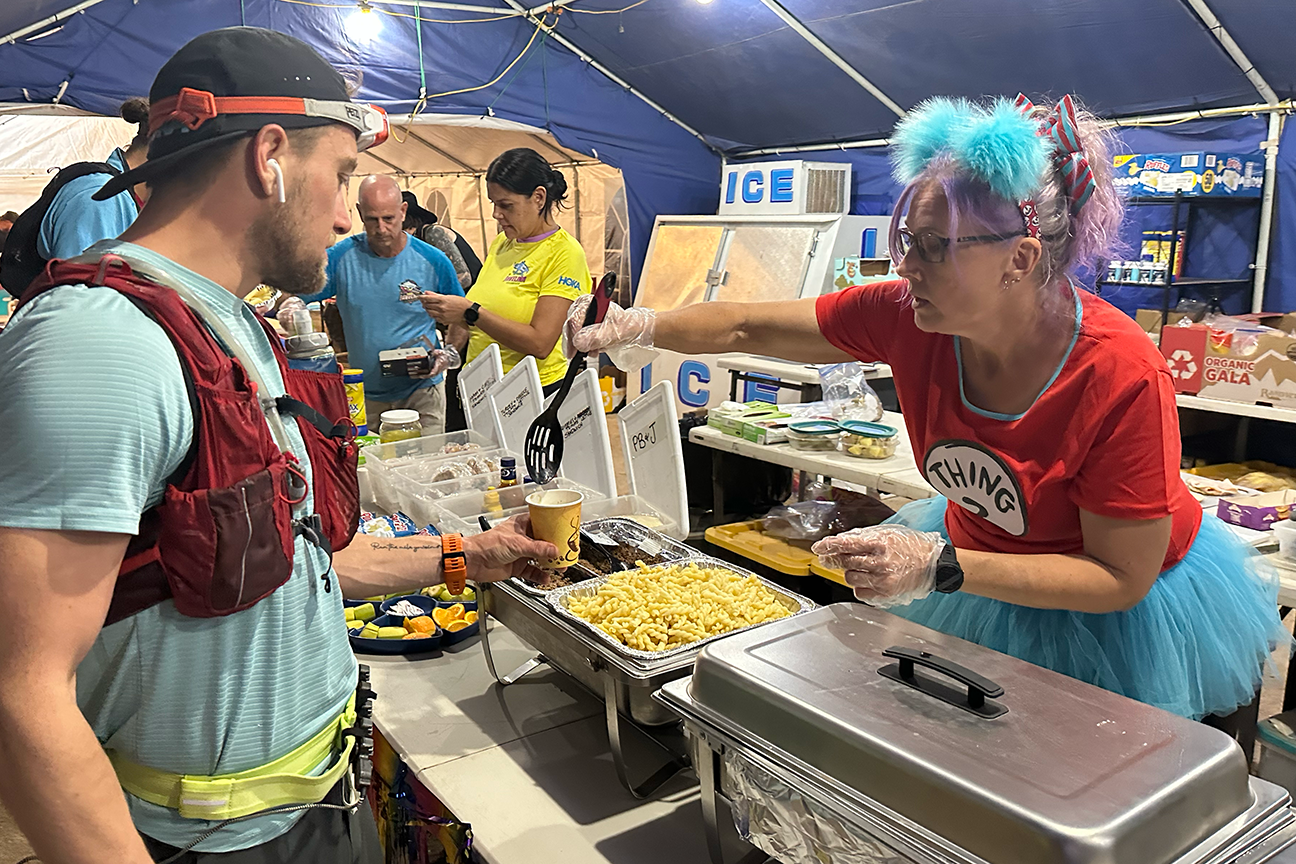
A smart fueling and hydration strategy helps prevent bonking, but those are never foolproof, especially if you’re not consistently following your plan.
“I’ll just despair and think ‘Why can’t I do this?’ Hinman says, “and I’ll remember, ‘Oh yeah, I need to eat something.’”
Experiment to Find What Works for You
Running an ultra creates a dozen problems, from blisters to stomach problems to chafing, and finishing a race means solving those issues before they turn into a DNF.
“Ultimately, ultras are just problem-solving things,” says Krause, a 50-year-old coach and runner who lives in northern Virginia and posted hundreds of videos on his YouTube channel and website, Motivation Theory Running.
If you can’t keep anything down, try using liquid calories or eating ginger or peppermint. If your feet hurt, try changing your socks or shoes. There’s always a way to soothe a problem, even if you can’t solve it.
Anticipating problems before they occur, such as lubing up potential hot spots, are also brilliant ways to prevent bonks.
Focus on Surviving
When you’re bonking, throw out your outcome goals, Krause says, even finishing, and focus on doing things that will give you a chance to make it to the next aid station. This includes eating and drinking, of course, but also doing something to get your mind right, such as listening to music.
“I think it’s more beneficial to do things that will make you successful,” he says. “Your goals should be process goals, not time.”
Slow Down
Going out too fast is probably the number-one reason runners bonk in any race, even an ultra, says King, 38, founder of the Beyond The Ultimate Global Race Series. This is even true of multi-day races like the kind King puts on.
“They often go hard that first day,” says King, who is based in Sheffield, England adjacent to Peak District National Park.. “Anything is recoverable, but it often takes a real reduction in your pace and effort.”
Even those trying to win or place in their age group need to pace themselves. King recalls a race where he led for a while but eventually finished fifth. So this tip, much like eating and drinking, is good to remember before the race and during a mid-race bonk.
“Had my tactics been better, I might have won,” King says.
Do Regular Assessments
Take stock of what’s really wrong before you drop. Are you really injured or do your legs just hurt? Are you really sick, or is this just a bad 15 minutes? Are you dying, or do you just feel like you are?
Do these assessments every 20 to 30 minutes until you feel better. Krause will even warn his crew that he will likely want to drop based on a problem that will often seem small in another hour.
This is also why Krause recommends having an experienced ultrarunner in your crew to talk things over and provide perspective that can often prevent DNFs.
“We make panicked decisions when things aren’t going well,” Krause says. “It’s good to have someone to think for you.”
Practice Sucking
Krause used to think it was a good idea to bonk during a training run to practice how to handle it. He would run fasted and even a little dehydrated just to practice getting through it.
“I don’t know if I would give myself the same advice now,” Krause says with a laugh. “I think it’s probably better to practice fueling. But I will say, once you’ve been through a bonk, you know the world’s not ending.”
If you don’t want to do that—and we don’t blame you if you don’t—you can prepare your mind for the tough times ahead even weeks ahead of the race. Hinman writes herself notes on post-it notes on her bathroom floor and writes messages to herself at work that the race will deliver dark moments and not to give in.
“Even in a 3-mile run, there’s a part that isn’t my friend,” Hinman says. “So I write it down throughout the year that I’m going to finish.”

Don’t Feed the Bad Thoughts
Keeping a positive mindset is crucial to getting through a mid-race bonk and reaching a finish line. Hinman tries to cut off dark moments before they start to grow. Don’t give into negativity that can grow out of fatigue, calorie deficiency, a painful body or just frustration.
“If I put any power toward it, I get really emotional,” she says. “I panic. I’ve learned to pull over to the side of the trail or else I’ll implode.”
Need help getting through the dark thoughts? Develop a positive mantra you can repeat to hold off those demons, or, do like Courtney Dauwalter has famously done and embrace the depths of the pain cave.
Break Your Race into Manageable Chunks
It’s easy to be overwhelmed by how much you have to do in a long ultra, especially if you’ve already ran so far. Try to break the race up and work on finishing that distance. That might mean running from aid station to aid station, or even just running to the next feature on the course, all the while continuing to refuel, rehydrate and remain positive.
“Sometimes it can be the next tree in front of you,” King says.
Remember your ‘Why’
You need to have an answer for that voice in your head questioning why you’re out there. What motivated you to run trails in the first place? Because you wanted to run beyond the marathon or wanted to try something that seemed at the edge of your physical, mental, and emotional limits? Or did you want a life-changing experience? When the going gets tough in an ultra—and it always does—you need to lean into what and who inspires you. That’s the reason you’re out there, and ultimately what will help you get through the hardest moments.
“The people who drop tend to lose their why,” King says. “They can’t answer the, ‘Why am I doing this?’”
Just Don’t Bonk
This would be the perfect solution, but unfortunately it doesn’t seem to be possible in an ultra.
“If someone finds a way to not bonk,” Hinman says, laughing, “let me know because I have yet to figure it out.”
RELATED: Find Your Next Trail or Ultra Race
Dan England is a UESCA-certified running coach specializing in ultramarathons and Colorado 14er climbs, focusing on endurance, trail running, and helping athletes finish long-distance races. Based in Greeley, Colorado, he offers personalized coaching for trail running, 50K-100-mile races, and peak climbing.
RELATED: 6 Smart Tips to Successfully Navigate Aid Stations
RELATED: Life is an Ultra: Amanda Basham has Learned How to Juggle a Busy Life
RELATED: How to Transition from Running Marathons to Trail Races
RELATED: 8 Mistakes New Trail Runners Make (and How to Avoid Them)
RELATED: What to Expect For Your First Ultra