Running more may make you faster at 100 miles. But it doesn’t guarantee that you will be permitted to express that fitness for all 100 of them.
Runners love data. Or, more accurately, we love what data promises: a little certainty in a sport built around uncertainty.
Building toward a race like UTMB, we log every mile, minute, and foot of vert, then wait for the kudos to roll in on Strava. I love a good training graph, and it is tempting to read its upward trend as a contract. Accumulate enough fitness, arrive in Chamonix, circle the mountain, and collect your finisher’s vest. Done. Time for a croissant?
But TrainingPeaks data reveals why cracks form in that all-too-tidy thesis.
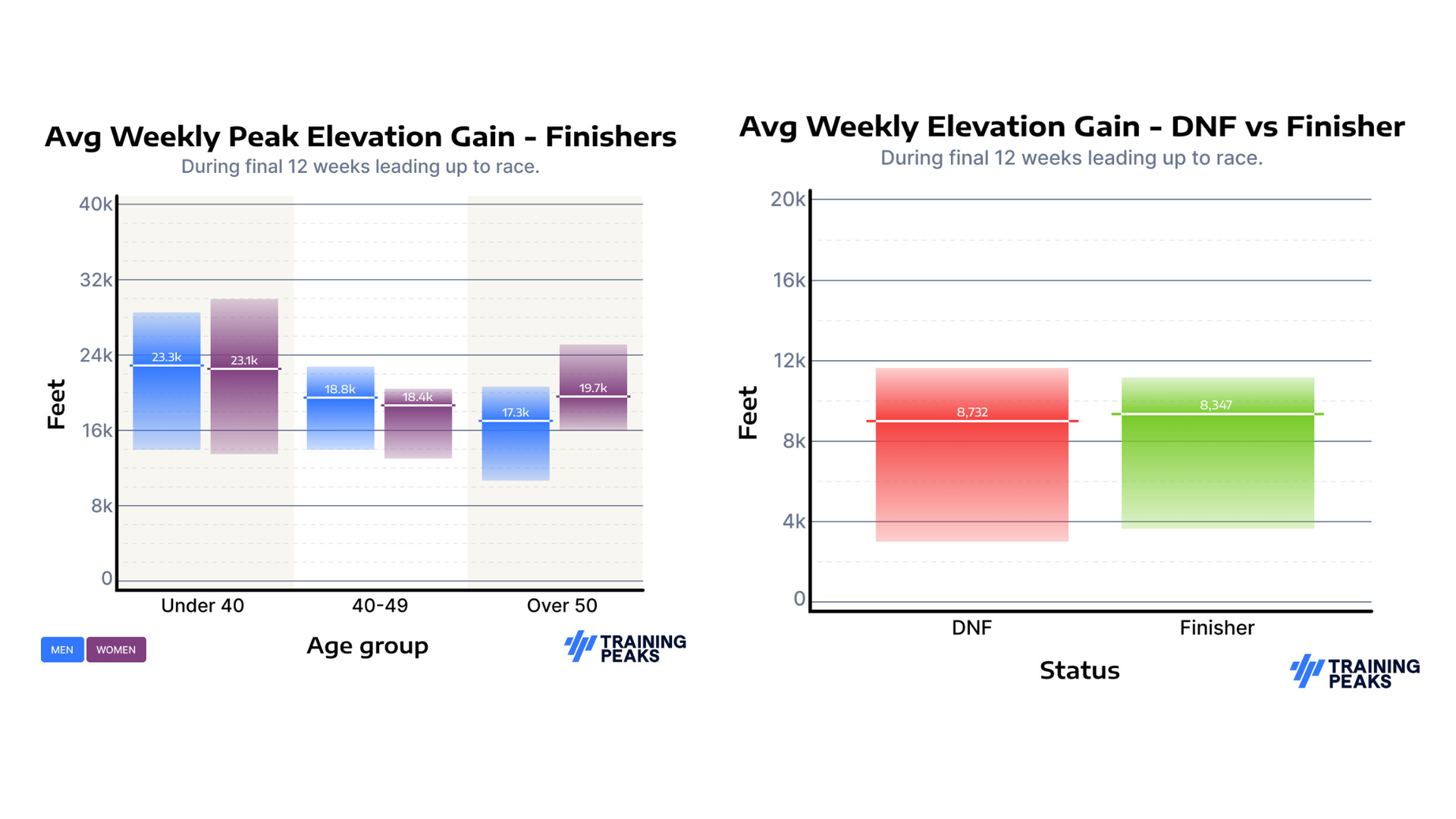
Finishers averaged 44 miles per week. Runners who DNFed averaged 42.5. The DNF group actually recorded slightly more climbing, 8,732 feet per week compared with 8,347, and a slightly longer longest run: 45.2 miles versus 44.5.
The most surprising difference between the groups, in other words, is how little difference there was.
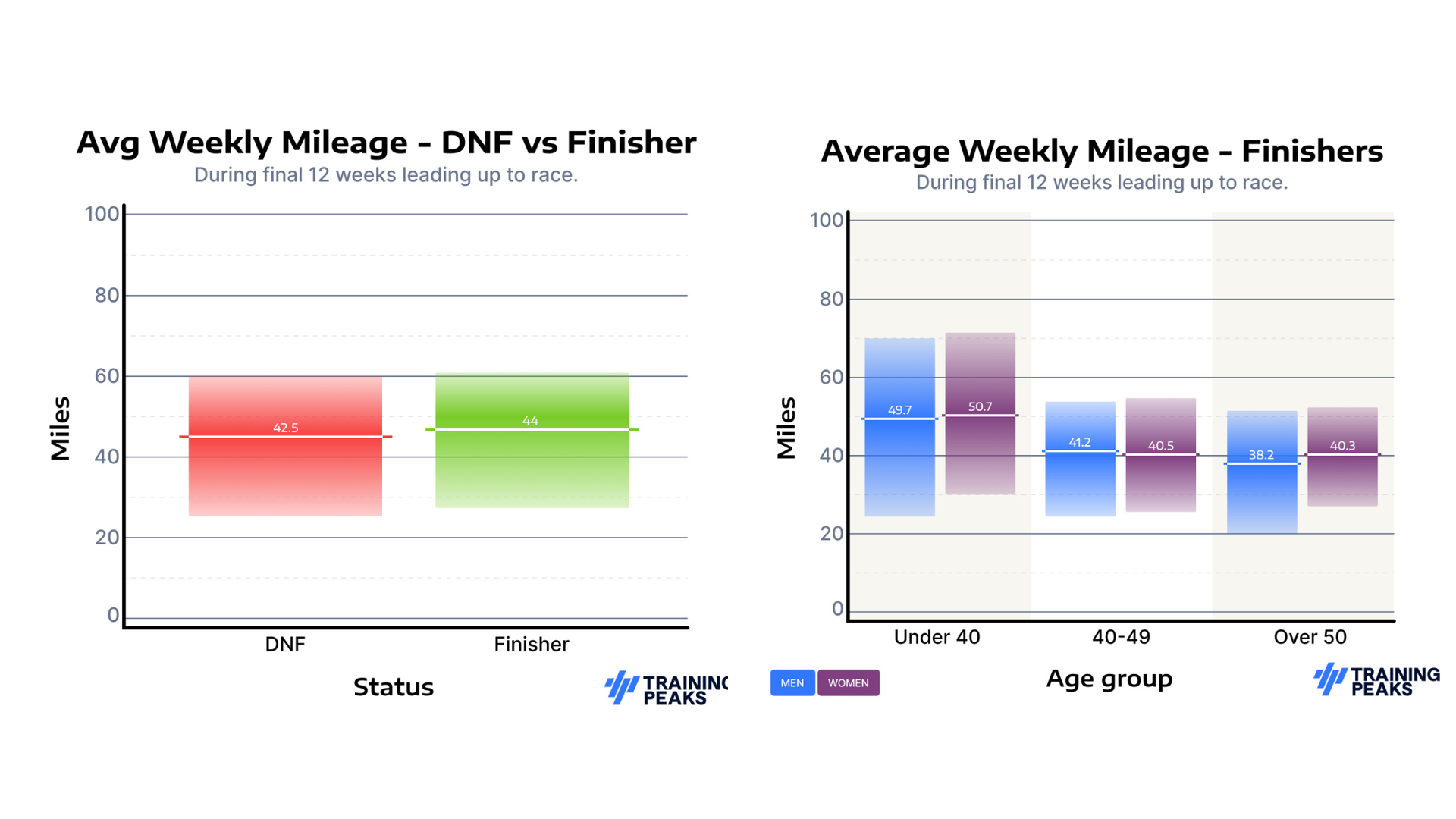
Those numbers are also, on their face, kind of bananas. UTMB covers roughly 106 miles and climbs 33,000 feet, yet the average finisher in this dataset recorded only 44 weekly miles during the final three months of preparation. Their longest run was roughly equivalent to their entire average weekly volume, a programming choice we do not have the digital ink to litigate here.
This is not evidence that 44 miles per week is the secret UTMB training plan. What it establishes is narrower, but still useful: within this dataset, there was no obvious mileage, climbing, or long-run threshold separating finishers from DNFs.
That matters because training prescriptions are often built around exactly those thresholds. Run X miles per week. Accumulate Y feet of vert. Complete a Z-mile long run. The TrainingPeaks data suggests that those numbers, considered alone, are not enough to classify someone as ready to finish UTMB.
That does not make the numbers meaningless. It means we need to ask a better question than, “How many miles do I need to run?” If more training generally improves ultramarathon performance, why doesn’t it more clearly determine who finishes?
What the UTMB Data Actually Establishes
The recorded training of UTMB finishers and DNFs looked remarkably similar during the final 12 weeks. That finding challenges the idea that finishing can be reduced to accumulating a particular number of miles, feet of climbing, or long-run miles.
It does not show that training volume is irrelevant, or that 42 miles works just as well as 82. The dataset includes only what athletes recorded and uploaded, and mileage cannot tell us how many hours those miles required, how technical they were, how much hiking went unrecorded, or what an athlete accumulated before the 12-week window. Averaging across taper weeks also pulls the totals down.

Most importantly, these are group averages. Without the sample size, distributions, and uncertainty around each estimate, we cannot tell whether the small differences are meaningful or simply noise. An average is a description of a group, not a tiny coach with a clipboard telling you what to do Tuesday morning.
But the data still tells us something important: three of the metrics runners use most often to judge ultramarathon readiness did not clearly distinguish the athletes who finished from those who did not.
That should not make us throw out our training logs. It should make us interpret them more intelligently.
Training Volume and Performance
Across several decades of research, higher training volume has been associated with better ultramarathon performance. This finding is so obvious that I resent having to type it. The sky is blue. Kilian is fast. Jacob Elordi can get it. Running more tends to make you better at running.
A 2015 study by Tanda and colleagues comparing marathon and 100-kilometer runners found that training volume and training pace predicted race pace. Volume appeared especially important for the 100-kilometer runners, while training pace carried more predictive weight for marathoners.
A study of 24-hour runners found that the longest training run and marathon personal best together explained a substantial portion of race performance. In the Western States and Vermont 100, higher training volume was associated with faster finish times.
Running more generally improves the aerobic capacity, musculoskeletal durability, economy, and fatigue resistance that allow athletes to move faster for longer. I know “training more makes you better trained” is not exactly the kind of scientific insight that could earn me a MacArthur, but it bears repeating because the UTMB data could easily be misread to suggest that volume does not matter.
There is, however, an important distinction between performing better and finishing.
Performance exists on a continuum. It can be measured through pace, placement, finish time, or the margin by which someone clears a cutoff. Finishing compresses an athlete’s entire race into a pass-fail result.
A runner who trained more may finish several hours faster. Another may be fit enough to contend for the podium, pursue an aggressive pace, blow up, and DNF. A less-trained runner may move conservatively, avoid major problems, and finish near the cutoff. In all three cases, training influenced performance; it just didn’t simply map neatly onto who finished. Ultrarunning is a wild sport, and it will always be hard to capture its nuances in tidy conclusions.
The TrainingPeaks data does not tell us how fast its finishers ran, how close they came to the cutoffs, or how far the DNFs traveled before withdrawing. Training volume could have had a meaningful relationship with performance within both groups, even though their average training did not clearly separate one group from the other.
That is the first practical takeaway: train to improve your performance margin, not merely to cross an imagined readiness threshold. More fitness can let you move faster at the same effort, create more room under the cutoffs, recover from mistakes, and spend less time exposed to heat, cold, darkness, and sleep deprivation. Fitness is the best insurance policy you can have against disaster.
Thriving Versus Surviving
A finish is a binary outcome imposed on a wildly continuous, variable-ridden event. A runner finishing UTMB in 21 hours and one finishing in 45 hours both receive a finish. Someone missing the final cutoff by 30 seconds and someone withdrawing at mile 12 both receive a DNF.
Training volume should logically have a clearer relationship with finish time, placement, speed, and cutoff margin. It may have a weaker relationship with finishing because DNFs arise from different processes.
There is no universal ranking of ultramarathon DNF causes. The findings vary with the race, conditions, population, and how researchers collect and categorize the answers.

In a 2025 study of the Val d’Aran by UTMB and Canfranc-Canfranc, weather was cited in 37.7 percent of withdrawals, followed by in-race injury at 23.2 percent, fatigue at 20.3 percent, and performance-related reasons at 17.4 percent. Illness, GI distress, pre-race injury, and the squirrely category of “mental factors” also appeared. Athletes could report more than one reason, and the results were specific to those events and conditions.
In the Western States and Vermont study, nausea and vomiting were the most common primary reason for withdrawal, at 23 percent. Lower training volume was not associated with greater nausea or vomiting. Another study of 100-mile runners found that 35.6 percent of nonfinishers said GI symptoms contributed to their withdrawal.
A DNF is best understood not as a single outcome with a single cause, but as the endpoint of many possible causal pathways. Hot weather worsens nausea. Nausea makes it difficult to fuel. Inadequate fueling deepens fatigue. Fatigue slows the pace, and a slower pace eventually produces a missed cutoff. A runner could reasonably point to any link in that chain as the reason for their DNF.
These pathways also interact with training differently. Better preparation can reduce muscular fatigue, cutoff risk, some injuries, fueling failures, and pacing errors. It cannot eliminate acute illness, traumatic injury, extreme weather, severe GI distress, equipment failure, or a goal that proves unrealistic once the race begins.
Fitness shapes how fast an athlete can cover the course. Whether they cover all of it depends on what happens when that fitness collides with pacing, nutrition, weather, injury, expectations, and whether or not they put the correct amount of lube in their drop bag. If fitness equaled performance, we could all just submit our training logs and then get bottomless mimosas instead of slogging around the backcountry. Fortunately (or unfortunately), performance hinges on how well you’re actually able to execute on your fitness.
If there were a magic number of miles or step-ups that appeased the ultra gods and guaranteed safe passage on a raft of peacefully digested gels over trails mysteriously cleared of rocks, we would all be doing it.
So, What Can We Say About 100-Mile Training?
We cannot extract a universal minimum mileage from these numbers. The snarky coach inside me also wants to suggest that if the idea of doing the “minimum” required for UTMB is especially appealing, perhaps we should talk about that nice 50K down the road.
But there are useful training conclusions here.
1. Build the most volume you can consistently absorb, not the most you can briefly survive.
Training volume contributes meaningfully to ultramarathon performance. Within an athlete’s capacity to recover, more running generally builds more fitness and fatigue resistance.
The important phrase is “within an athlete’s capacity to recover.”
Volume that repeatedly causes injury, illness, sleep disruption, or incomplete recovery is not productive merely because it makes the graph bigger. The goal is not to win Tuesday’s Strava leaderboard and spend Wednesday limping downstairs. The actual goal is to stack enough manageable weeks that training becomes an adaptation rather than a recurring medical event.
Consistency across months and years matters more than one heroic peak week. One good 12-week block cannot completely reverse years spent playing GTA on the couch. Likewise, one imperfect block because of injury, life stress, or an urgent need to conduct a comprehensive review of Jacob Elordi’s filmography does not erase years of durable, consistent training.
2. “Mileage” is not King
Forty-four miles on flat roads and 44 miles on technical Alpine trails are not equivalent stimuli. One might take six hours. The other might take 12 and leave your quads locked in a committed BDSM relationship with gravity.
For mountain ultras, evaluate training across several axes:
- Total duration
- Frequency and consistency
- Vertical gain and loss
- Terrain and technicality
- Intensity distribution
- Long-run duration
- Hiking volume
- Downhill loading
- Strength and cross-training
- Recovery between key sessions
Mileage is just one variable that shouldn’t bury all others. When translating research or someone else’s training log into your own plan, ask what workload those miles actually represent. Prescribing 70 miles because a successful athlete ran 70 miles ignores how fast they ran, where they ran, how long it took, and whether they have been tolerating that volume since you were still playing GTA.
3. Use long runs as rehearsals, not proof of worthiness.
The association between long-run distance and 24-hour performance gives us a reason to include substantial long efforts. It does not prove that every longer long run is better, or that UTMB runners should copy the 44- to 45-mile longest-run average in this dataset.
Long runs build durability and create opportunities to practice pacing, hiking, fueling, hydration, equipment, foot care, and decision-making under fatigue. But their benefits have to be weighed against their risks and recovery cost. A monster long run that leaves you unable to legally operate a motor vehicle home from the trailhead, descend stairs without assistance, or train again before the next season of Love Island might not be worth it.
4. Train for the course, not just the distance.
UTMB is not a track race with better scenery. It requires prolonged climbing, technical descending, hiking efficiency, nighttime movement, equipment management, and adaptation to rapidly changing mountain conditions.
Someone can accumulate an impressive mileage total while remaining extremely poorly prepared for the specific demands of the race. A complete UTMB plan should include sustained climbing, downhill conditioning, technical terrain, efficient hiking, and practice carrying and using required gear.
5. Train the systems that allow you to express your fitness.
If GI distress is a common contributor to withdrawal, fueling should be trained rather than left as a race-day administrative task. Practice the quantities, products, timing, and textures you intend to use. Learn what remains edible and appealing when you are hot, cold, nauseated, or deeply mad at any maltodextrin-containing substance that tastes vaguely citrusy.
6. Build margin rather than chasing certainty.
No training can guarantee a specific outcome. But it sure does help.
Better fitness increases your margin under the cutoffs. Better pacing protects that fitness. Better fueling helps sustain it. Course-specific training makes it more usable. Equipment and weather preparation reduce avoidable failures. Experience and practice help you distinguish a temporary low point from an existential crisis that ends your day.
The TrainingPeaks data does not tell us that finishers and DNFs were equally prepared. It tells us that preparation cannot be adequately described by three averages, and that training volume is better understood as a contributor to performance than as a ticket guaranteeing completion.
Run enough to build the engine. Train specifically enough that the engine works on the course. Practice fueling, pacing, and problem-solving so you can keep it running.
Train accordingly. Go get that vest.
RELATED: Everything You Need to Know About UTMB 2026
- The Art of Taking Running Seriously, But Not Too Seriously

- 3 Things I Learned from Coming Back From Injury

- Closing the Gap Between Ability and Ambition

- What Causes a UTMB DNF? Here’s What The Data Says

- Nine Lives: My Life in 9 Transcendent Pairs of Shoes

- Race Through the Night: Stay Awake, Alert + Mostly Sane