
I spent most of my 20s and 30s underfueling for just about every workout, long run and trail running race I ran while simultaneously trying every strange fueling strategy under the sun—from cheese cubes to brown-sugar filled sweet potatoes to running fasted with gimmicky fat-metabolism enhancing gel-like products—you name it.
I also refused to drink anything but plain water and Coke while overdosing on salt tablets. I was a hot mess. And it showed.
While I did have some success, it was almost in spite of myself. I bonked in more races than I didn’t, I missed start lines and DNFed, I struggled through the long, back-to-back training runs I needed to complete for 100-mile trail races and, perhaps most surprisingly, I had more difficulty bouncing back from hard efforts than I do now.
And I’m almost 40.
Yep, you read that correctly. Because now I eat when I run. And I eat a lot.
And you know what? I’m not only feeling better during training runs and races, but it’s translating to the rest of my life, too. I feel healthier, happier and stronger than I ever have.
But underfueling is still normalized. Even for ultrarunners. And the impacts are significant.
David Roche, a coach who works with some of the best ultrarunners in the world, sums this up perfectly: “It breaks my heart to see ultrarunners applying outdated advice from times when we didn’t have the data we do now on health and performance,” he says. “The performance benefits are obvious based on any competitive endurance event in the world. But it’s the health benefits that are most striking for long-term happiness.”
There’s research to back this up. Chronic underfueling pushes the body into energy-conservation mode, which causes a down-regulation in hormones and other important systems.
RELATED: Find Your Next Trail Running or Ultra Race
Eating more works, but at first it might feel weird (even wrong)
We have this idea that sugar is the bad guy. And that if we load up on simple, easy-to-digest carbs we’re going to gain weight. If you’re thinking that, you’re not alone, I once thought it, too. But not anymore.
Fueling for a hard ultra endurance effort is a far cry from sitting on the couch eating a bag full of Snickers (even if that’s exactly the thing you’re eating on the run).

Dr. Marc Bubbs, a performance nutritionist based in Toronto and London who works with elite endurance athletes and professional sports teams, says, “I like to talk about slow carbs and fast carbs. Slow carbs are what you want to have when you’re sitting at home on your couch and throughout regular life, while fast carbs are what you want to have when you’re running.”
Why?
When you’re in the middle of an endurance event—like a mountainous ultra—your muscles are burning fuel fast. And the faster and longer you run, the more your body needs glycogen, which you get from simple sugars.
You can fuel on fat at lower-intensity efforts, but it’s just slower and harder to access. And, your body has a limited store of glycogen, so after about 60 to 90 minutes of moderate to hard effort, you need to be adding fuel to the tank to prevent the dreaded bonk. That’s why carbs during long efforts are non-negotiables.
Bubbs, who is the author of Peak: The New Science of Athletic Performance That Is Revolutionizing Sports, also compares energy to a fire: think of simple carbs as kindling for hard efforts and fat as low-burning logs that keep the first going and going and going.
And this is where it gets interesting.
Ultra fueling isn’t one-size-fits-all
There are clear benefits to fueling more, but there’s not a single “more” amount that works for everyone. While some runners, like Roche, have openly espoused consuming 120 to 150 grams of carbs per hour, we know that about 90 grams of carbs per hour is generally the upper limit of what the body can absorb, though more recent research has suggested that some athletes can go up to 120 grams per hour, plus.
“Still, not everyone benefits from taking in 90 grams per hour,” says Stephanie Howe, a sports nutritionist with a PhD in exercise physiology and an ultrarunner. “Fewer people than we think actually need that amount.” Instead, she says most runners fall somewhere closer to 40 to 60 grams of carbohydrates per hour, especially if they’re newer to fueling.
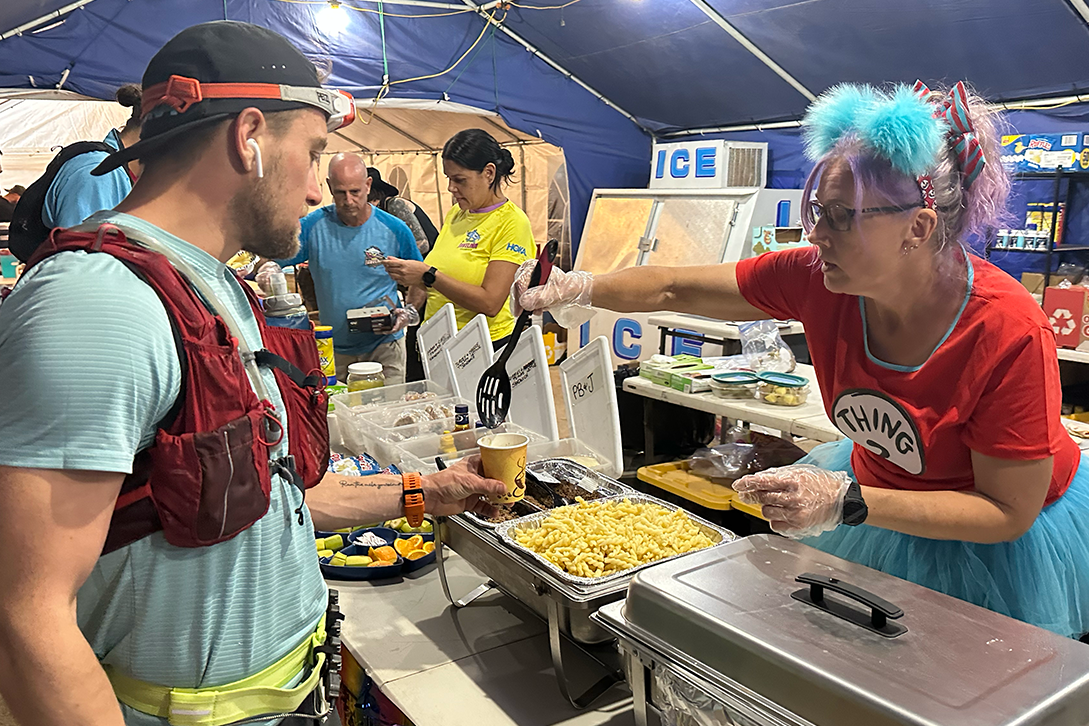
While that number might sound confusing since high-carb fueling strategies seem to be a hot topic these days, according to Howe, pushing carb intake too high too fast can backfire.
“Higher carb intake comes with an increased risk of GI upset,” she says. And that’s where your personal experience matters. What’s more, research shows that between 40 and 90 grams of carbs per hour works regardless of body weight and size.
“If someone is new to ultrarunning, I would try and get to that 60 grams per hour,” says Howe. But it comes with a caveat, as she says if someone is very new to fueling, starting at 30 grams per hour and working to increase that to 60 over a few sessions is likely the best route. “You usually know if it feels like too much.” How? Your GI system will send a clear signal that it’s not happy.
At the same time, the bigger issue for many ultrarunners isn’t overfueling, it’s not eating enough. Since you can only absorb so much carbohydrate each hour, you’re likely still in a net deficit even if you’re eating more than you have before. And in a race, when you’re running harder than most training runs, that gap can easily widen.
This is something I can attest to. It’s easy to underfuel simply because you don’t want to eat while you run, either because you’re suffering from race-induced stubbornness or a fatigue-induced mental haze And this often gets harder the farther into a long effort you are.
“Our bodies weren’t really designed to eat while we run,” says Bubbs. “Which is why it can feel uncomfortable at first, even if it ultimately helps performance.”
… But you can train your gut
That’s right, just like a muscle, your gut is trainable, too. And if your goal is performance, there actually is a pretty strong case for higher carb fueling.
If you’re training for a hard, fast race, working to increase the carbs your body can take on during the event is beneficial. “You will want to train with high carbs in your key long sessions in order to prepare your gut for the most intake during your race,” says Howe.
And Roche stresses the importance of loading up the longer and harder you’re pushing. “Generally, athletes are burning more than they can consume on runs, so overdoing it is rarely a concern on longer or harder efforts,” he says. “On short or easy efforts under an hour, there’s no need to think about it too much.”
But not thinking about it does not mean skipping fueling altogether.
Fasted training is never the answer
Despite fasted training being touted as a beneficial way to improve fat metabolism, Howe does not recommend it, and most sport nutritionists in the endurance sports world don’t either.
“There’s limited research on its effectiveness and plenty of evidence pointing to negative outcomes,” she says.
Even on early morning runs when you’re just going for an easy hour or less, she suggests having something small—half a banana, a handful of cereal, a piece of toast—to support better training quality and recovery.
This is especially important for women. Howe says that female athletes tend to have a lower tolerance for underfueling.
My experience supports this, too. And it’s actually something Roche drilled into me a few years ago.
I used to do almost every run fasted. Not intentionally, I just didn’t want to eat before I ran. It took a couple of weeks of feeling uncomfortable during my runs after eating breakfast, but eventually my gut adapted and my runs started feeling better.
But it still takes effort. I rarely want to eat in the morning before an early run or workout, but now I have enough reps to know I just need to force it down.
“You don’t want fueling to limit output,” Bubbs says.
My System: Fuel Mixup!
I take the kitchen sink approach because you never know what you’re going to want to eat once you’re halfway through a long run or race. And, like Bubbs says, I don’t want my fuel—or lack thereof—to limit me anymore).
I take high-carb and electrolyte rich drink mixes, gels, fig bars, candy, peanut butter dates, chews … basically anything that sounds even remotely appealing at the moment and whatever I can carry in my trail running vest And I aim for a mix of gels, drink and chewable foods so I can get carbs down regardless of how I feel
Drinking calories is such an easy way to ensure you’re getting enough carbs when you don’t want to eat. The Ashley of today is flabbergasted that the Ashley of 10 years ago would only consume plain water and Coke.
For me, having options makes it easier to keep eating long past when I really want to be eating.
“Mixing fuel sources is amazing! Whatever is most fun and sustainable is ideal,” says Roche.
If there’s one thing to take away from everything you’ve just read, it’s this: fueling for ultras isn’t about doing something perfectly, it’s about finding what works for you over and over, and getting in enough calories to not only run strong, but recover well and have all the energy you need for the rest of your life.
RELATED: Find Your Next Trail Running or Ultra Race
About the Author
Contributing writer Ashley Arnold is an ultrarunner and the former director of brand at Fleet Feet who lives in Missoula, Montana, with her husband and two young children. Aside from writing about running and motherhood and how to train for trail races, she tells stories through video, words and photos, and is most at home running trails, adventuring in wild places with her family and sipping coffee while eating cake.
-

-

Fueling for Ultras Can Be Complicated: Here’s How I Finally Made it Work for Me
-

-

Running Through Motherhood: 10 Tips for Managing Trail Running as a Mom
-

Life is an Ultra: Amanda Basham has Learned How to Juggle a Busy Life
-

RELATED: Smart Tips to Recover From a Mid-Race Bonk
RELATED: How to Train for Trail Races Without Access to Trails
RELATED: Running Through Motherhood: 10 Tips for Managing Trail Running as a Mom