Here is why volume is the most crucial component to training for your next ultra.
Most ultrarunners aren’t afraid of running more. They’re afraid of getting slow.
That fear shows up in a specific way. Athletes tell me they don’t feel sharp without the faster stuff, that cutting max effort intervals and threshold work makes them feel like they’re losing fitness, so they keep some version of it in the plan year-round, sometimes right into the taper. It makes sense if you’re training for a race that actually rewards top-end speed. It doesn’t make sense for a long ultra, and understanding why gets at something most athletes have backwards about what fitness even means for this distance.
There’s a second fear sitting underneath the first one. Even athletes who accept the case for volume worry that committing to it will break them down, so they reach for something that feels safer—a hard session that feels finite and controlled instead of a long run that feels open-ended and uncertain. Those fears come from this root mistake: confusing how fit you feel in the moment relative to one goal with how fit you actually are for the distance in front of you. You may lack fitness for a 5K personal record, but at the same time, you can be fit enough to set a personal record in 100 miles.
I want to make the case that volume, done correctly, is the most specific and most important thing you can do to prepare for an ultra. Not maximized volume, but optimized. Those are different ideas, and confusing them is what actually gets people hurt.

Why Volume Is the Specific Tool
Every running event sits somewhere on a spectrum between aerobic and anaerobic energy production. Aerobic means your body is using oxygen to produce energy, which is what fuels lower-intensity, longer-duration efforts. Anaerobic means energy production without oxygen, and it can only be sustained briefly before it shuts you down.
Even a race as short as the 1500 meters, essentially a mile, leans aerobic more than most people assume. Spencer and Gastin’s 2001 study in Medicine & Science in Sports & Exercise measured energy system contribution across 200m, 400m, 800m, and 1500m using the accumulated oxygen deficit method in highly trained track athletes. The aerobic contribution came out to 29 percent at 200m, 43 percent at 400m, 66 percent at 800m, and 84 percent at 1500m. The aerobic system dominates well before you get anywhere close to ultra distance, and it only becomes more dominant as distance extends further.
If aerobic capacity is already the deciding factor for a miler, ask what that means for an event that takes fifteen, twenty, or thirty times as long to finish. Ultrarunning sits about as far into the aerobic end of that spectrum as endurance sport gets. It’s the reason low-intensity aerobic training isn’t just helpful for us — it’s the single most specific thing we can train, because specificity means matching your training to your event’s actual demands, and our event’s demand, more than anything else, is aerobic and mechanical durability sustained over a very long time.
What’s Actually Happening in Your Body
The physiology here is worth understanding, because it explains both why volume works and why there’s no shortcut around it.
Sustained low-intensity effort creates a specific kind of metabolic stress inside muscle fibers — changes in calcium flux and energy status that activate a signaling pathway built around a protein called AMPK. AMPK upregulates a master regulator called PGC-1alpha, often described as the master switch for mitochondrial biogenesis, because it signals your cells to build more mitochondria and improve the function of the ones you already have. Since mitochondria are where aerobic energy production happens, more of them, functioning better, means more capacity to produce energy aerobically at any given effort.
Alongside that, you get angiogenesis, the growth of new capillaries around trained muscle fibers, driven by a separate signal called VEGF, which improves blood flow and oxygen delivery to working muscle. You also get enzymatic changes that improve fat oxidation specifically, increasing your capacity to burn fat at a given pace and spare glycogen. In an event that might last fifteen to thirty hours, glycogen sparing isn’t a marginal benefit.
These adaptations don’t all happen on the same timeline, which matters for how you should think about your training calendar. Some enzymatic changes and early aerobic adaptations show up within a couple of weeks of consistent training. Mitochondrial density and capillary growth, the more structural changes, take longer, generally somewhere in the range of six to eight weeks or more of consistent exposure before you see meaningful change. You cannot compress structural adaptation into a few big weeks right before your race.
Where Intensity Still Fits
None of the adaptations above come from a hard interval session. That’s worth being precise about, because intensity still has a role in this picture.
High-intensity work activates a different signaling environment, centered more on calcium release patterns and pathways distinct from the AMPK route, and it drives different adaptations: improvements in VO2max, in your ability to buffer and clear metabolic byproducts, in top-end power. Those are real qualities, and I’m not arguing for zero intensity.
What matters is sequencing and proportion. Early in a training year, when you’re further from race day, VO2max and threshold work earn a real place in the plan, and volume comes down to accommodate the recovery cost of that intensity. As you move into the eight to twelve weeks before an ultra, the plan should narrow toward what the event actually demands.
That doesn’t mean zero intensity. It means the intensity that remains shifts toward steady-state work, the effort you’ll actually spend meaningful time at on race day, rather than short, sharp efforts that don’t reflect what you’re racing. This isn’t an argument against intensity; it’s an argument against letting it compete with volume for the recovery capacity you need to actually absorb your aerobic work.

Answering the Fear of Feeling Slow
Now back to that first fear.
The athlete who feels slower without speed work isn’t imagining it. Their intervals probably do feel less snappy, their legs probably do feel a step slower on a given day. But that feeling is measuring the wrong thing for this event. Top-end aerobic velocity answers the question of how fast you can run right now, briefly, before you have to stop. A hundred miler asks a different question entirely: how much of your aerobic capacity can you actually sustain, at that intensity, for fifteen to thirty hours, without your body falling apart.
That number—how much of your ceiling you can use, rather than how high the ceiling sits—is governed by where your aerobic threshold falls relative to your capacity. Volume is what shifts that threshold higher as a percentage of what you’re capable of.
An athlete with a well-built aerobic engine can sustain a much larger share of their capacity for hours on end. An athlete who kept chasing speed work instead might have a higher ceiling in isolation, but a smaller percentage of it they can actually use before they fall apart. If that ceiling matters over a mile, it damn sure matters over a hundred of them.
Building Volume Without Breaking Down
The second fear, that committing to volume means overtraining, has a real answer too, and it comes down to training architecture rather than just piling on hours.
Density is one piece. Instead of a single long run and hoping for the best, stack long runs closer together, sometimes back to back, to accumulate fatigue in a way that’s closer to what an ultra actually demands. That’s followed by structured recovery: short, capped recovery runs at truly easy effort, sixty minutes or less, placed between harder days specifically to help the body absorb the work.
Intensity control is the other piece. When easy runs stay genuinely easy, you free up recovery capacity to handle more total volume. Most athletes who believe they’re overtraining on volume are actually undertrained in intensity control. Their easy days aren’t actually easy, so there’s nothing left to absorb the dose they’re trying to build. Put density and intensity control together, and you can train more, safely, than most athletes believe is possible. That’s not a loophole; it’s just correct architecture.
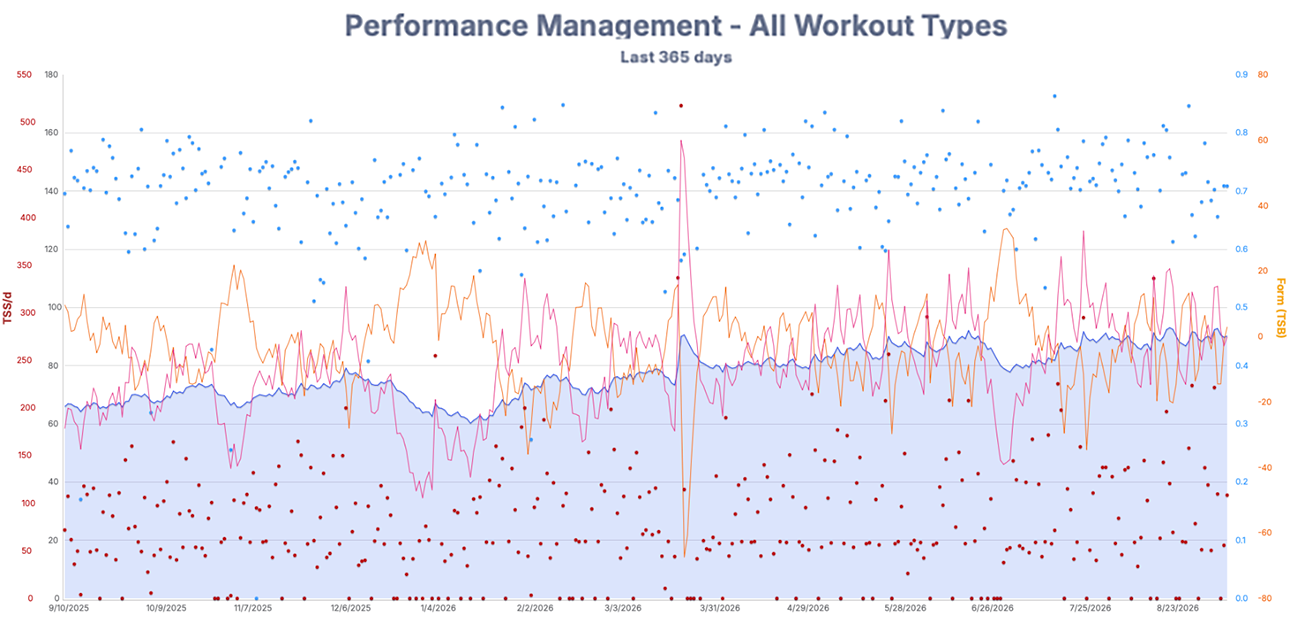
I track this for my athletes with a combination of tools, none of which work in isolation. Chronic training load in TrainingPeaks is the closest single number we have to accumulated aerobic fitness over time, which I watch alongside the full performance management chart to see whether fatigue is being managed or allowed to run away.
Beyond the numbers, I look at how an individual athlete is performing inside their long runs specifically—pace-to-heart-rate decoupling to see whether they’re holding aerobic efficiency deep into a long effort, intensity factor and normalized graded pace to see what an effort actually cost relative to what it should have. None of that replaces asking the athlete how they feel day to day. The data tells you what happened; the athlete tells you what it cost them to get there.
A Note on Time
Not everyone has the time to build volume this way. If you’re genuinely time-crunched—structurally, not just busy this month—leaning more toward intensity is a legitimate adjustment, because it’s a more time-efficient way to build general fitness. But be clear about what that is. It’s optimized for your constraints; it is not the same as optimized. An athlete with more time or a longer training history has access to a ceiling a time-crunched approach can’t reach, and that’s the physiology, not a judgment on the athlete.
Volume, done correctly, isn’t reckless, and it isn’t something to be afraid of. It’s math and physiology. Consistent aerobic stress, correctly dosed and correctly recovered from, produces the specific adaptations an ultra demands, and there’s no shortcut that replicates it. We say this often internally at CTS: volume is our biggest hammer. Not because it’s complicated, but because nothing else in the toolbox produces this much specific adaptation for this event.
I go deeper on the physiology and the training architecture behind this in a video on the CTS YouTube channel, if you want to see it laid out in full.
Major in the basics, minor in the marginal gains. Optimize your volume, control your intensity, build the architecture that lets you absorb the work, and stop being afraid of the one thing that’s actually going to get you to the finish line strong.
RELATED: Are You Getting Fitter? How to Know for Sure
RELATED: When A Race Crumbles: What’s Solvable and What Isn’t?
- Why Volume is King When Training for Ultras

- How to Keep Running Ultras as You Age

- What Causes a UTMB DNF? Here’s What The Data Says

- You should run a dress rehearsal at a small race before your big goal race

- What Should I Eat? Solving Real-Life Fueling Dilemmas
- Becoming an Ultrarunner: How to Survive (and Thrive) in Your First 50K Race