
There’s more data for runners than ever. Here’s what’s useful, and how to actually use it in training.
There’s never been more data available to runners. On any given day, you can check your training readiness, body battery, sleep score, HRV, RHR, VO2 max, CTL, or UTMB. (Wait, no, that one’s a race!)
But the great data glut hasn’t exactly produced a generation of immaculately trained, perfectly recovered athletes. It’s produced a generation of slightly neurotic over-optimizers. The quest to appease our metric overlords leads us astray, chasing marginal gains while the real, meaty advantages sit there untouched.
I’m not anti-data. I’m anti-whatever it is we’re currently doing with it, which mostly involves misreading numbers we don’t understand and then adjusting our training self-worth accordingly.
So how does a runner navigate all this? What’s worth watching, what’s worth a shrug, and what’s worth ignoring entirely?
Data for Runners and Goodhart’s Law
In 1975, British economist Charles Goodhart noticed something inconvenient. The Bank of England, like a lot of institutions, liked to steer the economy by watching reliable statistical relationships: when this number moves, that one follows. The trouble showed up the moment they tried to use one of those relationships as a lever.
The UK had noticed that a particular measure of the money supply tracked closely with inflation, so they started managing that money-supply number directly, expecting inflation to fall in line. It didn’t. The tidy historical relationship fell apart, because the link between the two had never been a law of nature. It only held as long as the money-supply figure was a neutral bystander, and the instant it became the thing everyone was aiming for, banks and markets adjusted their behavior around it, and the correlation that made it useful disintegrated.
So, the measurement was only trustworthy as long as nobody was aiming at it. Anthropologist Marilyn Strathern later compressed the whole idea into the line now known as Goodhart’s Law: “When a measure becomes a target, it ceases to be a good measure.”
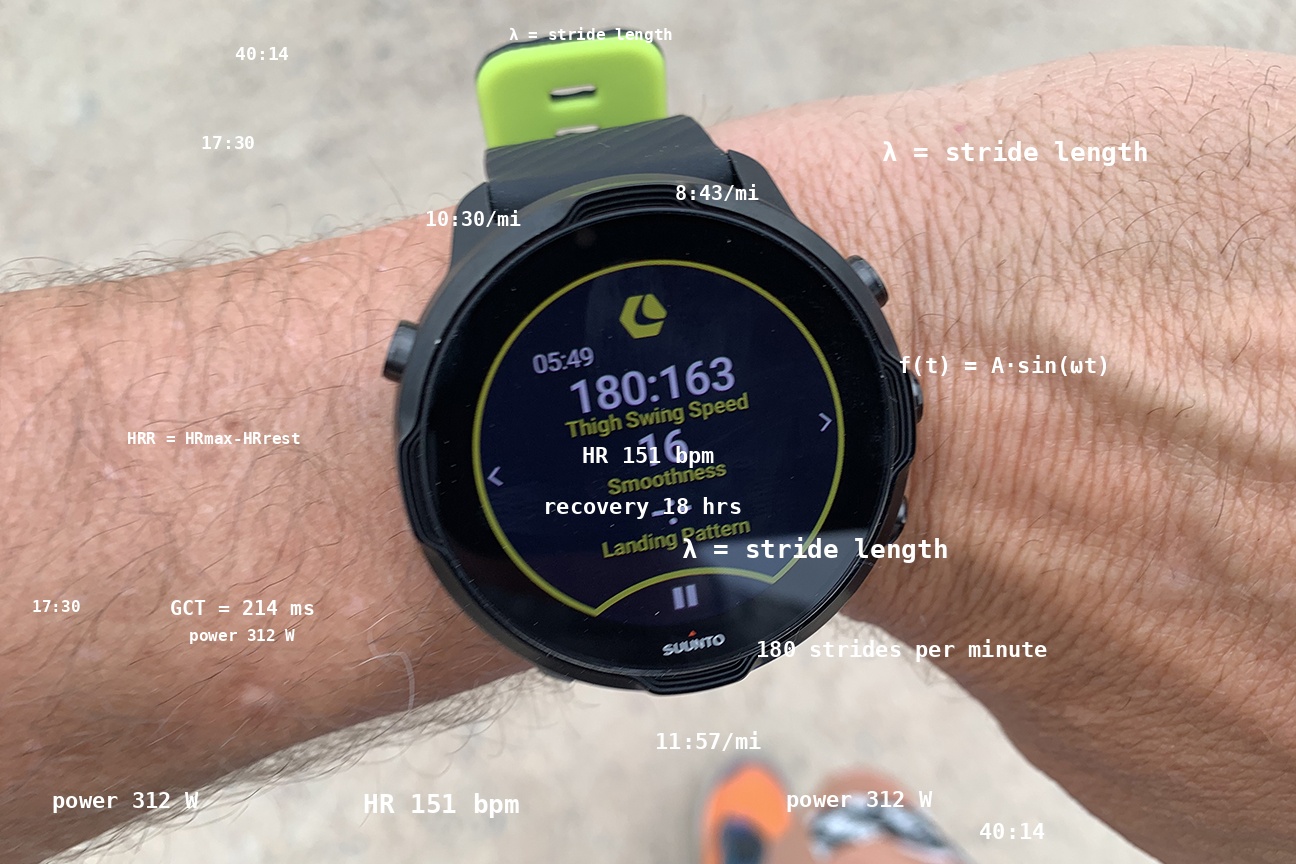
A proxy, like inflation numbers, or something closer to home, like a recovery score, weekly mileage, or HRV, only correlates with the real thing under natural conditions. The moment you start optimizing for the proxy, you break that correlation, because optimization means finding the cheapest way to move the number. And the cheapest way to move the number almost never involves the actual thing the number was supposed to measure.
For instance, in the 1980s, marathon coach Jack Daniels observed and counted the cadence of Olympic runners, and found that most ran at around 180 steps per minute or higher. It was an accurate description of what fast runners happened to do. But, then it mutated into a prescription for amateurs and runners of all abilities started to arbitrarily strive for a 180 cadence, even though the optimal cadence for any given runner will vary wildly dependent on their height, weight, leg length, speed, and any number of other variables.
So 180 steps a minute wasn’t a cheat-code to faster running, it was a descriptor of how faster running happens. The minute you optimize for the descriptor instead of the cause, you’re optimizing for the wrong thing.
To steelman the other side: data has a place in every training plan. Good coaches and athletes keep an eye on the numbers, alongside the qualitative feedback. The difference is that they treat any single number as one input among many, triangulated against training history, life stress, and everything else going on in a given week.
So no, I’m not suggesting you chuck your watch and heart-rate monitor into the nearest lake, or stage a data-driven Bonfire of the Vanities. Almost none of it is useless. It’s only use-ful once you know how to use it, and understand what it can, and can’t tell you.
Find Your Next Race: UltraSignup’s New Event Finder
Measurements are Proxys
We like data because it feels definitive. Objective. Science-y. Like a hermetically sealed chamber, pointing neutrally at a clean sequence of cause and effect. This is, of course, not remotely how training data works. Best case, the numbers assemble into a kind of information mosaic, something you read alongside your own feel and intuition to make a more informed guess about what’s happening under the hood. Worst case, it’s poorly written AI fan fic about the most boring topic on earth: your heartbeat.
Here’s the thing almost every metric has in common: it’s a proxy for stress and adaptation. Training works because stress plus rest equals adaptation. You stress the system, you recover, and the body rebuilds slightly better than before: more mitochondria, more capillaries, more blood plasma, a stronger heart, tendons and bones that tolerate more load.
Almost none of it is directly observable without near-daily muscle biopsies, blood draws, and lab VO2 max tests, a lifestyle available only to lab rats and Bryan Johnson, and appealing to neither. So, we reach for proxies instead. HRV, resting heart rate, pace-at-effort: information slivers we hope offer a glimpse of how the energy systems and the gristle are handling the load. But, the measurement never actually touches the thing it’s measuring. There’s a saying that dates back to the early days of computer programming: garbage in, garbage out, or GIGO.
Every metric has a chain, and some chains are longer and less reliable than others.
Mileage has a very short chain, because GPS watches are pretty dang good at measuring distance. The trouble is that distance is a lousy corollary for actual stimulus. Running 10 miles on a pleasant day at sea level is a different animal than 10 hot-as-hell miles on tired legs, which is a different animal again than 10miles over a 14er.
Same number on the watch, three completely different amounts of stress, and therefore three completely different adaptations. Your body has no idea what a mile is. What it understands is how hard you pushed, for how long, under what conditions. Once you realize that’s the thing we’re actually trying to account for in training, mileage and pace start to look like the blunt instruments they are.
Then there’s the distinct shame of your watch pinging to inform you your VO2 max has changed. Climbing, dropping, whatever. Don’t neg me, Garmin. The premise here is meh at best. Pace-to-heart-rate ratio does track aerobic fitness, but with enough caveats to sink it: pace is a garbage input the second you run anything but flat at sea level, and heart rate is its own unreliable narrator, shoved around by heat, hydration, medication, and mood.
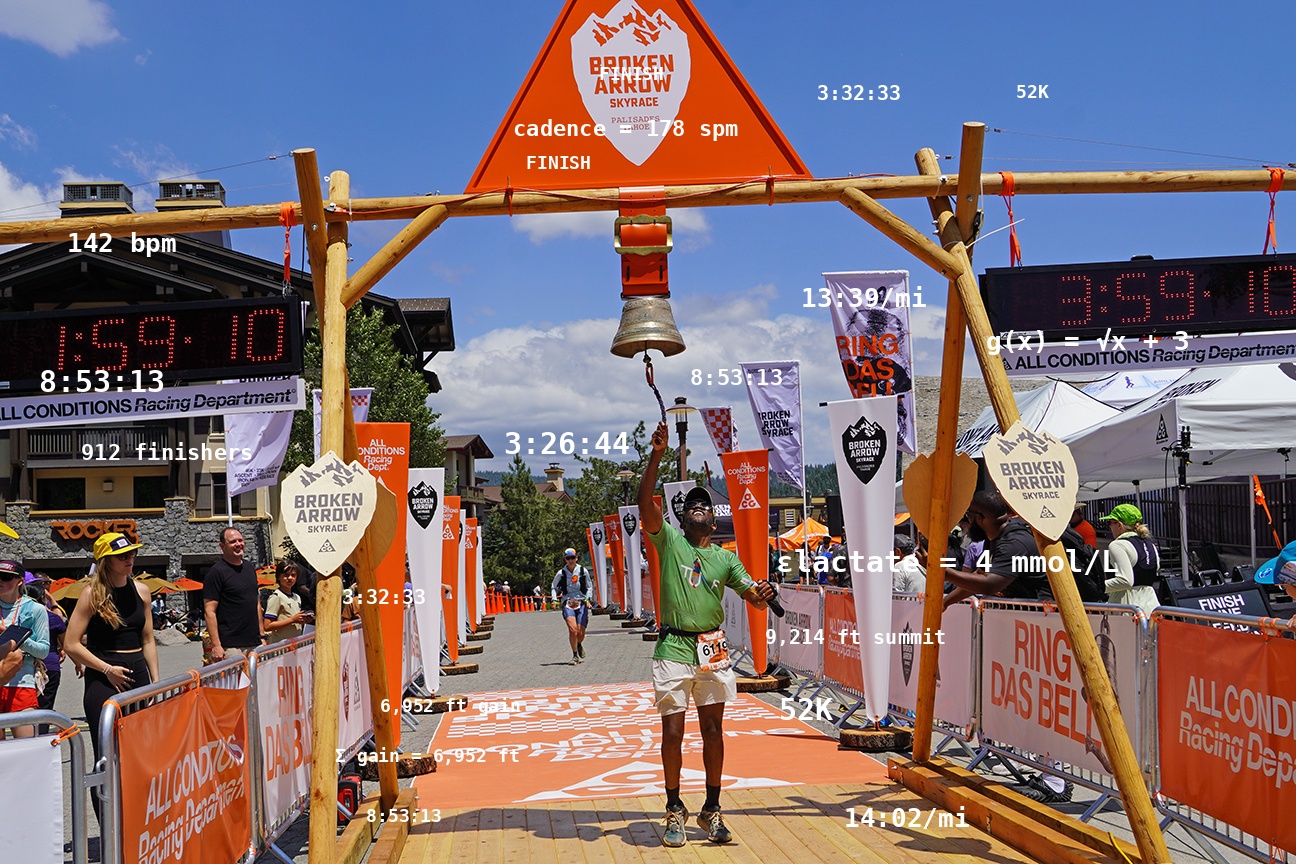
The whole thing breaks at the algorithm link, because it assumes pace reflects effort (not always true) and that your HR isn’t elevated because you had an extra cup of coffee, doubled up on your anxiety meds, are somewhere in a menstrual cycle, or are simply alive in 2026. Disregard accordingly.
And to be clear, most watches don’t include VO2 max estimates, sleep scores, and readiness ratings because those features are accurate. They aren’t. Watches can’t actually measure the things that determine any of it, so they guess. The features are there because they’re a fantastic marketing tool, a daily little reason to look at the screen.
Sleep tracking dangles off the end of an even more tenuous chain. Sleep stages are defined by brain waves, and if you’re anything like me, your grey matter lives a good distance from your wrist. So the watch guesses from movement and heart rate, buries the guess inside a composite score, and hands you a daisy chain of mushy metrics dressed up as an objective measurement.
There’s research suggesting that people given a lousy sleep score will rate their sleep as worse than it actually was, which means we’ve found a way to outsource our own interoception to a $200 wrist computer instead of, you know, asking ourselves how we feel. Chasing a perfect sleep score is rarely a matter of triumphing over your own brain waves. It’s mostly a matter of fiddling with your watch.
In all of these cases, non-lab VO2 max, sleep score, readiness, recovery, any “score” at all, the raw data gets decoupled from the thing it claims to measure, run through an occasionally dubious black-box algorithm, blended into a number, and spat back out by your spiteful little wearable as a rating or a colored dot.
Your actual physiology has passed through so many hands by then that what you’re holding is closer to a corporate opinion about a statistical summary of an optical estimate of an electrical proxy that, at its very best, only loosely correlates with the thing you actually cared about.
RELATED: How to Train for Western States, According to Data and Coaches
Watch, Shrug, Ignore
Trust in a number should scale with its proximity to an actual performance. Because a proxy can be moved at any link in the chain, but performance only improves if you move Link 1, we’re back to Goodhart’s Law. Avoid hills to protect your pace and you’re fiddling with Link 4 while sabotaging the actual fitness you’d build at Link 1. Gaming a metric means moving downstream links. Training well means moving the upstream one. The longer the chain, the more downstream links there are to accidentally optimize, which is why composite scores with their mile-long chains are the most gameable, and the least worth gaming.
Pay attention to the things with no chain: races, time trials, a repeatable benchmark effort (with a grain of salt for environmental conditions, fatigue, or just having an off day). These aren’t proxies for fitness. They’re samples of it, directly observable, no inferential steps. They feel intentionally boring. They’re free. Anticlimactic, unglamorous, and they don’t require forking over the down payment on a Lake Tahoe condo to a coach, an app, or a giant corporation.
Then there’s the stuff I’d file under “shrug”—the directional physiology. Resting HR trend, HRV trend, sleep duration (raw hours, not a made-up score with an accompanying emoji). These chains have only a couple of links. Think of them like a weather report. It can help you decide whether to pack a jacket, but you probably shouldn’t let it run your life. It informs your decision; it doesn’t replace it. And the operative word is trend. One outlying data point isn’t particularly useful. A deviation from a baseline you’ve tracked for months, even years, is another matter. Adjust accordingly.
Here’s what I’d straight-up ignore: anything with “score” in the name. Your body is not a game of foosball. You are a human being, a wonderful, beautiful feat of biology capable of turning pizza into ultramarathons, and your ancestors did not climb out of the primordial goo so you could let a watch boss you around. Readiness score, body battery, watch VO2 max, any purported measurement of “fitness”, because these have the longest chains, the most proprietary math, and the least accountability.
Most of them exist not because they’re some breakthrough capable of blessing us mortals with information once reserved for elite athletes and pharaohs (probably), but because apps need a reason to be opened daily, and a score that changes frequently is a pretty good one. It’s less about informing you as an athlete than retaining you as a customer.
So, use the data. Track your training. But, don’t get the measurement confused with the thing itself, and end up optimizing for the wrong thing.
RELATED: Are You Getting Fitter? How to Know for Sure
RELATED: Data for Runners: You Might Be Running Your Easy Miles Too Fast
- The art of accepting abject failure and moving on

- The Art of Taking Running Seriously, But Not Too Seriously

- 3 Things I Learned from Coming Back From Injury

- Closing the Gap Between Ability and Ambition

- What Causes a UTMB DNF? Here’s What The Data Says

- Nine Lives: My Life in 9 Transcendent Pairs of Shoes