
If you’ve been anywhere near running social media in the last few months, you’ve probably seen the headlines.
“Marathon Runners Face Unexpected Colon Cancer Risk.”
“Could Extreme Running Fuel Colon Cancer?”
They traveled fast, landed hard, and left a lot of runners with a version of the same question: should I be worried?
The short answer is: not in the way the headlines suggested. But there are things worth paying attention to, and they’re not quite what went viral.
Last summer, oncologist Dr. Timothy Cannon presented findings at the American Society of Clinical Oncology Annual Meeting. Over about a year, he’d seen multiple ultramarathoners under 40 show up at his cancer center with advanced-stage colorectal cancer; however, they were otherwise healthy people, with no genetic predispositions, and no inflammatory bowel disease.
That cluster caught his attention, so he designed a study: 100 long-distance runners between 35 and 50 (with at least five marathons or two ultras under their belts), all given colonoscopies. Fifteen percent had advanced adenomas, or precancerous growths, compared to roughly 4.5 to 6 percent in the general population that age. About 41 percent had at least one polyp of any kind.
That’s a notable signal. Cannon himself described the results as “hypothesis-generating more than proving anything.” But that nuance didn’t exactly make it into the TikToks and headlines.
What kind of evidence is this, really?
What Cannon presented was a conference abstract, preliminary findings accepted for presentation, not a peer-reviewed publication. The full statistical analysis, complete methodology, and limitations haven’t been independently scrutinized yet. There was also no control group: the 15 percent advanced adenoma rate is being compared against historical baseline rates from different studies, different populations, different time periods. The sample was small (100 people, mostly from Washington, D.C.) and potential confounders, like diet, alcohol, stress, family history, weren’t fully controlled for.
None of that makes the finding meaningless. It makes it early. And “here’s a signal worth investigating” is genuinely different from “running causes cancer”, a distinction that tends to evaporate somewhere between the press release and your feed.
Dr. David Lieberman, a gastroenterologist and one of the leading researchers in colorectal cancer screening, put it plainly: “The report was a small study, presented as an abstract, not a complete manuscript. It would be too small to be actionable.” He added that colon cancer risk is increasing in younger individuals, “irrespective of running”, a crucial piece of context.
The Masking Problem
Here’s where the conversation got less sophisticated than it should have. Most viral coverage treated this as a straightforward causal story: extreme running damages the gut, damaged gut produces polyps, polyps become cancer. But the researchers themselves pointed toward a more complicated and arguably more important possibility.
Runners, especially ultrarunners, normalize GI distress. Cramping, urgency, blood in the stool: these symptoms have casual nicknames, they’re bonded over at aid stations, and according to Cannon, they’re sometimes dismissed by physicians as a normal byproduct of the stress of training and racing. The problem is that those are also the most common early warning signs of colorectal cancer. Symptoms that would prompt a referral for a non-runner can get a shrug for someone logging 70-mile weeks.
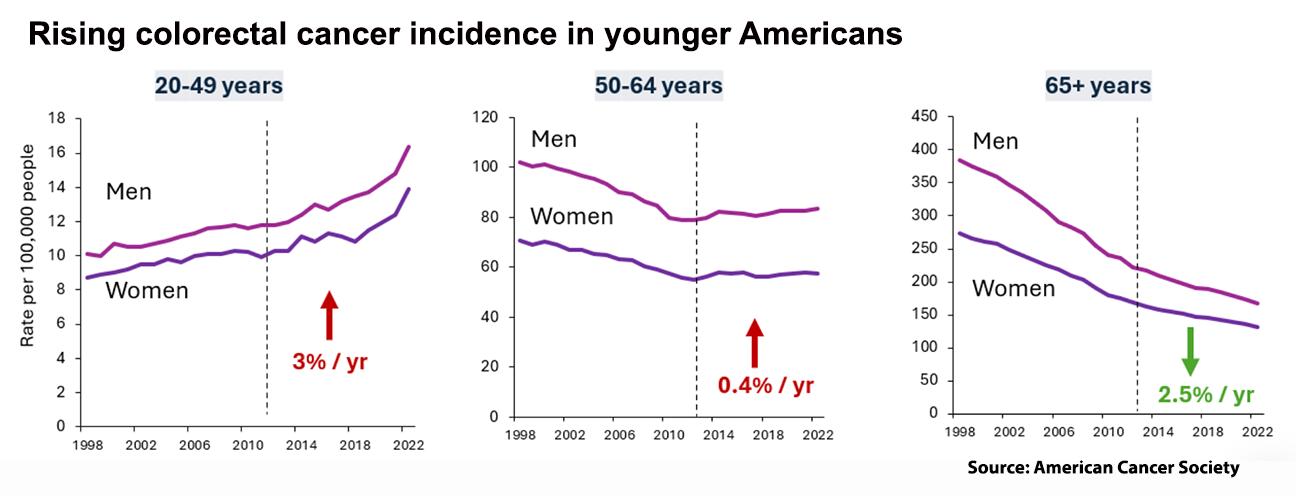
Meanwhile, early-onset colorectal cancer is rising across the board, in everyone under 50, regardless of fitness level. Incidence has been increasing by about 2 percent per year, and colorectal cancer recently became the leading cause of cancer death in Americans under 50. Researchers believe this is a generational effect driven by a combination of factors: ultra-processed food, microbiome disruption, and environmental exposures.
But it’s not specifically a running problem.
Put those two things together, a population-wide increase in colorectal cancer in younger adults, plus a community that’s uniquely conditioned to dismiss the early symptoms, and you don’t necessarily need running to be causing the problem. It might be obscuring it.
On the theoretical question of whether extreme running could carry some risk, Lieberman acknowledged there are plausible mechanisms worth exploring: “If ultrarunning is causing ongoing, chronic inflammation of the colon, it could be a risk factor. We do know that inflammation can possibly increase risk, we see this in patients with chronic inflammation like ulcerative colitis.”
Cannon has raised similar questions about recurrent bowel ischemia during very long efforts. But both researchers are careful to distinguish a plausible hypothesis from an established finding.
The Evidence You Didn’t See
At the same ASCO conference where Cannon’s abstract was presented, a massive phase III randomized controlled trial called CHALLENGE, 889 colon cancer patients followed for nearly eight years, found that a structured exercise program after treatment improved disease-free survival by 28 percent and overall survival by 37 percent. It was published in the New England Journal of Medicine. One of these studies made TikTok. The other didn’t.
Decades of research consistently show that physical activity is one of the strongest protective factors against colon cancer that exists. Cannon himself spends more time encouraging his colorectal cancer patients to exercise than talking about his study. That context matters.
What Should You Do?
Don’t stop running. Do assess your specific risk factors, and talk with your healthcare provider about a screening schedule that makes sense for you.
Neither Cannon nor Lieberman is recommending that runners change their training based on current evidence. What both are clear on is this: persistent GI bleeding or mid-run bathroom stops should not be dismissed as part of the sport. “I would consider recommending evaluation” for an ultrarunner with persistent bleeding, Lieberman said. Cannon’s message is more direct: treat rectal bleeding after running the way you’d treat any GI bleed, get medical attention, and don’t let a doctor wave it off without a real evaluation.
Current guidelines recommend colorectal cancer screening starting at age 45 for average-risk adults, or earlier with a family history. If you’re approaching that age or have risk factors, get screened. Colonoscopies can catch and remove precancerous polyps before they ever become cancer, which is exactly the outcome we want.
Cannon is currently enrolling participants in a larger, controlled follow-up study that will include matched runners and non-runners and account for the confounders his first study couldn’t. That’s the research that will actually tell us something. Until then, the most evidence-based thing a runner can do is stop treating GI symptoms as a badge of endurance honor, and pay attention when something doesn’t feel right.
About the Author
Zoë Rom is a journalist, writer, and podcast host based in Carbondale, Colorado. She’s the co-host and producer of The Trailhead Podcast and Your Diet Sucks Podcast, and author of the book “Becoming a Sustainable Runner” (2023).





RELATED: The EXPLORE Act is a Win for Runners and Public Lands
RELATED: The Forest Service Isn’t Hiring Seasonal Staff. Here’s Why Trail Runners Should Get Involved.
RELATED: The Benefits of Trail Running



1 comment
Heather Wilkinson
I read the original study and it really makes you ask a few questions (I’m a NP so I always have questions) – its a small sample size in one particular area (I dont recall the study recruiting runners all over the country), are there factors in that area that could affect the results? Power plants, contaminated water, water sources. Familial history of polyps or GI issues? Are they all Caucasian? Or do we go to a global perspective that may EVERYONE should be getting colonoscopies at earlier ages because everyone is at higher risk now?