I made them. I did. When I first started running trails I committed 100 percent of the mistakes on this list. And, if I’m honest, I’ve committed some of them again after long breaks from consistent training as work, pregnancy, injury, and life got in the way.
Maybe this is because I’m stubborn and learn the hard way. Or maybe it’s because these are all mistakes that new and experienced trail runners alike can make. (Perhaps stubbornness is part of the personality profile that most runners need to work around.) Either way, here are eight mistakes I learned the hard way so you don’t have to.
1. Running the same weekly mileages on the trail you ran on the road
Rather than fixating on mileage, when it comes to trail running, shift your focus to the concept of “time on feet,” which is essentially the amount of time you’re out there running. This is a tough one for goal-driven runners who enjoy seeing an up-and-to-the-right arrow on their Strava dashboard. But, most of the time, trail miles aren’t the same as road miles, and often tracking by mileage doesn’t make sense.
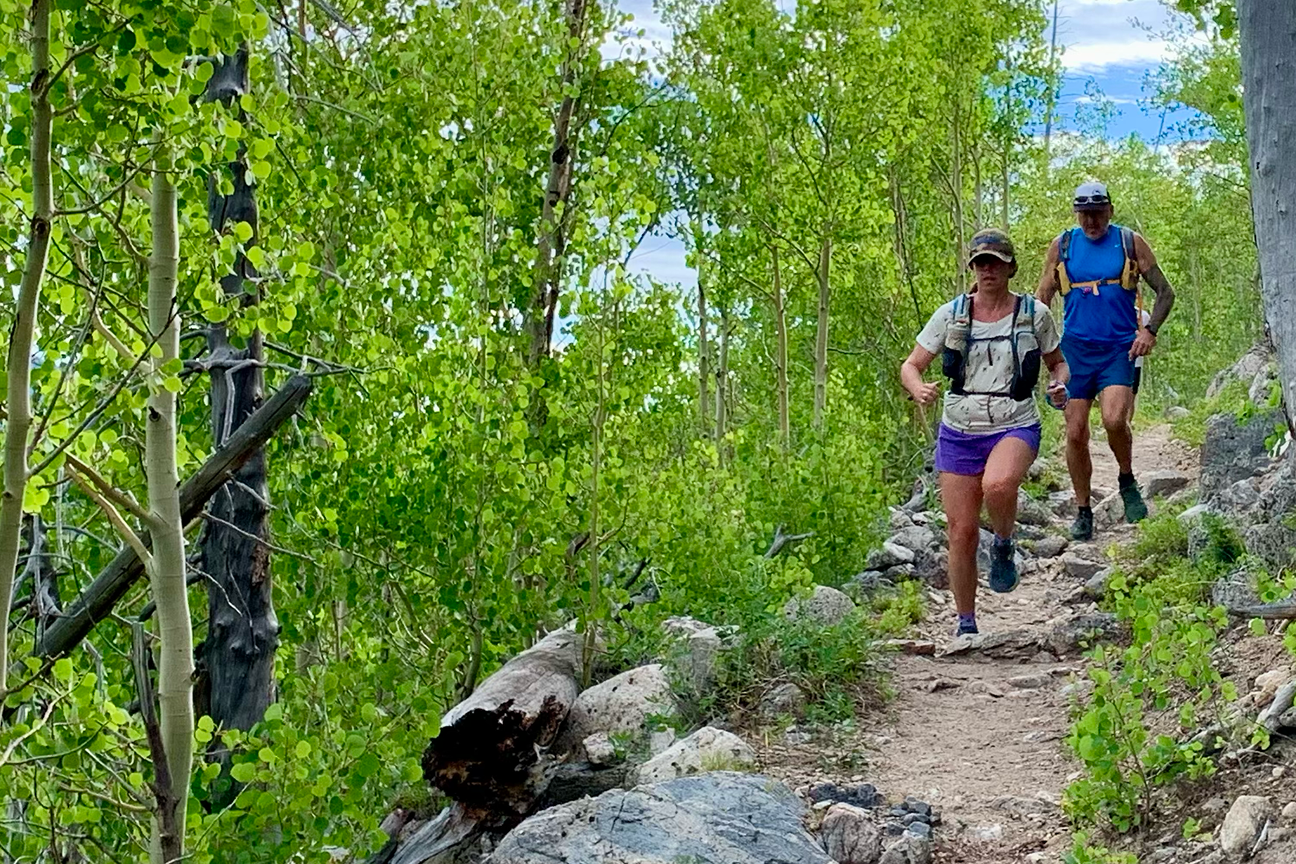
That’s because the trail changes the demands on your body. Rocks, roots, uneven terrain and elevation change all require more stabilization through your ankles and hips, eccentric loading with downhill running and more muscle fatigue overall. Plus, uphill running on trails elevates heart rate more than flat running. What’s more, navigating changes in footing means cadence changes as you scan the ground and plan for your next step.
On the flip side, running on the roads usually offers a smooth, predictable surface that allows your body to move rhythmically without much variation. And that rhythm is what makes it easy to run more during the same amount of time.
Even if you know this, it’s still hard to avoid this mistake. Why? Because chances are high that you’re fit enough to run the same distance even if your muscles and tendons aren’t quite there yet. So, what happens when you do? In short (or long) order, you suddenly find yourself with a niggle that just won’t go away. And if you’re particularly stubborn, you keep running until a small issue becomes a full-blown injury.
Trust me, avoid this one. Ease into the miles. Track the time you’re out there instead and let your body adapt gradually. It’ll happen faster than you think.
2. Refusing to walk or power hike because your ego won’t let you
When I first started trail running, this was hard for me. So, so hard.
When I first started running trails, I was convinced that running was running no matter what. And if I didn’t run every step it didn’t count. I didn’t quite understand that power hiking or even walking is an effective strategy to actually move faster sometimes.
Your heart rate spikes on really steep terrain, which makes it harder to recover when the terrain feels like a wall. In fact it can spike so fast that you hit the proverbial wall way too early. And what happens next? Poor pacing after the hill and an overall less than ideal run.
The best trail runners in the world hike steep terrain to deliberately keep their heart rate down and move efficiently uphill. Power hiking requires a different giant and enables different muscle-fiber recruitment, which means you can be more efficient hiking and also give some of your running muscles a break while reducing the impact of your running form. What’s more, if you get really good at hiking on steep terrain, you’ll find that, in most cases, you can move faster uphill by not forcing yourself to run.
But, this is mental, too. You have to detach from the idea that you need to run every step in order to be a “good trail runner,” even if you’re in a race or on a group run in which others around you are still running. It’s better to budget your energy and get to the end of your run feeling strong.
Pro tip: Keep a tall posture, pull an imaginary rope by alternating forward hand and warm movement and feel yourself gliding up the hill.
3. Not eating enough carbs/calories because you’re running slower
I laugh as I write this because this was my mistake for years … even after I decided I was an experienced trail runner. Why? Because my pace was slower on the trail than the road I assumed my fuel needs were lower too.
They weren’t.
Trail running is actually often even more metabolically demanding than road running even when your pace is slower. Climbing requires more energy, technical terrain uses more muscles and a longer duration on your feet means you’re burning energy for even longer. That’s a recipe for more calories not less.
So, I bonked. A lot. In all my long training runs and in race after race after race. Honestly it wasn’t until a few years ago that I finally started eating enough on the run (about 300-plus calories of mostly carbohydrates per hour). And it improved my performance and recovery dramatically.
What changed? I focused on fueling by time versus distance. Every 15 to 20 minutes I now take in 100 calories in the form of a gel if I’m going to be on the trail for longer than 90 minutes. Game changer.
4. Wearing road running shoes on technical or muddy trails
I once wore road racing flats during the sandy and technical trails of a 50-mile mountain race. And then I ended up with an Achilles injury because I was sliding a little bit every step.
It’s fair to say that I realized then that the difference between road and trail running shoes isn’t a marketing spin. Trail running shoes offer traction, protection and stability. And that matters exponentially when you run on technical terrain.
Road running shoes don’t have lugs and grip needed for mud, loose terrain and wet, slippery trail surfaces like rocks and roots. They also generally have less underfoot protection. All these things combined add up to wasted energy from slipping (like I did) or having to slow down or step with more care.
Bottom line: wear the right footwear for your terrain. A pair of trail running shoes can go a long way in providing much needed confidence when you’re stepping offroad for the first time.
5. Not dressing appropriately for the weather
This is especially important in mountainous climates where the weather is fast-changing and unpredictable—even during a 60- to 90-minute run.
You’re getting ready for a run and you think, “oh it’s a quick loop” or “my weather app says it’s sunny and 65.” But then you move through shady trees or climb uphill where there’s a brisk wind or a new weather pattern on the other side of a rocky ridge.
Then, suddenly you’re shivering, heading downhill without the proper layers.
For a short run, this is uncomfortable. But a long run? Dangerous. Particularly when precipitation is involved. Wind can force you to lose body heat faster and afternoon summer thunderstorms or springtime snow squalls can come out of nowhere and require quick layer additions.
Two years into my trail running journey, I set out on a 20-plus-mile adventure in the Colorado mountains in late August. At the start of my run, it was hot and sunny, so I left behind layers. By the middle it was storming and cold. I ended up waiting out a thunderstorm under minimal cover and, after over an hour of being wet and cold, found myself borderline hypothermic. It took a long time to recover from that.
The lesson? Dress for the worst-case scenario, not the outside temperature listed on your weather app. Also, check the radar for possible storms and wind. And, when in doubt, always carry a lightweight shell during shoulder season.
It may be less comfortable to carry extra layers, but when you’re running longer trail runs in the mountains, safety is not optional.
6. Running too many hills too soon
In many places, when you start running trails, vertical gain sneaks up on you. And, like running too many miles too soon just because you can, your body starts to work overtime. And it’s your Achilles and calves that feel it first on the ups and then your quads, knees and hips on the down. Combine that with uneven terrain and your small stabilizer muscles are also working overtime.
While your cardiovascular system can adapt quickly with so much uphill running, it takes the rest of your body some time to catch up.
And, if you’re like me and you make the mistake of doing too much, too soon, you might notice that you feel like you’ve just gotten into what feels like pretty good shape, only to wind up with a sore calf that makes it hard to walk and soon you feel some awkward tightness or pain sneaking down your Achilles. If that happens, you might be forced into a break from running just as you found a groove with your new favorite sport.
When transitioning to trails, think of vertical gain the same way you think about mileage: progress slowly. If you’re used to running flat, don’t suddenly start climbing thousands of feet per week. Also, there is nothing wrong with walking the steeper climbs and descents.
Introduce hills methodically and not in every run. Be patient and don’t try to do everything all at once.
7. Zoning out and getting lost
Road routes are predictable and Google Maps can easily get us back on track if needed. Streets are in a grid. Trails … not so much.
A singletrack trail may split when you least expect it. Markers or signs might be confusing or missing. Something that looks very clear and obvious on a map, may be hardly marked and severely overgrown in person. And, occasionally, trails just disappear if they’re not well traveled.
My husband and I once spent more than 10 hours covering 18 miles through the Joyce Kilmer Wilderness in North Carolina after canoeing across a lake to a trailhead to reach a loop that turned out to be little more than a faint line through tall brush dotted with difficult creek and river crossings. Thankfully we were prepared for misadventure and he was familiar with the remote area.
In high traffic areas, you may be able to ask others on the trail for help. But in the backcountry, some basic navigation skills are crucial—especially when you don’t have cell service.
Bottom line: trail running requires awareness. Review your route before heading out. Download offline maps to your phone, pay attention to elevation profiles and, while you’re running, stay engaged with your surroundings.
Notice trail signs and natural markings. Be extra safe by letting someone know where you’re going and how long you expect to be gone. Better yet, share your location with a loved one and consider turning on satellite texting when you run in remote areas.
8. Wearing no-show socks on gravel trails
This one feels like a preference. But I assure you it’s not.
If you come from road running, no-show socks are still fairly common. But head out on a gravel fire road or a trail surface with dirt and pebbles, and you quickly understand you never want to wear them again.
Small trail debris can easily slip into low socks and between your toes or somewhere exactly where you don’t want it. First it’s just annoying, then it’s a blister and, worst case, it’s a little cut.
The solution can simply be wearing higher-cut crew socks (like these from Darn Tough) or compression socks (like these from CEP). It creates a bit of a barrier against trail debris that can find its way into your shoes and become a major annoyance.
If you’re planning to run through sections of snow or mud or loose scree, you can take things a step further and opt for a full-on trail running gaiters (like these from Altra).
Whether you go with trail socks or with gaiters, know that small gear adjustments come with big impacts to your running comfort. (Also, pro tip for trail running: wear dark-colored socks, otherwise your white or light-colored socks will wind up stained with a permanent ring-around-the-ankle.)
One of the key takeaways from this should be that what works on the road doesn’t always work on the trail. But the good news is that every one of these mistakes is avoidable.
Ease into off-road running, stay fueled, pay attention, prepare with the proper gear, expect the weather to change, and, above all, have fun out there. And, if you’re stubborn and make every one of these mistakes, that’s OK. You’re in good company.
Contributing writer Ashley Arnold is an ultrarunner and the former director of brand at Fleet Feet who lives in Missoula, Montana, with her husband and two young children. She tells stories through video, words and photos, and is most at home running trails, adventuring in wild places with her family and sipping coffee while eating cake.
RELATED: Do You Remember Your First Mile?
RELATED: Transitioning from a Marathon to a 50K