
Epic trail races often bring to mind the high drama of the American West—the San Juans in Colorado, the jagged canyons of the Sonoran Desert, the steep granite walls of the Eastern Sierra, or the volcanic peaks of the Cascades. But east of the Continental Divide, a very different kind of challenge waits in the ancient mountains of the Appalachian region.
In central Pennsylvania, trail runners know it well. The rocks are relentless, the footing is technical, and the nickname “Rocksylvania” isn’t a joke, it’s a warning. These trails may not tower above treeline, but they demand a unique kind of toughness.
This year, the Eagleton Trail Challenge is leaning fully into that reputation with the addition of a new distance: an 86-mile race on the locally infamous Chuck Keiper Trail. We caught up with race director Blake Cohen to talk about Eagleton, the new Eagleton 86, and why Pennsylvania trail running has earned its gritty mystique.
Interview with Blake – RD for Eagleton Trail Challenge
Q: So Blake, tell me about Eagleton Trail Challenge.
A: Eagleton is for runners who like real trail running.
It’s remote Pennsylvania singletrack. It’s rocky. It’s roots. It’s steep little climbs that never really stop. There are long stretches between aid. You’ll get wet feet. You’ll experience the Pennsylvania backcountry both in the daylight and at night.
What we promise is solid logistics. Clear course markings. Staffed aid stations. Straightforward cutoffs. And a small field so it stays quiet out there.
Event Stats
Race Location: Lock Haven, PA — about 2.5 hours from Pittsburgh, 3 hours from Philly, and around 4 hours from DC and Baltimore.
Race Date: May 9–10, 2026
Event distances and elevation
- 86 miles / 16,000 ft
- 47K / 3,900 ft
- 25K / 2,600 ft (run/ruck divisions)
- 10K / 1,400 ft (run/ruck divisions)
Q: How long has Eagleton Trail Challenge been around? How did it get started and what was the original vision for the race?
A: The idea for Eagleton started in the summer of 2014. A friend of mine, Mike, pitched it.
Mike had helped build the original trail system out there years earlier, through a partnership between the local forest service and a local mountain bike group (around 2005). The problem was that after early use, a lot of that trail network got forgotten. It was underused, overgrown, and basically disappearing.
At the start, the “base” trail system was a 21‑mile loop. We built the first courses off that: a 25K and a 50K. And as we worked on course development, we also reclaimed about 8 miles of older trails that showed up on mid‑1800s area maps. Those were old logging and mining roads.
The first year of the Eagleton Trail Challenge was October 2016. A 10K was added more recently, and now the addition of the 86-mile course.
So the original vision wasn’t “let’s invent a brutal race.” It was more like: let’s bring these trails back to life and give people a reason to go explore a part of PA they’d never find otherwise.
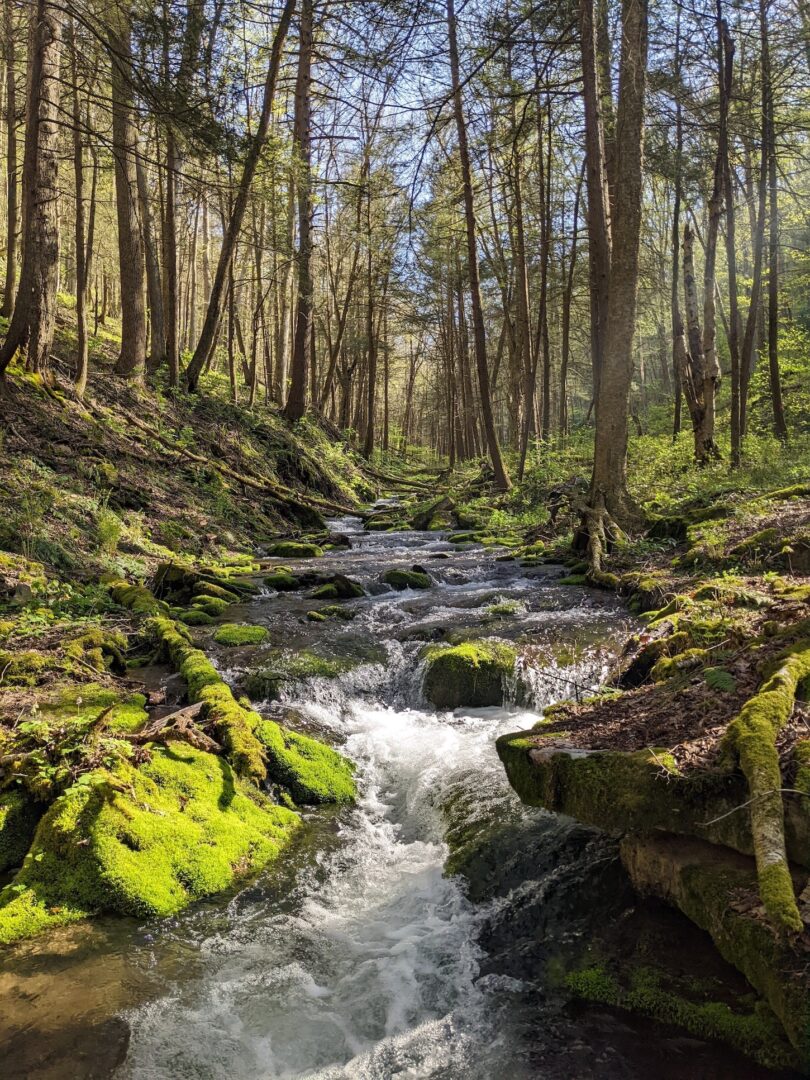
The area is full of local history.
The formal name for the trail system is the Eagleton Mine Camp Trail, and it sits on the site of the former village of Eagleton in Sproul State Forest, Pennsylvania. The village existed roughly 1845 to 1870. The Eagleton Coal and Iron Company built it to house miners working the local bituminous coal fields. It’s lore that a man named John Reville, who was in charge of several of the mining towns in this era, buried his fortune somewhere near the Eagleton Fields area – but no treasure has ever been found….
What’s still cool to me is that Eagleton had a mule-pulled mine car railroad that climbed out of the nearby creek valley up to the plateau on a set of switchbacks called the “Seven Switches.” A section of the Eagleton Mine Camp Trail follows that old railroad grade.
The area is rather infamous. In 1865, this area was the site of the first labor strike in Central Pennsylvania’s bituminous coal fields. About 200 workers revolted over wages, and the sheriff of the neighboring town showed up with twenty riflemen and calmed it down in a few days.
There’s even a Prohibition-era story tied to the area – a legendary prohibition-era bootlegger named Prince Farrington kept one of his stills at Eagleton Fields. Farrington was a bootlegger in Clinton and Lycoming Counties, and in April 1925 state and federal agents raided the still and arrested Farrington.
Q: You are the RD for this event but it is put on by the Eastern States Trail Alliance, why is that important to runners?
A: The Eastern States Trail-Endurance Alliance is a local, all-volunteer, grassroots non-profit and we’re dedicated to supporting trail stewardship, safety coverage, and direct give-back to the communities that help our trail events thrive.
Last year alone, we donated roughly $40k back into local organizations across central Pennsylvania.
So when you run Eagleton, you’re also helping keep Pennsylvania’s Wild spaces protected, accessible, and runnable.
Q: If I dropped a runner into the Eagleton Trail Challenge with no context, what would immediately tell them: “I’m running Eagleton”?
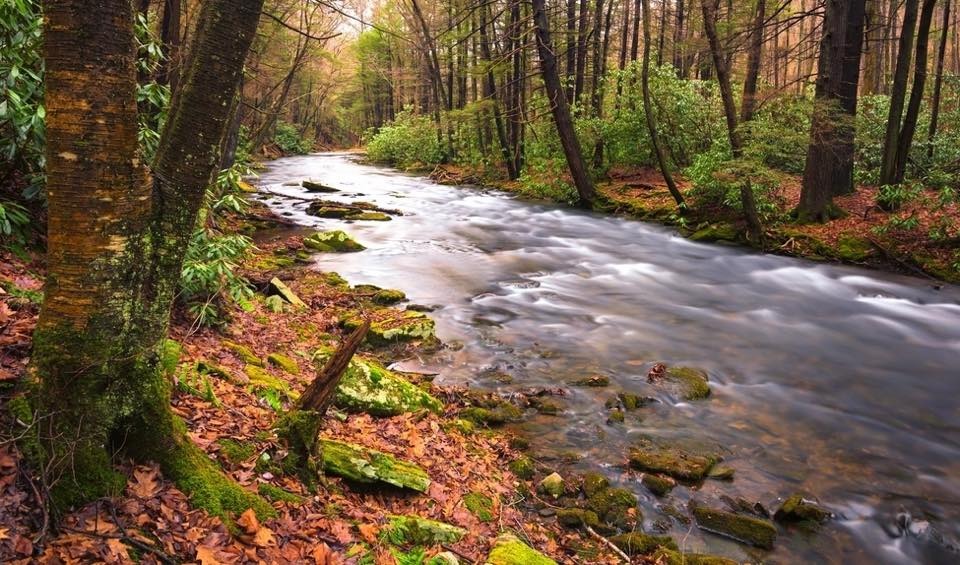
A: Two things hit you right away: the rocks, and the vibe of the place. You’re up on this forested plateau in the Alleghenies. Deep woods. Steep ridges. Little drainages everywhere.
And then you start noticing the old mining footprint. There are these weird gouges in the ground from old coal chutes. They look like little craters or disturbed pits in the middle of the forest. It’s not “ruins,” exactly. It just feels like the woods swallowed an old industrial site and kept going.
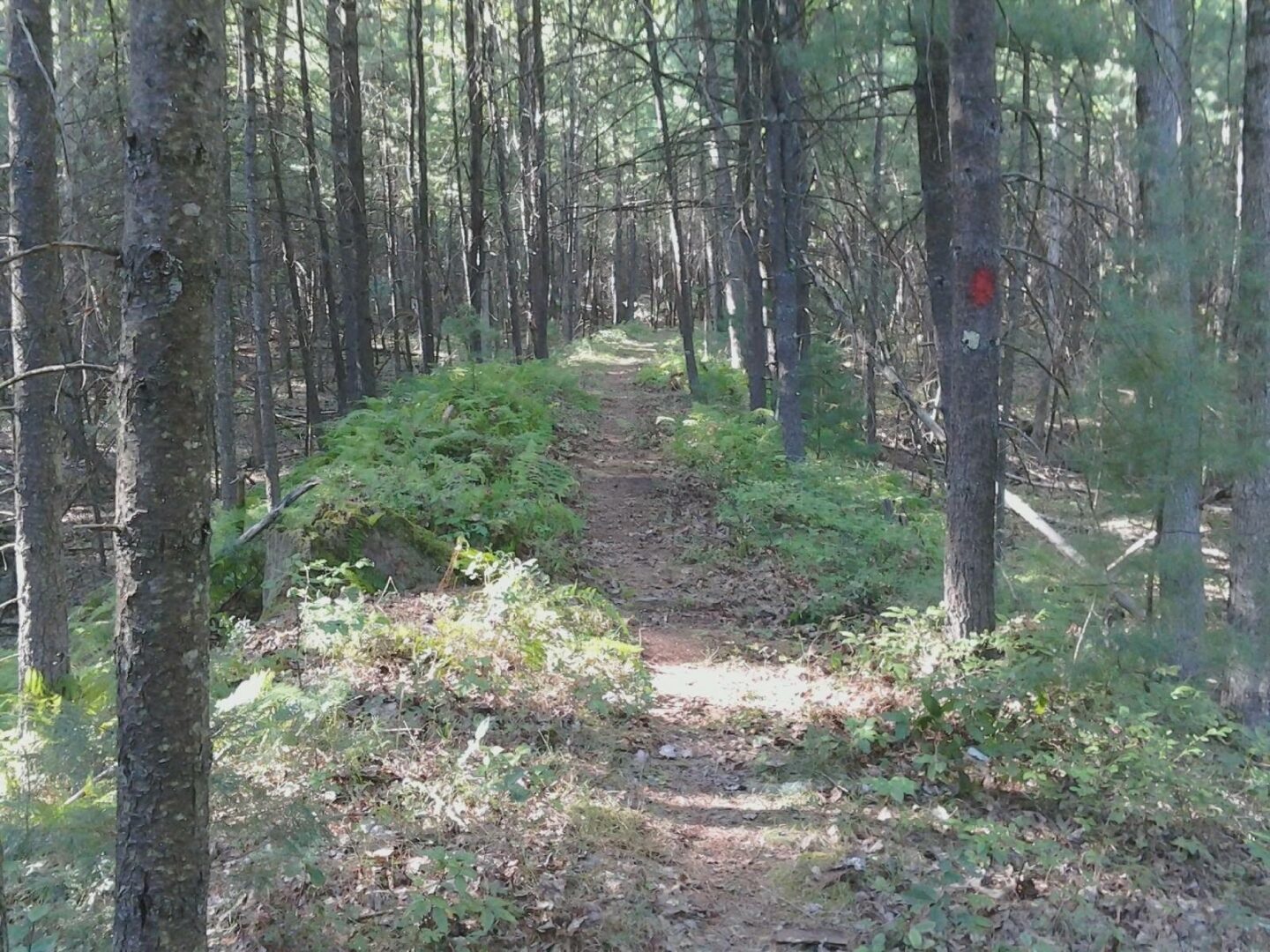
A lot of the tread is old-school too. You’re not on perfect, purpose-built singletrack the whole time. You’ll run sections of old mining road and old railroad grade, and then all of a sudden it tips off the edge of the plateau and drops hard toward the West Branch of the Susquehanna.
It’s multi-use trail, so you’ll see the signs of hikers, mountain bikers, and horseback riders. That’s part of what makes it feel a little rough around the edges in a good way.
The elevation is pretty reasonable on paper, but the footing is what wears you down. Rocky and uneven. You’re paying attention all day.
Q: This is the first year of the 86-mile distance, why the addition? What does it allow runners to experience that the shorter distances simply can’t?
A: We knew we wanted to add one more level of distance to Eagleton. Around here, there just aren’t many races that sit in that upper range between 100K and 100 miles. We wanted something that would complement the trail running scene in central Pennsylvania without jumping straight to a full hundred.
Once we started looking at where we’d actually want to take people for that kind of day, Chuck Keiper was the obvious answer. That trail is the whole point of this place.
The 86 lets you fully commit to it. You hit two Natural Areas, two Wild Areas, waterfalls, the old splash dams, and some long, isolated stretches where it’s just you and the woods.
And the distance itself ended up being perfect. It’s more than a 100K, but it’s not quite a 100-miler. It fills that gap for runners who want something bigger, but still doable.
Even if someone has done a bunch of 100s, the 86 still hits different. It’s early-season, it’s remote, it’s technical, and you get that overnight piece with a lot of solitude.
It’s a real mental test, in the best way.
Q: What part of the 86-mile course will be surprising to runners? Why might this hit differently?
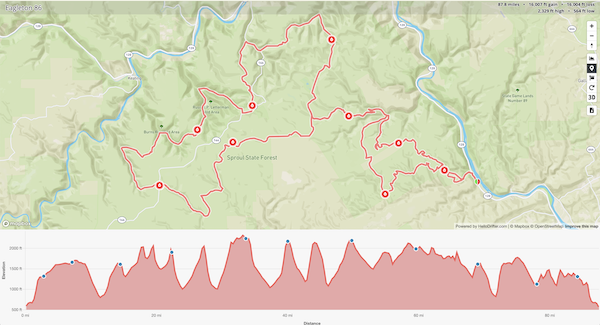
A: Honestly? The constant up-and-down Sawtooth-like elevation, and how wet your feet can stay.
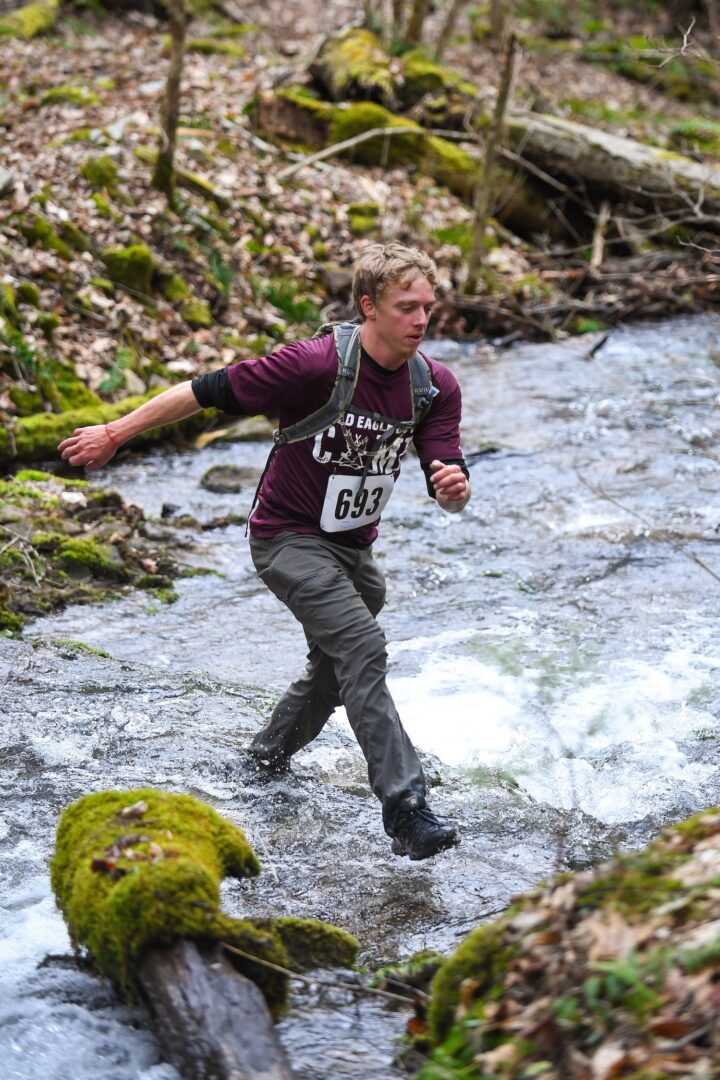
There are a lot of stream crossings out there. In early May, a bunch of them can be knee- to thigh-deep. That’s not “one big crossing and you’re done.” It’s more like: cross, dry for a minute, cross again. So the surprise for a lot of runners is how long you can end up running with wet feet. There isn’t really a clean way around it. You just keep moving.
On the Chuck Keiper trail, the wet is baked into the course because you’re constantly dropping off the plateau into the stream beds and then climbing back out. It has this sawtooth profile that hikers talk about. It rarely stays flat for long. You’re always bouncing between the high plateau and the runs below.
By the time you’re out around mile 60, the remoteness and the repetition of that terrain start to add up. It gets quiet. You’re tired. You’re alone more than you’re used to. That’s when the course feels different than a more “social” race.
And you’re not just running through generic woods the whole time. You pass through two Wild Areas (Burns Run and Fish Dam), and you hit these little pockets of boggy plateau terrain around Eddy Lick Run with vernal pools and swampy sections.
Q: Is there a spot on the course where runners tend to need to pay attention, either because of difficulty of the terrain or because the landscape deserves it? Where is that? Why?
A: If I had to pick one spot, it’s Boggs Run (roughly mile 24–29), because it’s steep, tilted, rocky and rooty under foot, so you really can’t go on autopilot.
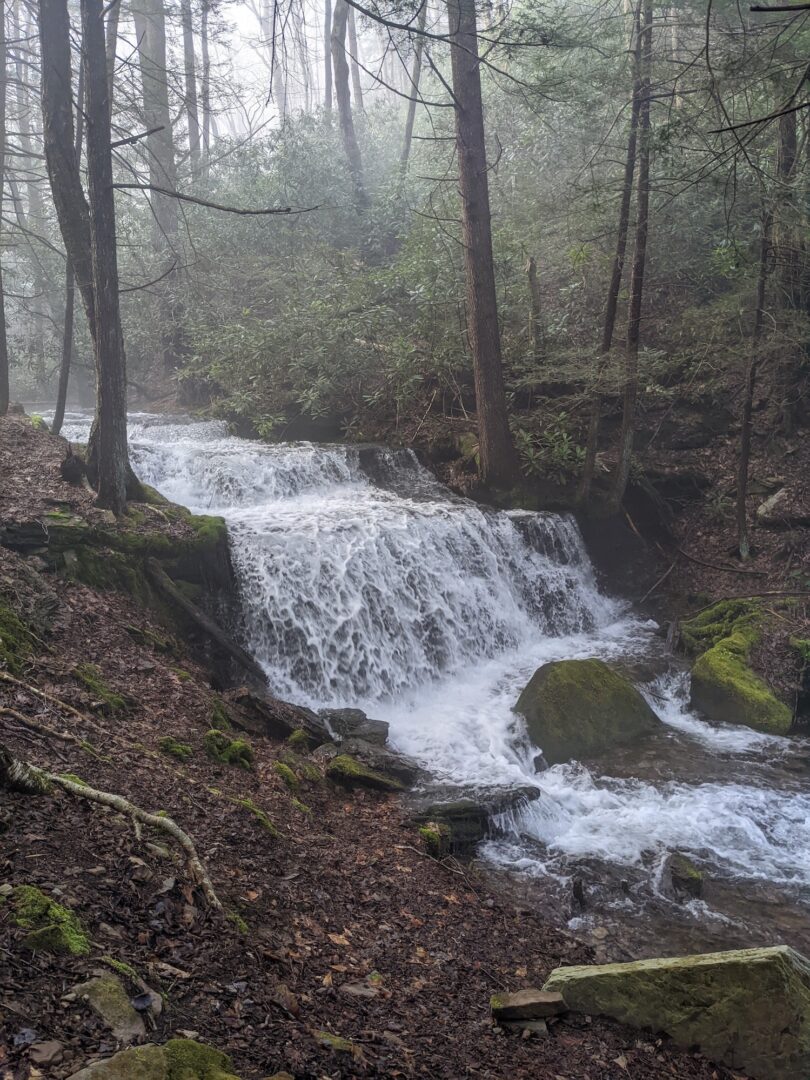
And then right after that you’ve got Yost Run and Eddy Lick Run, which aren’t “hard” in the same way, but they’re some of the prettiest miles on the course — mossy rock, clear water, and the old splash dam — so they’re worth slowing down for a second and actually taking in.
Q: What kind of runner do you think will thrive at the Eagleton 86?
A: The runner who does well here is the person who likes a “graduate-level” early-season ultra — real technical trail, real climbs, long gaps between aid, and enough time out there that day turns into night.
It’s not an altitude thing — it’s Pennsylvania trail: rocks, roots, punchy steep climbs, steep drops, and basically no long, smooth sections where you can just lock into a rhythm.
So the runner who thrives is someone who can stay patient when the trail forces you to slow down, keep eating and moving when things get uncomfortable, and stay switched on when it’s dark and you’re tired, because the cutoffs and the footing both reward steady, focused effort.
If you like technical trail and you want an early-season race that feels like a legit backcountry day, that’s the kind of runner this course is built for.
Q: Thinking more generally about the terrain across all of the distances, what’s a mistake a first-time Eagleton runner might make?
A: The biggest mistake is looking at the elevation chart and thinking, “Cool, I know what pace I’ll run.”
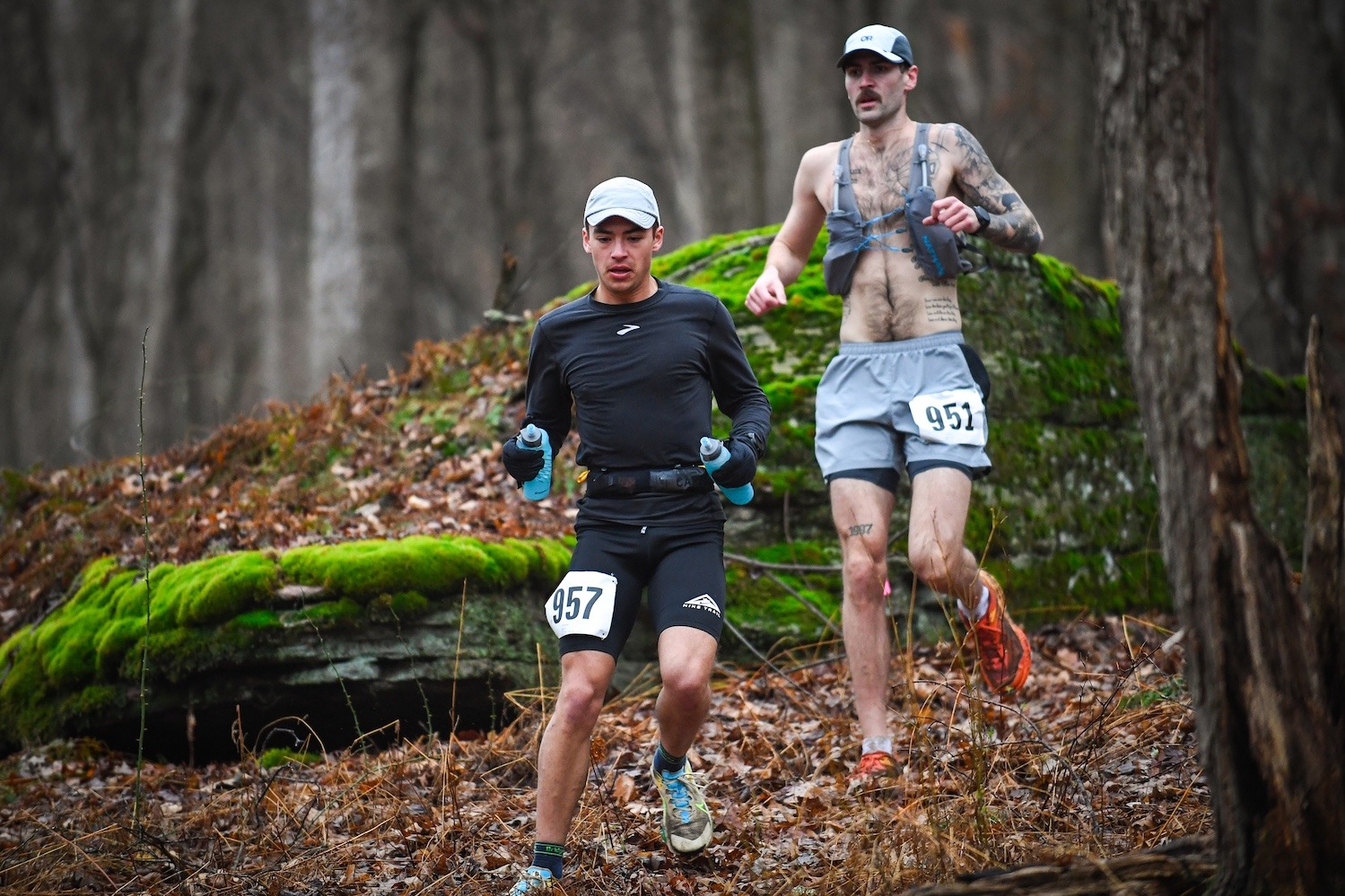
Eagleton isn’t hard because the climbs are huge — it’s hard because the trail is slow. It’s rocky and rooty underfoot, with sections that run off-camber across the side of a slope, and a bunch of little ups and downs that never really let you settle in — this isn’t smooth, groomed trail, it’s a narrow footpath cut through the backcountry of Pennsylvania’s forested wilds.
And it’s coupled with dozens of stream and creek crossings, because a lot of this terrain is shaped by water: you’re constantly dropping into little runs and drainages and climbing back out, and the trail follows those old, water-cut corridors through the forest.
If you come in expecting a long day, technical footing, and very likely wet feet at some point, you’re going to have a much better experience.
Q: What’s a small, easily overlooked moment, an aid station interaction, a stretch of trail, a volunteer tradition, that often ends up being the most memorable for runners at Eagleton Trail Fest?
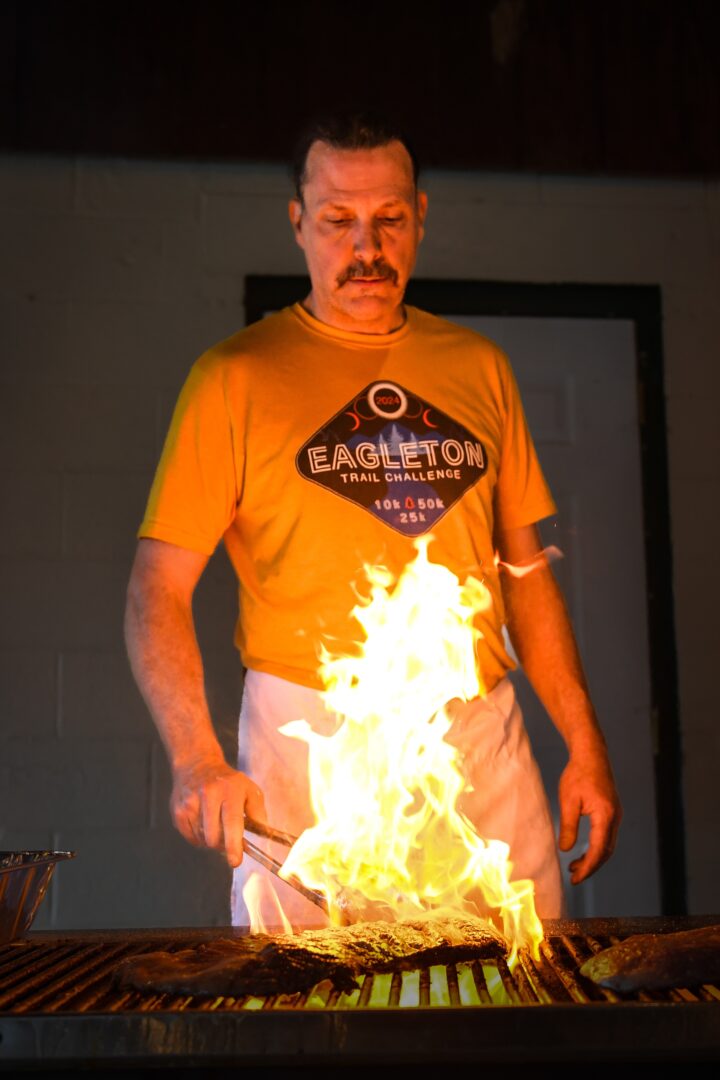
A: Honestly, it’s the finish line meal. People expect the usual post-race spread, and that’s just not what Eagleton is.You sit down with a full plate of real food, next to other runners who were out in the same woods all day, and it turns into this little reunion even if you’ve never met.
I’ve had runners tell me they come back year after year just for that meal and I get it — if they gave Michelin stars for trail race food, Eagleton would be on the list.
For example, we’ve had hand-prepared, fresh grilled chicken with a ginger-carrot sauce, jasmine rice, roasted vegetables, and salad. Every year it’s something unique.
That’s probably what I hear most often from runners – they remember the food.
Q: There are countless trail races a runner could sign up for. Why should someone choose Eagleton Trail Challenge?
A: Because Eagleton is the kind of race that’s hard for real reasons, and we don’t try to hide that.
If you want a “graduate-level” early-season ultra, this is it: technical trail, long steep climbs and descents, long stretches between aid, and enough time out there that you’re likely running in both daylight and darkness.
The flip side is we take the execution seriously. The course is marked clearly. Aid stations are staffed by people who actually know these trails. Cutoffs are straightforward.
We also cap the field at 150 on purpose, because we want it to feel remote and personal, not like a conga line.
And the bigger picture matters too: your entry is supporting trail stewardship through the Eastern States Trail-Endurance Alliance, so you’re not just using the place for a day — you’re helping support the work that keeps it wild and keeps the trails open and usable.
Q: What do you hope runners carry with them after finishing Eagleton, even once the soreness wears off?
A: I hope they walk away with that quiet confidence that comes from handling a hard day well.
Not just “I finished,” but “I handled it.”
Wet feet. Darkness. Long quiet stretches. The moments where things got messy and you kept moving anyway. And I hope they remember the place, too. The sound of water on rock. That tight, closed-in forest. The kind of backcountry quiet you just don’t get in normal life.
Q: Is there anything else that you want runners to know about this event?
A: Yeah — two things can both be true: Eagleton is a real challenge, and you’re going to be well supported.
The big thing is just showing up with the right expectations. This isn’t smooth, groomed trail. It’s rocky, rooty backcountry footpath, and in May there’s a good chance you’ll have wet feet.
The other piece is the spacing. Once you’re out in the middle of the course, you’ll have some long stretches between aid (think roughly 8–11 miles), so plan like it’s a long day and carry what you need.
Support-wise, it’s a small, all-volunteer crew that takes a lot of pride in doing this right — clear marking, staffed aid, and straightforward cutoffs.
If you come in ready for the terrain and the time out there, it’s an awesome day.
Check Out The Race
Register for Eagleton Trail Challenge here →
RELATED: Behind the Bib: Moab Run The Rocks
RELATED: Tahoe Trail Week 2026
RELATED: 20 Great 200-Mile+ Races in the U.S.

1 comment
Mary Kowalski
Nice course explanation and history of the area. Last time I was on Chuck Keiper Trail the stinging nettles were out in full force. I believe it was in June when the Laurel were blooming as well. Sounds like a great ultra and a good example of our beloved Rocksylvania.