
Strength training has earned a reputation among trail runners akin to flossing: you know you should be doing it, but you don’t always prioritize it until something goes really, really wrong.
It used to be seen as auxiliary to running, injury prevention at its best. Increasingly, though, it’s getting attention as a key factor in endurance and durability. Take Francesco Puppi, a professional Italian trail runner with a decade at the top of the sport across distances from the half-marathon to 100K: he’s been using strength to build durability not just across training seasons, but within races themselves.
His coach, Tito Tiberti, says strength training for durability has been key to that success, essential to both Puppi’s consistency and his standout performances of the last couple of years. For Tiberti, strength is a primary pillar of what lets an athlete last.
“Being healthy is essential to stay the longest possible in the sport: strength training helps, consistency is key, appropriate loads and recoveries are key, too,” Tiberti says.
Every source I interviewed pointed to durability as part of a much larger, more complicated puzzle. If you just needed an Amazon weight vest and a few step-ups to become Francesco Puppi, we’d know that by now.
But the fact is that, no matter what your running goals are or what kind of training you’re doing, all signs point to the need for consistent strength work.
“I view strength as a core pillar of performance, just like workouts, long runs, recovery, and fueling,” says Nell Rojas, a Boulder, Colorado-based professional runner and coach who builds strength work into the routine of the trail runners she trains.
What is Durability?
As trail and ultrarunning mature, more attention is being paid to durability from a coaching and research perspective. Previously, metrics like V02Max, lactate threshold, and running economy have taken up much of the physiological spotlight, partially because they’re easier to measure and quantify through laboratory tests and, quite frankly, the smartwatch on your wrist.
Durability can be broken down into two component parts: aerobic durability (does your heart rate and metabolic thresholds stay stable) and muscular (do your biomechanics and form break down later in a race).
“It’s the ability to delay pace decay over time within a single, acute effort. How long can you hold form and pace before [fatigue] sets in?” says Danny Blake, a strength and conditioning coach and founder of Alpine Performance Labs in Carbondale, Colorado.
In 2021, a paper in Sports Medicine proposed durability as the fourth pillar of endurance performance, alongside v02max, lactate threshold, and economy, and another paper in 2024 defined it as physiological resilience, or how well your fresh physiology holds up into a longer effort. This article will primarily be tackling the muscular component, since that’s what is targeted in strength training.
Durability isn’t testable in the same way that VO2Max or Lactate Threshold are. There isn’t a simple lab test or protocol that can tell you how durable an athlete is. By its nature, you can only measure it by fatiguing an athlete first and re-running traditional physiological tests to see how far metrics have drifted. But the wrong time to find out about your durability is at mile 87 of a 100-mile race.
While there’s no consensus on the best way to test or measure durability, coaches like Tiberto point to aerobic decoupling as being the best proxy. Coaches and athletes can look at metrics like heart-rate-to-pace (or HR to power) ratio in the first half of a longer (ideally 90-120 minutes or longer, and the longer your event, the better data you’ll get from longer training) effort versus the second half.
If your heart rate climbs while your pace stays the same or deteriorates, your physiology is likely fading (or, you might be bonking … but that’s a different article), and a smaller drift means you’re more durable. Most training platforms, like TrainingPeaks or WKO, compute this directly, so that athletes can get a sense of their durability without having to run back-to-back lab tests or figure it out the hard way on race day.
To assess your durability, check your pace to heart rate ratio (Pa:Hr). If it’s below 5 percent for a given effort, that’s solid durability. If it goes over 5 percent, that might be a sign you need to be more intentional around durability.
“My approach has evolved from doing more general strength work to being much more intentional, focusing on movement quality, unilateral strength, tendon capacity, force production, and exercises that directly support the demands of running,” says Rojas.
Some critics have pushed back on the fourth-dimension framing, arguing that it isn’t a separate parameter at all, but the same ol’ determinants (aerobic capacity, fueling, thermoregulation, pacing) expressed over time. Whether it’s packaged as a newer way of understanding performance or a reheated version of an older concept, athletes and coaches are increasingly targeting it specifically in training.
RELATED: Isometric Strength Training: A Safe, Simple, and Effective Path to Better Running
How Do You Build Durability?
The too-simple answer: Train more.
Boom. I’ll be at the gym if you need me.
Not so fast. Any zealous gym-going trail runner can tell you about the unique displeasure of learning your boutique internet strength plan was never optimized for mountain running. Looking at you, Hyrox.
Before you even get to the gym, there are two upstream limiters no amount of box jumps can fix: poor running mechanics and poor aerobic conditioning, both of which, you guessed it, come down to more (and smarter) training.
“Gym strong is high concentric force production, sagittal plane, familiar joint angles, fresh, controlled environment,” Blake says. “Trail [durability is] producing and absorbing force across multiple planes, at varying joint angles, fatigued, on unpredictable terrain, for hours.”
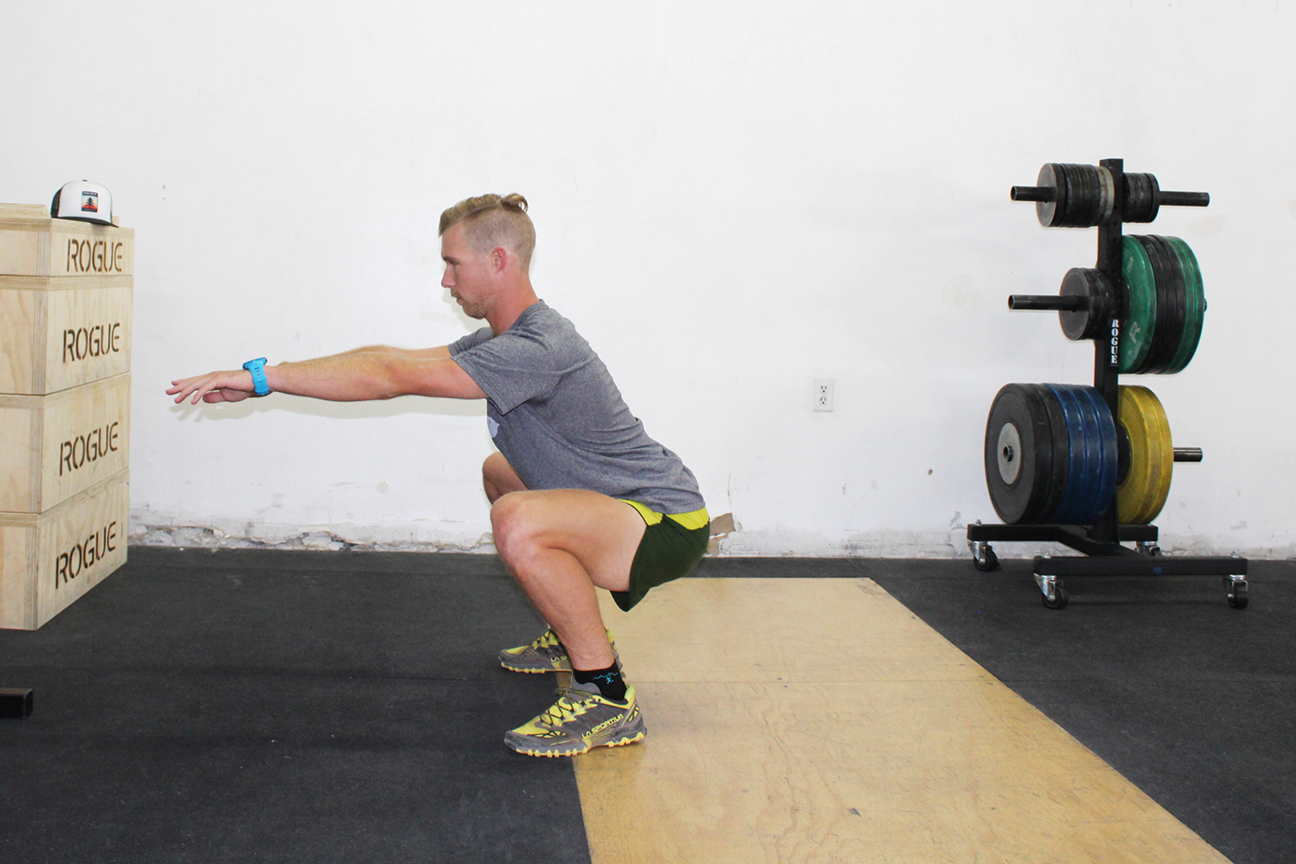
Durability for Downhill Running
Durability really pays off on the downhills. Descents are where races tend to unravel, and that’s often times an eccentric-loading issue that strength training can help solve for. According to Blake, you can replicate high concentric force production, sagittal plane, familiar joint eagles, while you’re fresh in a controlled environment. Which is helpful, but it doesn’t completely address the need to produce and absorb force across multiple planes, at varying joint angles, while fatigued on unpredictable terrain…for up to 30 hours.
How to train it:
- Eccentric-based lifts: Slow lowering (3-4 seconds) split squats, step-downs, Bulgarian split squats, single-leg RDLs, and eccentric heel drops for the calves. Don’t rush these- the slow lowering is what helps the muscles tolerate the descent.
- Train the range your descent demands: According to Blake, don’t live in the half-squat. Load deeper knee flexion so that the strength you’re doing actually translates to the terrain you’ll be running.
- Repeated bout effect: progressive add downhill volume and steepness in training so that race day isn’t your first mega hit of vert. Start small, build over weeks.
- Take notes on race day: If your quads and calves still hold on the descents late, you can brake without trashing them, and you’ve evaded a quad-pocalypse, your training is working.
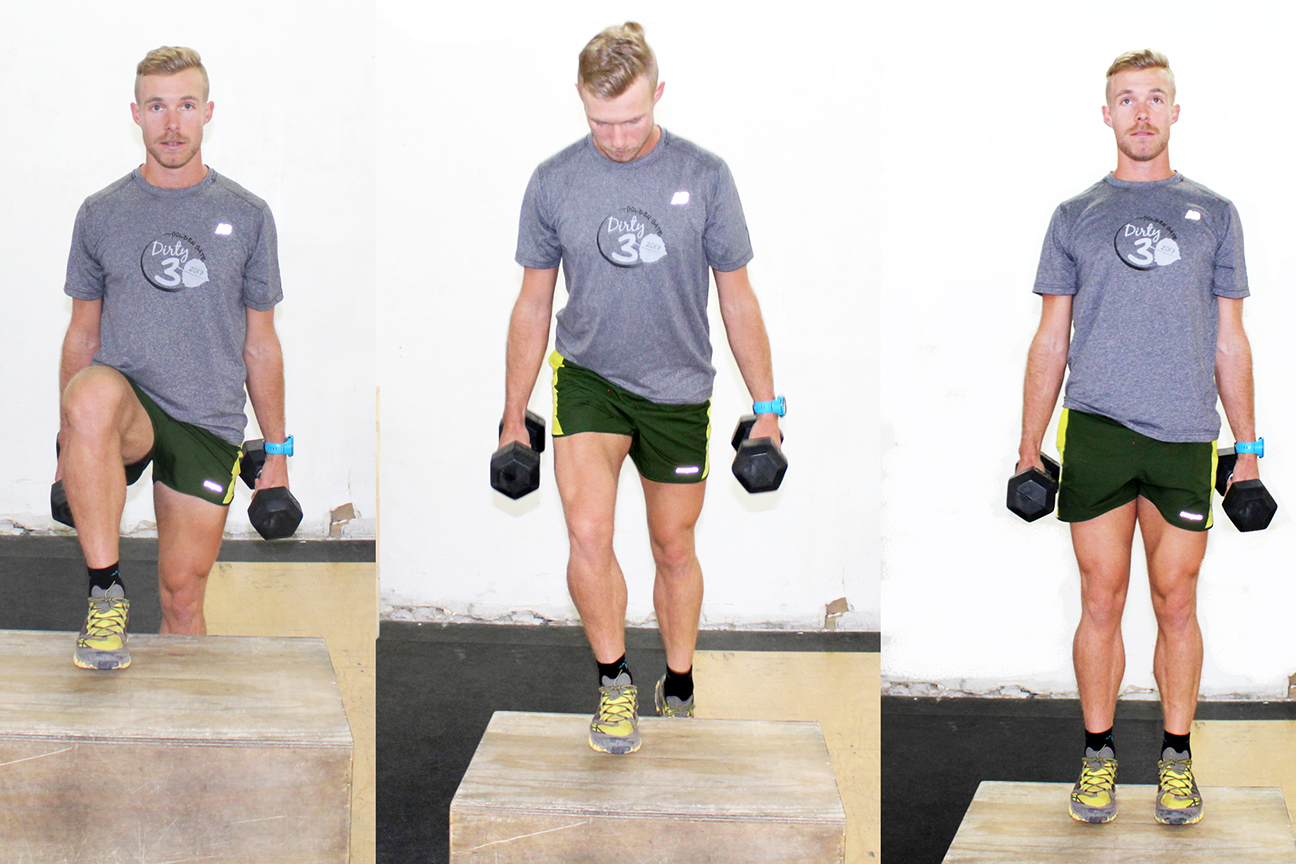
Weighted step-downs are a unilateral, lower-body exercise that targets your quadriceps, glutes, and hips. Photo: Brian Metzler
Holding Pace & Form
It might look like speed, but being able to maintain pace later in races is a key part of durability. While part of it is obviously related to aerobic durability, the chassis needs to be able to keep up with the engine. Strength helps build a reserve of force, raising how much force you can produce with a stride, so that the stride each step generates is a smaller percentage of your max output. Basically, if you know you’re going to be making a ton of tiny withdrawals, you’d want to pad out your bank account as much as possible.
Strength can also help you maintain better form after hours of running. “Better neuromuscular control also keeps your movement patterns nice and tight so you’re less likely to move in bad ways as you fatigue,” Stephenson says.
Rojas says that the strength needs to complement and enhance the running, not take away from it. “Done correctly, strength makes runners feel more powerful and durable, not slower.”
How to train it:
- Heavy work: Tiberto recommends a “maximal” block—low reps (between 3-5) of heavy load, full rest, big patterns (squat, deadlift, step-up, hip thrust) to build the force reserve.
- Structure: Tiberto has his athletes follow a very specific workout structure: warm up, followed by heavy or main set, and a short circuit to finish. The heavy set is the key ingredient for durability, with the conditioning finish playing a more supporting role.
- Keep progressing: Blake says runners should add load across the season, and warns against camping out at the same maintenance weight for years.
The biggest mistake runners make when diving into strength training is overprioritizing intensity to the detriment of consistency.
“Take a slow progression and think in years rather than weeks. I always ask, is this manageable for 5 years?” Blake says.
While strength training can serve a supporting role in developing durability, it can’t replace running, which has the dual benefit of addressing aerobic durability, which strength doesn’t. So: run more. Strength train better, and more intentionally.
Just Don’t forget to floss.
Find Your Next Race: UltraSignup’s Event Finder
- Closing the Gap Between Ability and Ambition

- What Causes a UTMB DNF? Here’s What The Data Says

- Nine Lives: My Life in 9 Transcendent Pairs of Shoes

- Race Through the Night: Stay Awake, Alert + Mostly Sane

- New Ways to Think About Data for Runners

- You Might Be Running Your Easy Miles Too Fast