This started with a Facebook post when a woman wrote in Slow AF Running Club that, at 47 years old, she had just run her first ever mile without stopping. I scrolled through the comments, of which there were hundreds, and every single one was encouraging. What really stuck out to me, though, were the comments that said, “I can’t wait until I can do that.”
There is no shortage of inspiration in trail running. Barriers are constantly being broken, women are running faster and farther than ever before, records are being shattered, and more women than ever are showing up to start lines. Movements and organizations like Here for the Women’s Race, Trail Sisters, and Women of the Wasatch, as well as the 10 to 100 program, have stepped up with the goal of increasing visibility and representation of women in trail and ultrarunning.
As our fight for equity rages on, when the spotlight remains only on the fastest of women, it can make it feel more intimidating for those who are just trying to get started. I truly believe the scariest steps to take are the first ones.
After reading that Facebook post, I was inspired to identify and lower the barriers to entry for women, and it got me thinking. How many women out there, especially women in their 40s and 50s, are just getting started? What convinced them to take those first steps, and what obstacles did they face to get there? What keeps them coming back? What would they say to someone who is right where they once were: considering lacing up their shoes, hand hovering over the door handle, but not quite ready to step outside?
Identifying the Barriers
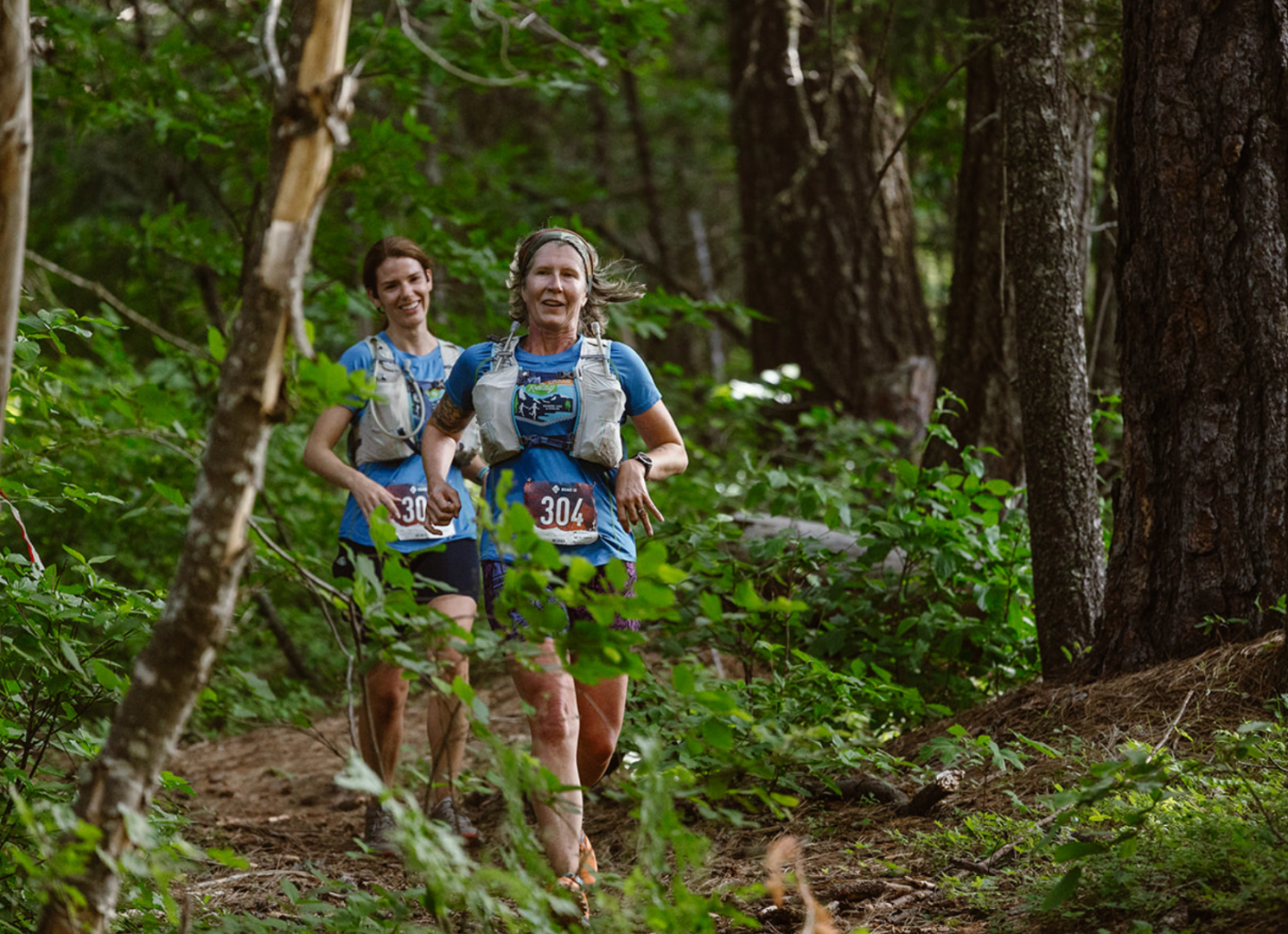
I created a survey that I posted on some Facebook running groups, thinking I might get a couple dozen responses. Pretty quickly, it became clear that I wasn’t the only one curious about the topic. In less than a week, I had over 100 responses. I could hardly keep up with organizing the data. I would sit at my desk and scroll through answers, tearing up at every other story I read.
Every woman’s background is so special, so unique, that I realized this story was becoming bigger than I could have imagined. What started as pure curiosity had blossomed into a passion project, and all of a sudden I felt an immense responsibility to share every story.
This is just one way I am choosing to express what was shared with me. I may choose to hone in on specific aspects in the future or dissect the information in different ways. No matter what, I promise to treat each story entrusted to me with the utmost respect.
The survey I sent out consisted of the following prompts:
- What is your age?
- How old were you when you first started running?
- What motivated/inspired you to take your first steps?
- How did it feel to reach your first milestone, whatever that may have been for you?
- What makes you want to continue running or working towards it?
- What barrier(s) did you face to be able to start running?
- Please explain your previous answer in as much detail as you are willing.
- How did you overcome that/those barrier(s) to start running?
- What would you say to someone who is considering starting running but hasn’t yet?
- Do you have a mantra?
- Please describe anything else you think might be relevant to this story.
The first point of data I was interested in looking at was current age and how old they were when they started running. Nearly half of responders are currently in their 40s, a little more than half are in either their 30s or 50s, and just a handful are in their 20s or over 60. Most women seem to have found running in their 20s and 30s, most of whom are now in their 30s and 40s.
Now, what does all this tell us? Maybe it’s telling us that there is a generational difference—a larger portion of those who are currently in their 20s started running much younger than those who are now in their 30s and older. This isn’t surprising, seeing as the first woman to ever run the Boston Marathon did so only 60 years ago, and illegally at that, and it wasn’t until 1984 that a women’s marathon was included in the Olympics. (To its credit, the Western States 100 allowed women to participate from the start, and five women participated in its first official race in 1978.)
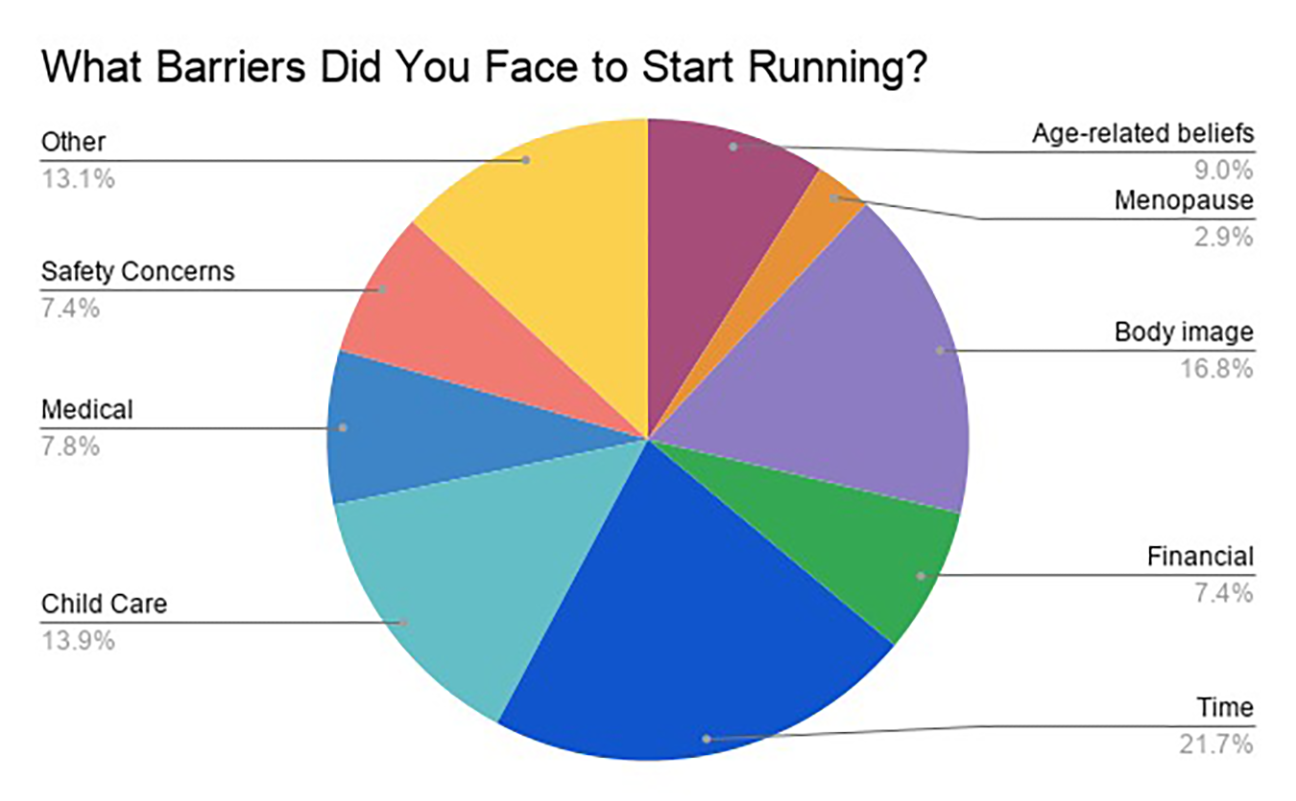
However, just because women are now legally allowed to compete (barring regressive policies currently targeting trans women), it doesn’t mean it’s easy to do. Forget competing, there are still countless barriers for women to be able to get out there and run at all. In addition to my survey question “What barrier(s) did you face to be able to start running?” I included a dropdown menu with the following options, where they could check as many as they wanted: age-related limiting beliefs, menopause, body image/weight-related/disordered eating, financial, time, child care, medical (including doctors writing off your problems as “woman issues”), safety concerns, and other.
Medical Conditions as a Barrier
There is no shortage of medical conditions that can affect a person’s ability to run. Depression, anxiety, chronic fatigue, addiction, menstrual cycles, menopause, postural orthostatic tachycardia syndrome (POTS), cancer.
“I had two doctors refuse to diagnose POTS because I could run. They claimed nobody with POTS could exercise.”
Guess what doc? Katie Ledecky, the most decorated female swimmer in Olympic history, manages her POTS just fine. After seeing the POTS specialist, this runner was told that her POTS is actually less severe because she runs. This is not the only example of what is, by definition, medical negligence. One runner suffered from horrific menstrual cycles—she would bleed so heavily for more than 12 days at a time that she couldn’t get a job outside of the house, could hardly take care of her child, and nearly bled to death multiple times, and her doctors told her she was “overweight and needed birth control.” She finally found a doctor who was willing to listen to her (what an absurd statement) and had emergency surgery. Three months later, she was walking every day, and less than two years after that, ran her first ultramarathon.
There is an extreme lack of research regarding menopausal and perimenopausal women, which is, of course, a major issue. In fact, there is actual research about the lack of research on menopause. Hormone replacement therapy (HRT) has played a huge role in helping many women manage the symptoms of the changes their bodies go through during menopause. It is a unique experience for every individual, and with little research, every case is trial and error. However, a handful of women shared with me that they are on HRT and it is the reason they have been able to continue running through menopause.
RELATED: 13 Great Women’s Trail Running Events to Put on Your Calendar
Trauma as a Barrier
All kinds of trauma can have long-term effects on the body, how we navigate our lives, and how we respond to stimuli, even after the direct cause has long been removed. Many women reported having been in relationships with abusers who made them feel unsafe to go anywhere alone. One woman mentioned she was afraid that she wouldn’t be believed if she told anyone about the abuse. Another shared that she was followed home one night while out for a walk, and “that’s why [she] loves ultra events – [she gets] to run at night and feel comfortable knowing it’s an organized event.”
These experiences highlight how safety concerns dictate when and why women run, but even in spaces where physical danger is less immediate, body image and weight insecurity is another common barrier that women face when considering when and how to show up. Societal standards surrounding how women should look are ever changing and unreachable. Toxic diet culture has demonized fat and preached that thinner equals better. This general mindset has caused harm to women who are not thin.
Other women have felt that they are too skinny to run, and whether they have felt too thick or too thin, all have endured judgmental comments on the way their bodies look while running. Some women started running with headphones in to literally block out the noise, while others opted to run early morning or after dark to avoid being noticed until they grew more comfortable in their own skin, which doesn’t work for everyone. We don’t always feel safe running alone at night, because, sometimes, it’s not.
Others suffered trauma from childhood sports that made them have to step away from sport and find their way back on their own terms. Other women were told by their community when they were younger that running would make their uterus fall out or give them breast cancer.
So why did they do it anyway? How did they decide that it was time to get out there despite the list of things keeping them from it?
The answers to this question ranged from they wanted the cool middle school team warmup jacket to desperately trying to beat addiction. However, when you ask anyone why they continue trail or ultrarunning, the answer, almost always, is “the community.”
Their boss inspired them to trail run.
They couldn’t let their mother-in-law beat them in a race.
Their sister was training for a 5k.
They were raising money for charity.
They wanted to make friends.
Whether their existing community convinced them to give it a shot or they wanted to be part of a new community, the soul of trail running is the people.
Body Image as a Barrier
Another popular response was for general health, fitness, and weight loss. Some were overweight, and a couple women mentioned having just had a baby. One woman wrote about how she and her partner decided to go on their journey together and provide support and accountability for each other. Mental health was a common motivator as well, with some responses crediting stress relief and “me-time” as their main reasons.
Depression and anxiety can make it nearly impossible to get out of bed in the morning, not to mention get dressed and go outside. But one woman refused to believe that she couldn’t. Running became so essential to her mental health that she was able to get off all of her psych meds and her doctors started prescribing running as treatment.
Most of these answers fell into a category I decided to call “Taking Power Back.” A few women shared about their battles with addiction. “Smokers don’t run” was good enough for one woman to replace smoking with running. Some had medical conditions that had doctors believing they would never be able to run: chronic injuries, a spinal tumor, POTS. Others were trying to escape their abusers. One comment that stood out to me was, “I always liked the feeling of running fast—it felt like a superpower.” For those of us who believed we’d never be able to, it is.
What I think this all boils down to is happiness. Some saw the joy it brought their parents or their kids or even their pets—one woman started running alongside her dogs in the forest one day, and she saw how happy it made them. Some needed a safe space for their mental health. Quite a few cited needing something that was theirs—whether they had young kids, were in grad school, or used to play a team sport—they needed something where they could explore themselves and find fulfillment that could not be taken away.
RELATED: Check Out The Wild Woman Trail Race Weekend
Milestones Are Empowering
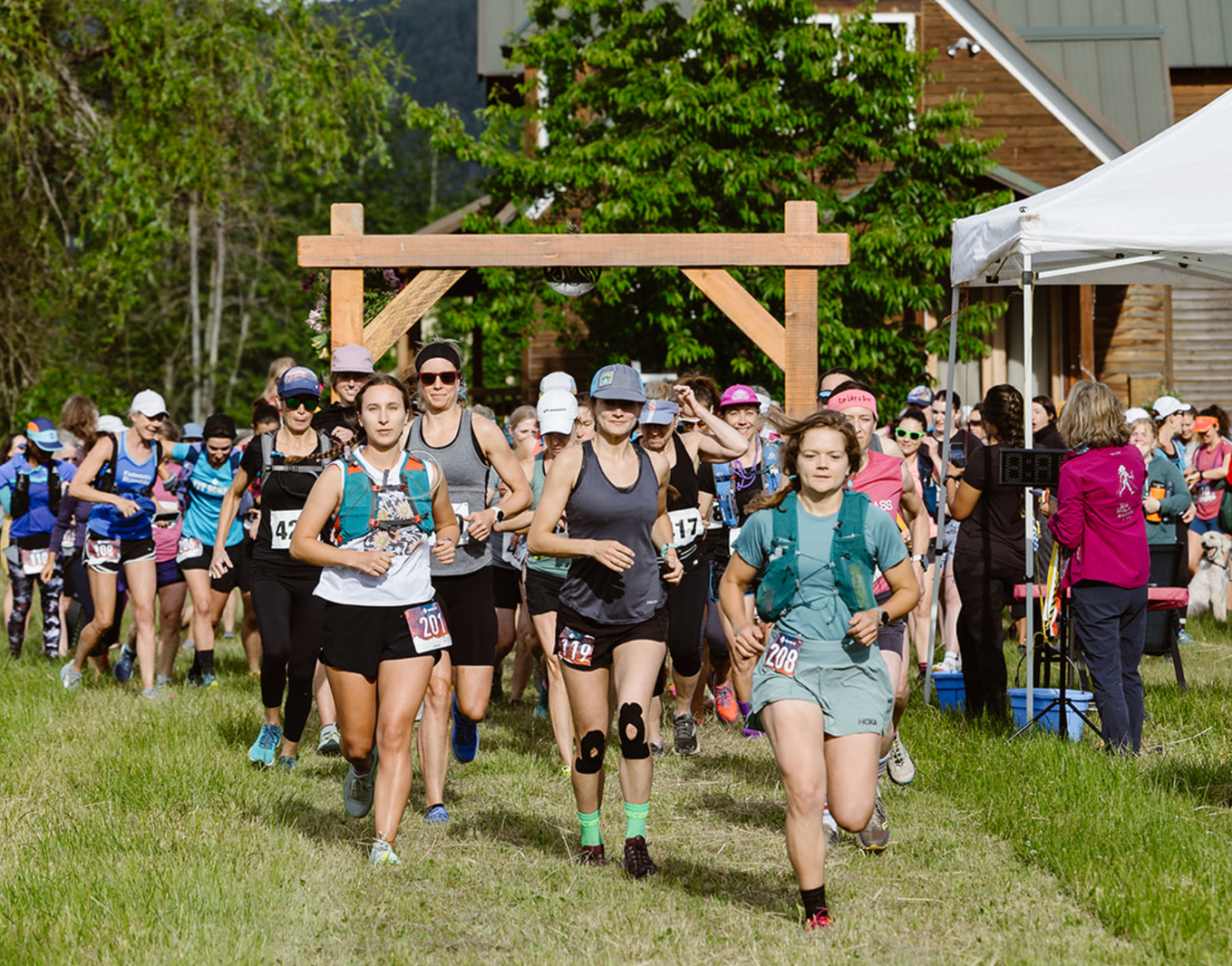
Trail running meets us where we are. For some, running a single mile is as momentous as running 100.
I like to think of milestones as turning points. A point in time at which your mindset transitions from “I don’t think I can do that” to “What else am I capable of?” I wanted to know not what their first milestone was, but how reaching the first one made them feel. The general consensus? Empowered. I think it best to just pull a few direct quotes.
“Amazing. I went from smoker to first marathon in a year.”
“I was so elated and filled with joy the first time I ran a whole mile without stopping. I was always told I couldn’t because of my asthma or knee issues when I was young, so running a mile was huge. Then I ran 5k and was in shock. Then 10k. 13.1, 25k, most recently 50k. I’m just in awe that I can do this.”
“I felt like I had great worth. My broken imperfect body was able to accomplish more than produce babies and be a physical outlet for an abuser. I feel at every new milestone I rise higher and farther away from the years I was in that situation.” *
“It was exhilarating. For me it was running my first mile. I still remember all the details except how long it took me!”
“I don’t know that I counted many milestones until I ran my first half marathon – and did so faster than I thought possible. That wasn’t until I was 36 years old. Then, I realized that all of my self-limiting beliefs were just that, beliefs – not facts. Everything after that changed.”
The empowerment we experience is what keeps us going back for more, but that doesn’t mean it’s ever easy. Every step forward is an active choice, and our internal dialogue becomes a powerful tool. How we talk to ourselves during each run can be just as defining as why we chose to run in the first place. Mantras are something to keep in the toolkit for low moments when you need to remind yourself why you’re out there. The answers to the question “Do you have a mantra?” had pretty clear themes.
Resilience
We are capable of more than we’ve ever thought possible.
Relentless forward progress.
Identity
Whatever it takes. I was born for this.
I can do anything because I am me.
Gratitude
I GET to do this, and I CAN do this. Keep going.
I’m thankful for this moment.
Defiance
I don’t stop when I am tired, I stop when I have finished.
Fuck it.
Purpose
And have you too finally figured out what beauty is for? And have you changed your life?
If not now, when?
RELATED: 10 to 100: A Program To Guide More Women into 100-Milers
Start Small, But Give Yourself a Chance
To every woman out there who is on the verge. Maybe you’re doing everything you can to get yourself out of bed, and maybe your hair is already up, your shoes are on, and your hand is on the door. Our collective advice to you is give yourself a chance.
Start small.
Walk. Then run for 30 seconds. Then promise yourself 10 minutes. Start small and build, and once you do, it will be wonderful. Baby steps are still steps, and forward motion, no matter how slow, is progress.
“You can wear what you want, look how you want, go as fast or slow as you want, and you don’t need to track it with a sports watch. Just go out and have a nice day slightly faster than normal.”
Ask yourself, What if?
One final, important note, for those of us who need it…get a good sports bra.
Some Final Personal Input
There was one final section at the very end of the survey: Please describe anything else you think might be relevant to this story. I was blown away by what contributors put in this box. It felt as if some people were opening their ribcage, baring their soul—an opportunity for the most personal diary entry. To express something they’ve surprised themselves with. Something that is true, an actual fact, of something they’ve accomplished or are accomplishing. A safe place to admit that they are in awe of themselves.
Some other things in that box that stood out to me:
- The need for more research on women and older athletes. Most research is conducted on elite men, and the results from those experiments are applied to cis-women as if we are “small men,” when we in fact need different guidelines and considerations. Diet, sleep quality, stress levels, preventative care, bone and heart scans before the age of 65, differences in blood biomarkers between athletes and sedentary people.
- The trail race director of Storm Sporting Events in Minnesota has increased accessibility for all athletes, no matter skill level or speed, by having no cutoffs at their races.
- The importance of respecting the environment and indigenous lands.
- It’s not the running. It’s about the desire to do hard things and push yourself out of your comfort zone that is the rewarding part.
- Shout out to Pocatello Running Club for the support you’ve shown one woman in her journey and making her feel like family.
- One woman convinced a group of women at her work to run with her. At first they all thought she was crazy, but then they started bringing even more people with them, and even those who moved on to other jobs started their own groups. Running is a movement movement.
- One woman, who was diagnosed autistic late in life, suffered permanent brain damage after being told to just “suck it up.” She experienced severe burnout and had to retire early at age 32. Trail running is now what brings her joy and allows her to push herself in a healthy way.
And a couple that resonated with me personally…
- Each person has a different story. Don’t worry about theirs, write your own. Find joy and pride in how far you’ve come.
- It is important to put yourself on the list of people you take care of.
Going Forward
I am very grateful for the responses I received from my survey, and I hope this can lead to next steps—both individually and collectively—to lowering the barriers for women in trail running. A handful of thank yous are in order. Thank you first to the woman who brought it to my attention that “safety concerns” needed to be included as one of the barriers to running. Thank you to the woman whose original post online inspired this entire project. And thank you, thank you, THANK YOU, to the women of ULTRA LADIES, Trail and Ultra Running **LADIES ONLY**, and all the other groups, clubs, and organizations who took the time to fill out the survey and share a piece of their soul with me. The gravity of what some of you shared is not lost on me, and I am in utter disbelief at the trust I have been shown to handle your stories with grace and respect.
No one is alone. Whether you’re looking to set a speed record on the 2,100-mile Appalachian Trail (a record that is currently held by a woman, by the way) or searching for a reason to step outside at all, there are other women out there who know what you’re feeling. You, reader, are not alone. Your community is out there. Your family is waiting for you.
(* Every woman who responded to this survey sharing their experience of having been abused has since escaped her abuser.)
RELATED: The Wit and Wisdom of Mike Smith, One of the World’s Most Prolific 100-Mile Runners
RELATED: Back of the Pack Runners are the Backbone of Ultrarunning
RELATED: Jamil Coury’s New Obsession
2 comments
Ann Bertram
Love this story, I didn’t start running until 42, when I was struggling with knee pain and walking. A physical therapist recommended ai try running, since I hadn’t done it since I was a kid due to an injury to my knee in basketball. It helped. Now my muscles are stronger and my joints are lubricated, so the joint pan is gone! My son also promoted me giving it a try, since he had started running cross country. I am now 58 and have several marathons and one 50k under my belt.
Jennifer
I’m 59-1/2 and have been running since 12. I was a multi-sporter through hs, college and running was always my time for fun or escape or fitness or peace. At 59, it’s soo different, with a different body and stamina. I’m bummed about cut-off times of some local races. I don’t want the stress of HAVING to make a tight cut-off because the stress is not enjoyable, not motivating, but would love the access to some of these unique trails a race provides. I understand the need for cut-offs, but for an older runner like me it’s a barrier to entry.