
Thirsty? Claim your free LMNT gift here with any purchase, and get your salt on!
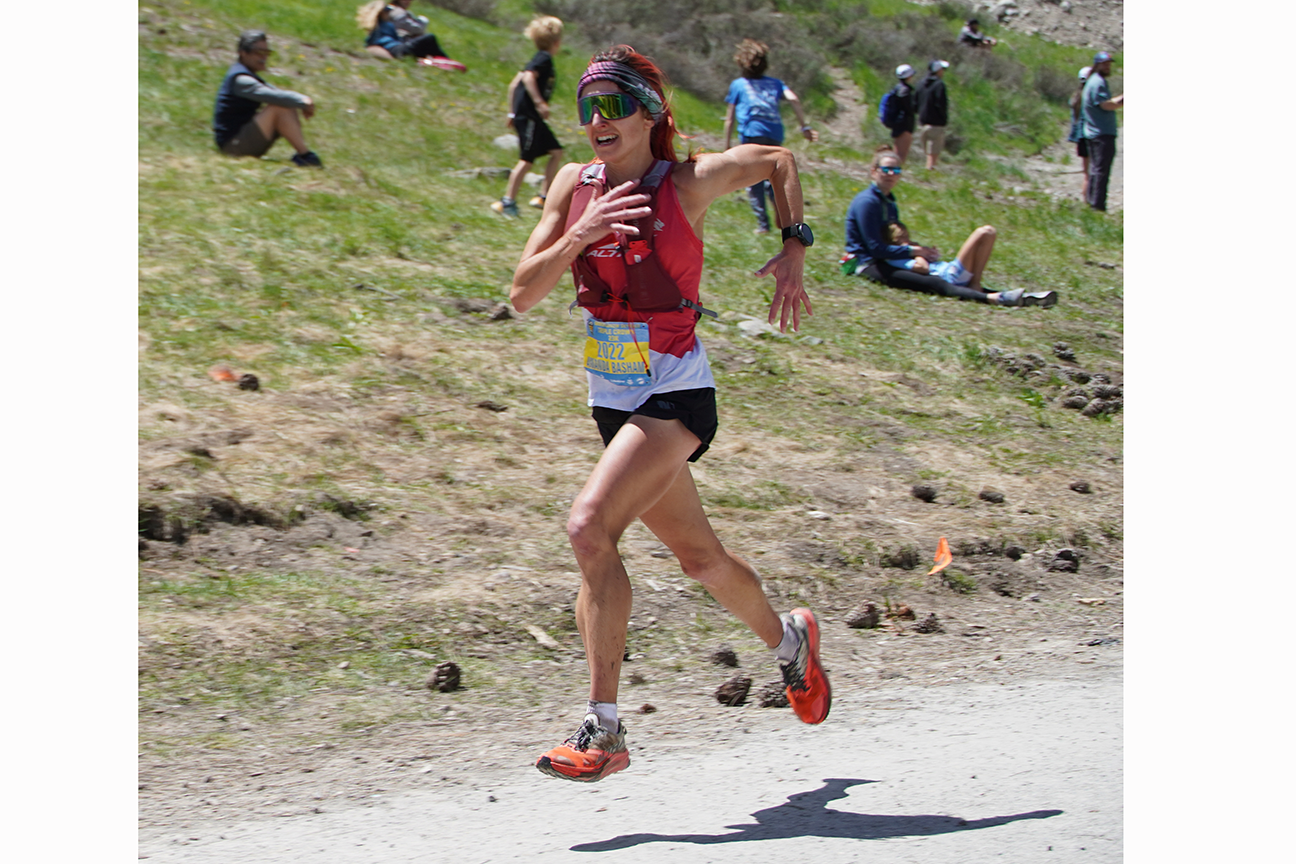
Amanda Basham talks about the first few years of becoming a mother in the same way you recount the middle miles of a 100-miler: she remembers them being difficult and overwhelming, but also wonderful … and very blurry.
“You’re just in it,” Basham says. “You figure it out because what else are you going to do?”
For Basham, an Altra-sponsored professional ultrarunner whose fourth-place finish at the 2016 Western States 100 launched her into a successful career, becoming a mother changed everything. And, at times, Basham has even found herself questioning whether or not she wants to continue racing at all. She loves running, but her perspective has expanded with two young daughters and has re-centered her sense of purpose, priorities, and time for training.
Amanda Basham will talk in depth about balancing training in a busy life on UltraSignup Live on March 25 at 5 p.m. ET. Register for free: UltraSignup Live
Breakout races and big changes
After Basham’s Western States breakout, she went on to win the Ultra Race of Champions in 2017 and 2018, secured another fourth-place finish at Western States in 2018 and then a second-place finish at the CCC 100K in Chamonix, France, in 2019. Just 29, she was running strong amid the growing surge of young female trail runners.
And then life became a fast-moving whirlwind.
She met her husband, Justin Grunewald, in January 2020 at the Bandera 100K in Texas. They hit it off, started spending a lot of time together, then a few months later, just about the time the Covid-19 pandemic hit, they learned she was pregnant with their first daughter, Rylan.
Life happens in unexpectedly beautiful and complicated ways. Basham’s ultrarunning trajectory took a hard turn as she shifted into the even more challenging world of motherhood. Still, she came back strong after Rylan was born, finishing fourth in the Speegoat 50K, but then, then a few months later, and right before the 2021 CCC 100K, they discovered she was pregnant with their second daughter, Maeve.
Postpartum and running
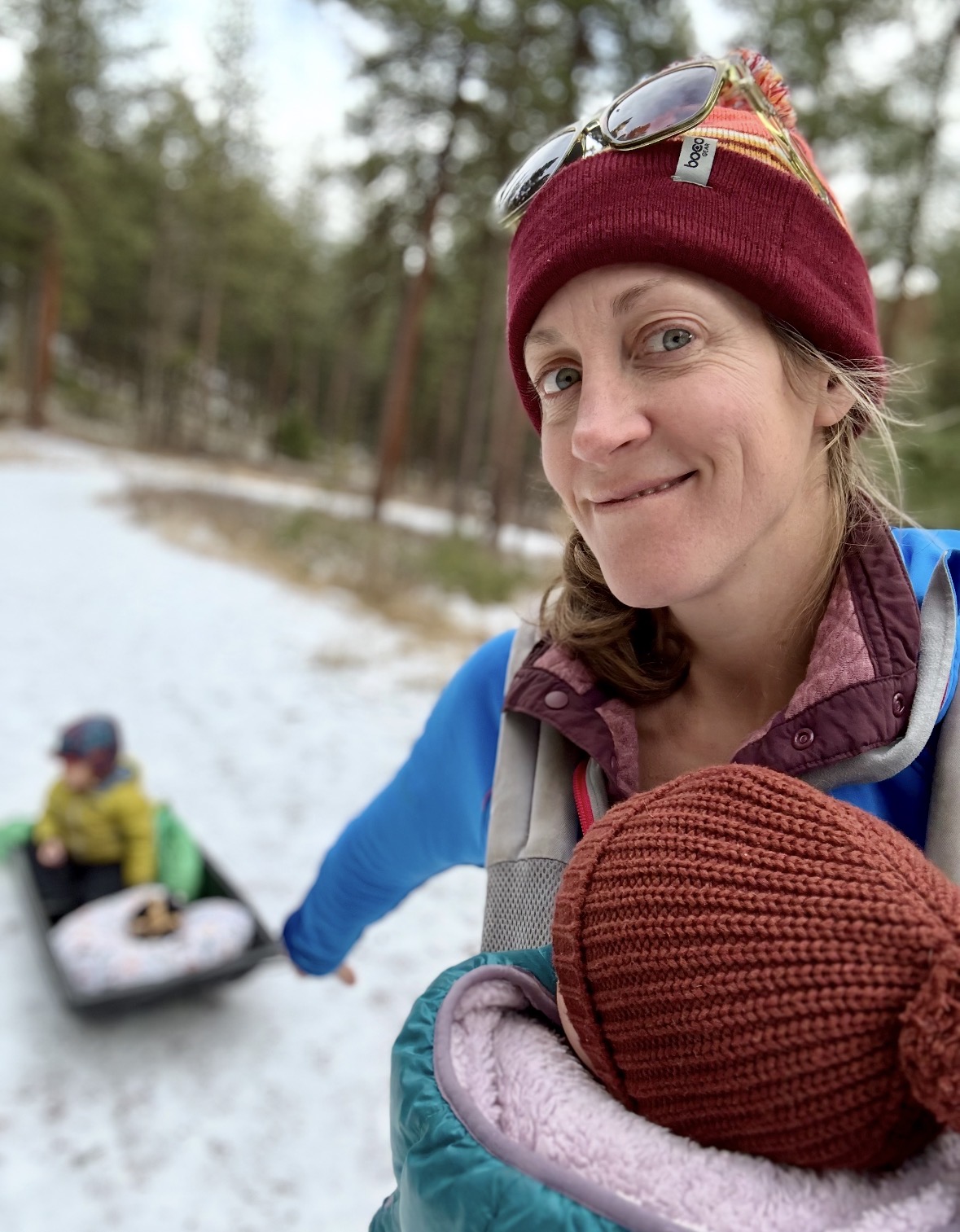
Basham found herself parenting an infant and barely a toddler who wasn’t walking yet. Grunewald traveled for work as an ER doctor, commuting to Minneapolis from their home in the foothills above Boulder for a full week every month, which meant Basham was home alone with the kids during a very difficult time.
“I was solo parenting during a pandemic up in the mountains with no childcare, with two kids who couldn’t walk at the same time because Rylan walked pretty late, and I was breastfeeding Maeve while the other one was learning to walk. I mean, I don’t know how—when I tell people this now I’m like, ‘Oh wow, I kind of forgot that it was like that.’”
Despite the circumstances, Basham says she didn’t resent her husband for it, and made the best of it as they found ways to adapt. “We tried to get him a job in Colorado, and it didn’t make sense,” she said. “He’d be gone more often and make less money.”
Instead, they approached it like an ultra: one step at a time. As in ultras, so as in life, things constantly change, and adjustments need to be made. The problem-solving skills they learned on the trail helped immensely in real life. “We’ve just worked really well together and took it day by day,” she says.
Basham’s return to training
Training through the early days was hard. Very hard.
“So many training days I was so exhausted I don’t even remember them,” Basham says. “It’s kind of like parts of an ultra where you don’t even know the 10 miles you just did.”
For Basham, and many women returning to ultrarunning after having kids, it’s a slow, often winding rebuild that can feel like two steps forward and three steps back. Rebuilding fitness after any major life transition takes time.
But her initial return was faster than expected. Basham was able to run almost immediately after both pregnancies. The first time, after her daughter Rylan was born, she took only one week off postpartum.
“The first run was literally a mile,” Basham says. “We had this one-mile loop around our neighborhood.”
Despite fitness returning relatively quickly, everything else wasn’t stacking quite right. Sleep was hard to come by (and still is), and she started experiencing extreme sacrum pain after her second pregnancy.
An MRI revealed nothing was wrong structurally and, despite hours of physical therapy, the only thing that worked was implementing a solid strength training plan.
“I started working with a strength coach,” Basham says. “And he gave me a lot of core and adductor and glute exercises. Once we started strengthening those things, the pain finally went away.”
But that was just one piece of the puzzle.
An early diagnosis
Basham is stubborn. And so she kept pushing. Pushing despite a severe lack of sleep combined with difficult training cycles and underfueling
“You’re making food for your kids and they eat half of it, so you eat the rest.” If you’ve been there too, you know it’s easy to do when you transition to motherhood.
She felt like she wasn’t doing anything well. She was putting in long hours running, doing strength and PT and feeling like she was just hitting the wall. “I wasn’t being the best version of myself and I wasn’t being the mom I wanted to be.”
So Basham started questioning whether or not she should keep running and racing at all. That’s when she went to see a doctor. And they discovered something she didn’t expect: early perimenopause.
“I’m only 36,” Basham says. “But when they explained it, it made sense. Because I kept thinking something was wrong with me.”
Progesterone and supplements have helped stabilize her energy, but Basham admits that recovery is still slow, and some days her energy still feels lower than it should.
What’s more, while she loves to run, she says she still questions whether or not she should keep racing.
Shaping her life in a way that supports training
So, Basham and Gruenwald made a few decisions to make parenting and racing easier.
First, they moved out of their mountain home into Boulder proper to make it easier to get from place to place. This not only made it easier to get out of the house with the kids, it also made it easier to just run from the door all the time.
They shifted childcare around and moved from half-time days to full-time days to give Basham more time to train and complete her own work.
“It gave me so much time back,” says Basham.
Now, she’s starting to notice she feels better. But recognizes there’s a lot of progress still to be made.
“I’m really bad at fueling,” she says. “You know when you’re making food for your kids and they only eat half of it, so you eat the rest.” And then, you forget to eat or end up eating simple carbs and other easy foods that don’t give you all the nutrients you need.
It sounds simple, but proper daily nutrition before, during and after a run is foundational for performance. Even more so when performance spans beyond the trail. … Because as a mom, you don’t ever get a real rest day.
“It’s low-hanging fruit,” Basham says, “but it’s still hard.”
How to train with little kids
Looking back, Basham says one of the biggest lessons she wished she had learned early was to accept help.
When it comes to running post kids, this is something she says she really struggled with early on. “I didn’t want to be a burden to other people so I didn’t let them help me,” she says. But, she learned to realize, if people offer, it means they really want to. And just as in ultra, getting through life often takes a village.
She sees things differently now. Even an hour of help from a friend or family member can create the space needed for a training run, proper recovery time or a mental reset.
Stroller running can also come in handy. Basham says she did “quite a bit of stroller running” after her first daughter was born. But after her second? Not so much, “Maeve would last 10 minutes and then she wanted snacks or to get out, so it would take hours to get a few miles.”
Eventually, Basham moved to the treadmill for simplicity.
Bottom line? Basham says flexibility is the most important skill to training with kids. Learning to adapt is essential.
Racing now and into the future
Before kids, Basham admits that competition was her driving force for running races. Not anymore. These days, racing is more about personal challenges than racing against other people.
She’s continued to put up strong results over the past several years, including an 18th-place finish at Ultra-Trail du Mont-Blanc in 2023 and winning the three-race Triple Crown (Ascent, 23K, 46K) at the Broken Arrow Skyrace each of the past two years.
Maybe it’s her stubborn nature that keeps her going, or the fact that she still has more to prove to herself. When it comes to races, Basham never thinks about quitting. To her, ultrarunning is a test of personal strength and endurance more than it is about racing anyone else these days,
“I know I can do it, and I have no ego. I can get 40th place even though I came here to win and it’s not going to embarrass me,” she says.
And throughout all of last year when every day was a struggle, Basham never once thought about quitting a race. “I might be having a terrible day,” she says, “but I’m still going to get to the finish line.”
She’s still concerned about whether or not she should keep going.
“I’ve always been more competitive with myself versus other people. I can look at it like, well, 2026 is going in a better direction than 2025.” And for Basham right now, that small amount of progress is enough to give her hope.
In ultrarunning—like motherhood—you keep moving forward even when you don’t have all the answers and the finish line isn’t clear, trusting that the next mile (or the next day) might feel a little easier. You’re just in it, and you figure it out as you go.
Contributing writer Ashley Arnold is an ultrarunner and the former director of brand at Fleet Feet who lives in Missoula, Montana, with her husband and two young children. She tells stories through video, words and photos, and is most at home running trails, adventuring in wild places with her family and sipping coffee while eating cake.
Did this article make you thirsty? Claim your free LMNT gift here with any purchase and get your salt on!
RELATED: 10 to 100: A Program To Guide More Women into 100-Milers
RELATED: The Importance of Identifying and Lowering Barriers for Women in Trail Running
RELATED: The Wit and Wisdom of Mike Smith, One of the World’s Most Prolific 100-Mile Runners