Why we all should embrace each trail’s distinct “terroir” — its particular smells, textures and character.
One of the things I love about trail running is the sense of place. Moving through a landscape at the speed of me is my favorite way to get acquainted with it.
I run the same stretch of local BLM land in Carbondale, Colorado constantly. Eight hundred feet up. Eight hundred feet down. I know exactly where the singletrack forks from the service road, where I’ll stutter step over the same rock, where the trail follows the hills’ curves. I know where the shadows fall at nine in the morning and three in the afternoon.
The familiarity goes both ways, at least physically. Those eight hundred feet have shaped my quads, my Achilles tendon (oops). That one rock has been steadily honing my lateral agility for years.
I know how it smells after rain, when the sage fills the air. On hot summer mornings, I can smell the sun baking the iron-rich soil, the Gambel oak almost sizzling in the heat. In spring, something blooming along the trail makes it smell like walking past the perfume counter at the mall, but good. In fall, the rich smell of decaying wet leaves as the higher parts of the mountain turn white, like the mountain is steadily going grey.
It is a very placey place. With a strong sense of itself. Something that I’m increasingly drawn to as the world seems to alternate between a beige grid and an AI-generated fever dream.
I love trails, and experiences on them, with a sense of terroir.
What is the Terroir of the Trails?
In wine, terroir describes how a place expresses itself in what it grows. The soil, climate, rain, sunlight. The elevation, the steepness of a slope, which direction it faces. The people tending the vines and the choices they make. All of it contributes to something that you can taste. Well, some of us. I do not have a particularly refined palate. If you’ve ever eaten a gel and thought, “yeah, sure, citrus,” you understand the level of discernment I’m working with.
I love a trail that tastes like itself.
I love the briny air on the trails in Marin, the damp, soft underfoot, the smooth, windswept grass that gives very little indication of how heinous the weather can get. I love the mossy, vegetal smell of the Pacific Northwest trails, the air thick with water and growing things, the wet wood and soft give of the peaty ground.
I love the trails in Northern New Mexico, the sandy loam that infiltrates even the tightest shoes, like the trail insists on following you home. Sage, pine, and the sound of magpies.
I love the warm, sandy smell of the Sierra, where sunlight hitting a ponderosa fills the air with something like vanilla, mixed with warm granite. Bath and Body Works could never.
I love my home trails in Arkansas, which smells like wet leaves, wet rocks, wet dirt, wet socks. There’s a strong sense of place, and it is moist.
One of my fears as trail running grows, which I want it to do, is that we’ll get better at recognizing the aesthetic and worse at recognizing the place. In our enthusiasm for protecting “trail culture,” we can overlook what makes any particular culture—its own ticks and quirks, its terroir- unique.
I work in running media, where we’ve gotten considerable mileage out of “small person, big mountain.” It’s a good image. I like it. I have been the small person. But after enough repetitions, the mountains start to look interchangeable. I want to arrive somewhere and still be surprised by it, give a place a chance to exceed whatever idea of it I brought along. I worry about the trail-running equivalent of elbowing through the Louvre so we can all take the same selfie with the Mona Lisa, then leaving with not quite enough photographic evidence to not feel dead inside.
Some of my favorite trails are difficult to photograph compellingly. There’s a lot of scrub, an unremarkable hill. I can wax poetic about my favorite switchback, but by then someone has posted a drone shot of the Dolomites.
A few years ago, borrowing from coffee tasting journals, I made a tasting wheel for trails. It had axes for technicality, steepness, forest, solitude, exposure, and pizza proximity. Filling it out helped me pay closer attention to what I liked, appreciated, and noticed about a particular trail. It gave me a vocabulary beyond “beautiful” or “hard,” which can describe a lot of places while telling you very little about them.
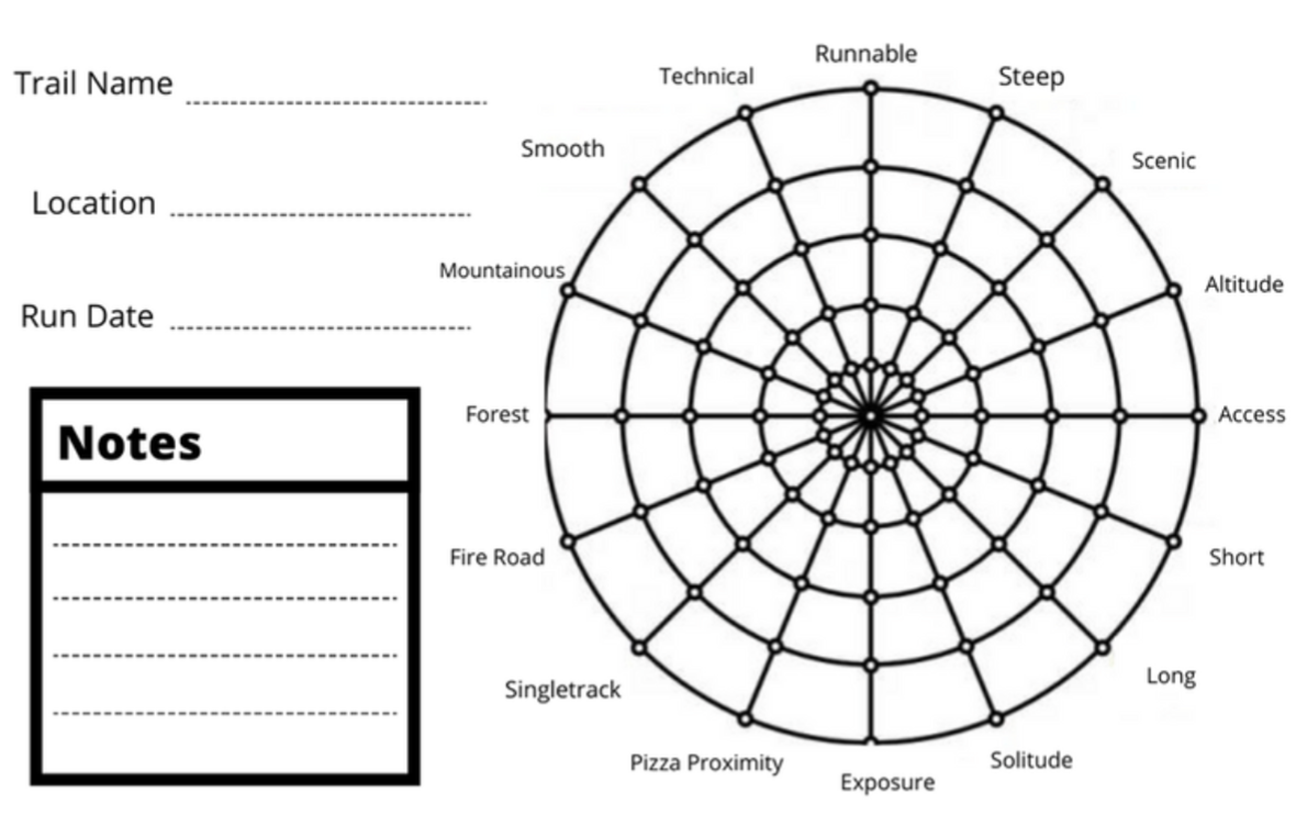
A trail could be short, smooth, accessible, and conveniently located near lunch. Another could be steep, remote, and actively hostile to forward progress. Over time, I could also learn to appreciate qualities I hadn’t initially gone looking for.
Coffee tasting journals helped me think about those differences, which makes the sameness of so many coffee shops feel especially strange. You can travel a long way and arrive at the same pale wood, exposed concrete, carefully placed plants, and minimalist signage. The details tell you what kind of establishment you’re in, but very little about where you are. A business built around the distinctive character of something grown in a particular place can end up looking like it could be anywhere.
I worry about that happening to trail running. About becoming so fluent in the shared aesthetic that we lose a tactile connection to the place beneath it. That we’ll arrive somewhere new already knowing which parts we’ll photograph and how we’ll describe what happened.
I don’t want to keep trail running small. I want more people to have the chance to develop these attachments, and to bring their own tastes and traditions with them. As the sport grows, I hope we make room for more versions of it: different landscapes, different race traditions, different ideas about what makes a run worth doing.
We can share what we love while leaving room for unfamiliar things to become somebody’s favorite. I want to arrive at an aid station and encounter something that belongs to the people who put it there. I want to run somewhere new and have to find new words for it, and in truly trying to taste the terroir, expand my palate.
Tomorrow I’ll go back to my usual stretch of BLM trail. Eight hundred feet up. Eight hundred feet down. I know where the rock is. I’ll probably still stumble over it. Depending on the weather, there’ll be sage, or hot dirt, or evidence of cattle.
I’ll come home with a little more of the place in my shoes.

More Writing from Zoë Rom
- Get to Know the Terroir of the Trails
- The art of accepting abject failure and moving on
- The Art of Taking Running Seriously, But Not Too Seriously
- Closing the Gap Between Ability and Ambition

- Nine Lives: My Life in 9 Transcendent Pairs of Shoes
- Go Touch Some Grass