
You need stones to run UTMB. Literally.
No, not those kinds of stones. And not rocks, either. You also need an index. But not the kind at the end of a textbook.
Alright, let’s start over.
UTMB is known for beauty, challenge, and competition, not for simplicity. Runners looking to participate in the iconic 106-mile race spanning 3 countries and gaining more than 32,000 feet might find the race a piece of cake compared to the entry process.
If your goal is to test yourself on running’s biggest global stage (and you’re not an elite athlete with guaranteed entry or willing to pay €2,000 for a charity bib), all your hopes come down to the lottery. To enter that lottery, you’ll need the two things: Running Stones and a UTMB Index.
Don’t worry, we’re here to break it down for you.
What is UTMB?
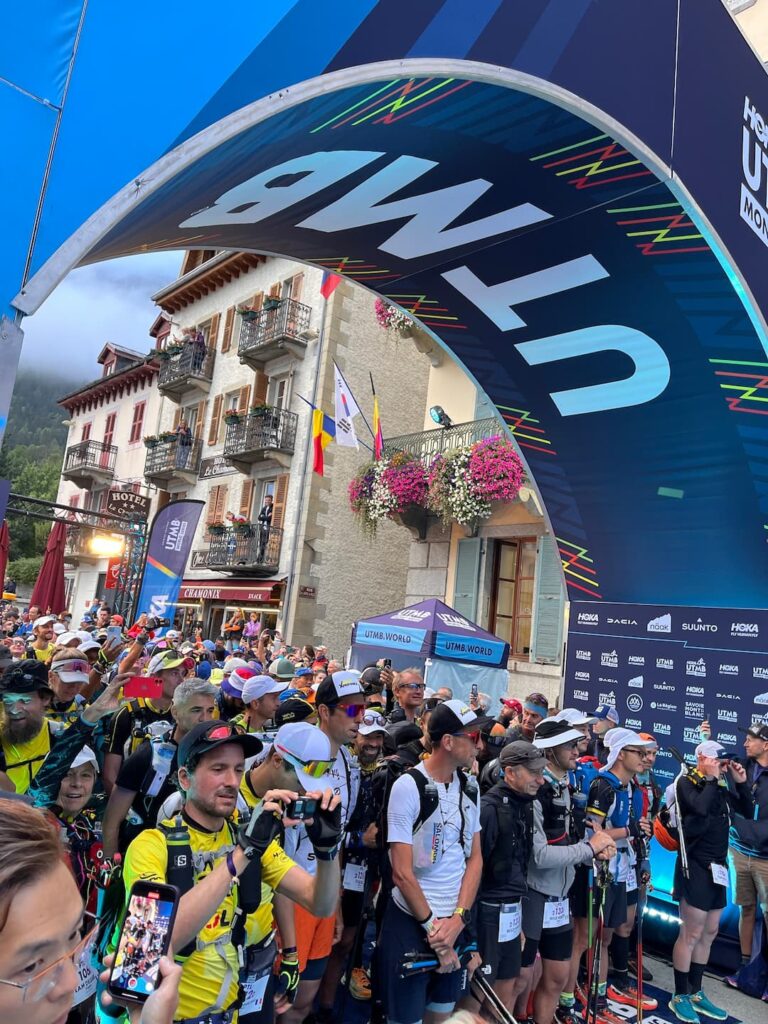
UTMB often refers simply to the 106-mile Ultra-Trail du Mont Blanc—the race/party that kicks off each year at the end of August and ends in Chamonix in the French Alps. However, UTMB is also a behemoth global trail running organization that hosts trail races around the world.
To understand the convoluted world of UTMB, it helps to break it into bite-sized pieces:
- UTMB World Series refers to every race at which finishers can get at least one UTMB stone (the number of stones depends on the race distance—more on that soon). In 2024 there were a total of 43 events around the world, with eight of those races in North America. All UTMB World Series races are organized by UTMB—except for the Western States Endurance Run, which is independently run.
- UTMB World Series Majors are 3 races UTMB chooses every year—one each from the Americas, Europe, and the Asia–Pacific region—as their “pinnacle events.” They’re usually particularly iconic and gorgeous courses, but the key takeaway is that a finish in any major will earn double the stones as in non-major races.
- UTMB World Series Finals are the three races held at the end of August or early September and ending in Chamonix. They are the 106-mile UTMB, the 100K CCC, and the 50K OCC.
- UTMB Index Races are any of the thousands of races that earn a UTMB Index score. Keep reading to learn what that means.
What are UTMB Running Stones?
Now that we understand the wide world of UTMB, how do you enter the lottery for one of the Finals? The first thing you need are Running Stones.
Running Stones are essentially lottery tickets, and each stone is one entry into the lottery. They are cumulative and have no expiration date, so the more stones you have, the higher your chances of winning the lottery and entering your chosen race.
You get Running Stones by finishing UTMB World Series races. The number of stones you are awarded depends on the race distance:
- 20K = 1 stone
- 50K = 2 stones
- 100K = 3 stones
- 100M = 4 stones
To get the most bang for your buck, run a UTMB World Series Major. That way, you get double the stones. So rather than four lottery entries, a UTMB Major finish in the 100M category would give you eight lottery entries.
The only catch is that at least one of your stones must be from the last 24 months to enter the lottery—no resting on that one awesome 50K from five years ago.
Where Does the UTMB Index Come In?
The UTMB Index is essentially the result of an algorithm judging your running ability. It’s Skynet for runners.
Each runner’s Index Score race is based on their finish time for a given course. UTMB then compares the course to other index races, using distance and elevation change to identify similar races run by other competitors in your original race. They then compare your time to other finishers and assign you a number.
Your Index Score must be in a race distance that’s at most one category below your desired distance. If you want to run the 100M UTMB, your Index has to be in either the 100M or the 100K distance. A 50K won’t cut it.
Clear as mud? Don’t worry, it doesn’t actually matter what your score is as long as you have a “valid score,” meaning your last Index race was within the last 24 months. If your last Running Stone is less than 24 months old and your Index is in the same distance or one distance shorter than the race you’re entering, you’re good to go.
There are thousands of Index races around the world, and you can use UTMB’s search tool to find local races that qualify.
Is That It?
Pretty much. If you want to participate in the world’s biggest running party, just sign up for a UTMB World Series race, get a stone or 30, and toss your name in the hat.
And if the expense of jet-setting around the world to gather stones is too much, you can always fork out the €2,000 and get yourself a charity bib. But beware—they sell out fast.
Read the full series:
The Demystifying Series: How to get into Western States Endurance Run
The Demystifying Series: What is the Golden Trail World Series?
The Demystifying Series: How to get into the Hardrock Hundred Endurance Run
RELATED: The First Running of Ultra-Trail du Mont-Blanc. Part Two
RELATED: The First Running of Ultra-Trail du Mont-Blanc
RELATED: The Demystifying Series: How to get into the Hardrock Hundred Endurance Run



2 comments
Norbert
I thought I understand but I do not 🙂 I ran a 15km race which I found to be a UTMB index race. It was not a 20K category though, but a blue colored one. I thought it will give me a score but it did not happen. The result just popped in and no index score.
So I do not really understand what is the role of these races if (the blue ones) if you do not get an index.
Jerry Nairn
It would be awesome if I could look up UTMB stones races on ultrasignup.