
Last year, I signed up for a race I’d never heard of, in a place I’d never been, with a course map that looked like it was drawn by a caffeinated toddler. And honestly? It was one of the best decisions I’ve made in a long time.
It was a 75-mile loop through the Chianti hills—123 kilometers, to be exact—and what hooked me was the distance itself: smack dab between a 50-miler and a 100. What would that feel like? A really hard 50? A breezy 100?
TL;DR: Running 75 miles through the Italian countryside feels like nothing else. But I can confirm, it’s definitely not a 50, and it’s definitely not a 100. But the abundant presence of rich, red wines at the finish line certainly helped to dull the particular pain of running for 15 hours.
There’s something electric about stepping into the unknown. No benchmarks, no expectations, no pressure to beat a previous time, just pure discovery. You don’t know where the aid stations are. You don’t know when the next climb will hit. You barely know where the heck you are. But your brain is lit up like a switchboard, your senses sharp, your feet finding new rhythms.
That’s exploration. And it’s one of the most underrated performance tools in your training toolbox.
Curiosity as a Training Strategy
We love a routine. Runners, especially. Wednesday hill repeats, Saturday long runs, a favorite loop that somehow always ends at your favorite coffee shop. Predictability is comforting. But when it calcifies into rigidity, that comfort can turn into complacency.
Exploration, by contrast, introduces variability, excitement, and adaptability—the holy trinity of endurance success. New routes teach your body to respond to shifting terrain. New races stretch your mental and logistical flexibility. Even a spontaneous detour mid-run can jolt you out of autopilot and reawaken your love of movement.
I recently interviewed Alex Hutchinson for an episode of The Trailhead podcast, author of The Explorer’s Gene: Why We Seek Big Challenges, New Flavors, and the Blank Spots on the Map, about the value of exploration and how we could all benefit physically and mentally from seeking the unknown. In the book, Hutchinson explores the science behind our urge to push boundaries, tracing it from the early days of human migration to the modern obsession with FKT boards and novelty races. He argues that exploration isn’t just about geography, it’s about curiosity. It’s a mindset, a behavioral trait, even a performance enhancer. And it’s not limited to extreme adventurers or polar explorers, it shows up in everyday choices, like picking a new trailhead or trying a new gel (just don’t do it on race day).
What Hutchinson makes clear is this: the urge to explore isn’t frivolous, it’s functional. It fuels adaptability, sparks creativity, and can even protect against mental stagnation and burnout. In other words, exploring new terrain, whether physical, psychological, or both, might be one of the most sustainable ways to grow as an athlete and a human.
It’s not just good for your legs, it’s good for your brain. Novelty lights up the dopamine system, boosting motivation, learning, and that elusive sense of “hell yes, let’s do this.” Research shows that trying new things can fend off burnout, enhance neural plasticity, and build resilience to stress. It’s like sodium bicarb for the soul.
In other words, exploration is basically cross-training for your hippocampus. (And let’s be honest, mine spends half its life glued to a screen and could definitely use a little CrossFit energy.)
Exploration as Identity Expansion
Trying new things isn’t just about chasing peak performance. It’s about rewriting your internal story of what kind of runner you are. Maybe you’ve always thought of yourself as “not a technical runner,” or “someone who only runs roads,” or “a mid-packer who doesn’t podium.” But what if all that was just… outdated data?
As Rebecca Solnit writes in A Field Guide to Getting Lost, “Getting lost was not a matter of geography so much as identity, a passionate desire, even an urgent need, to become no one and anyone, to shake off the shackles that remind you who you are, who others think you are.”
Our routines, no matter how well-meaning, become stories we tell ourselves about who we are. And that’s not inherently bad; we need some scaffolding to get up, get stuff done, and keep our lives from unraveling. But over time, that structure can harden into a kind of spiritual thundershirt: comforting, sure, but also constraining. It shields us from uncertainty and, in doing so, from the undiscovered parts of ourselves that only emerge in the wild, weird margins of routine. Sometimes, getting physically lost is what cracks things open. Exploration in the external world becomes a spark for inner rewiring, a way to loosen the grip of old identities and make space for something stranger, softer, more true.
It’s about giving yourself permission to be someone different, or no one at all, just for a little while. And in that space, in the blank spots on the map, you might find a version of yourself you actually like better.
Exploration is how we evolve. It’s how we ditch old labels and trade up for something bigger, wilder, more true. Because here’s the thing: you’re not some static character in a story with a tidy arc and a predictable ending. You’re a living, sweating, stumbling, learning organism with untapped potential, if you’re willing to get a little lost now and then.
Solnit writes, “To lose yourself: a voluptuous surrender, lost in your arms, lost to the world, utterly immersed in what is present so that its surroundings fade away… To be lost is to be fully present, and to be fully present is to be capable of being in uncertainty and mystery. And one does not get lost but loses oneself, with the implication that it is a conscious choice, a chosen surrender, a psychic state achievable through geography. That thing the nature of which is totally unknown to you is usually what you need to find, and finding it is a matter of getting lost.”
The word lost comes from the Old Norse los, meaning to disband one’s army. I love that—this idea of a general laying down arms, breaking formation, and heading home not in defeat, but in quiet surrender. To get lost is to disarm yourself. To call a truce with the way things are. It’s not about being aimless, but about stepping off the path, on purpose.
When my brain feels stuck, and my thoughts feel like they’ve been retracing their steps up and down the same cognitive singletrack, I’ll drive to my favorite trailhead. And instead of taking the well-worn left turn, I’ll go right. The trail still winds through the same dusty hillsides of scrub oak and sage, but the angle of the light is different. The view shifts just a few degrees in the zoetrope. The breeze brushes a new cheek. Small things. But somehow enormous enough to shake something loose. To make the familiar feel new again.
I’m not lost, exactly. But I’m not exactly found either. And maybe that’s the sweet spot—the in-between space where disorientation outside makes room for clarity inside. Where stepping off the map lets you stumble into some part of yourself you hadn’t met yet.
So take the trail you’ve always avoided because it looked “too weird.” Sign up for the race that gives you butterflies (in a good way). Order your favorite dish Thai-hot (just not before a run). Hike instead of hustle. Hell, throw in a cartwheel. No one’s watching. Or if they are, they probably wish they had your guts.
The best runners aren’t always the fastest. But they are often the most curious.
See you out there, hopefully somewhere new.

Read More of The Aid Station By Zoë Rom
- An Immaterial Gift Guide For Runners
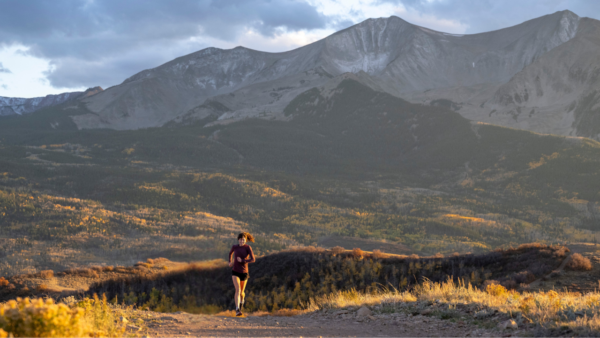 Holiday gift guides are inescapable, insufferable, and mostly useless. So instead of hawking stuff you don’t need, here are eight immaterial gifts every runner should put on their wish list this season.
 - How To Build A Race Season Without Burning Out
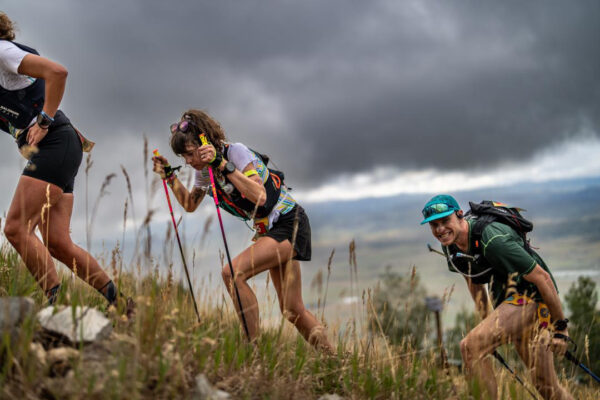 Building a race season is like pacing an ultra: if you go out too hard, you’ll blow up before the finish. Start conservatively. Trust the process. Give your body the recovery it needs to adapt.
 - The Space Between Seasons
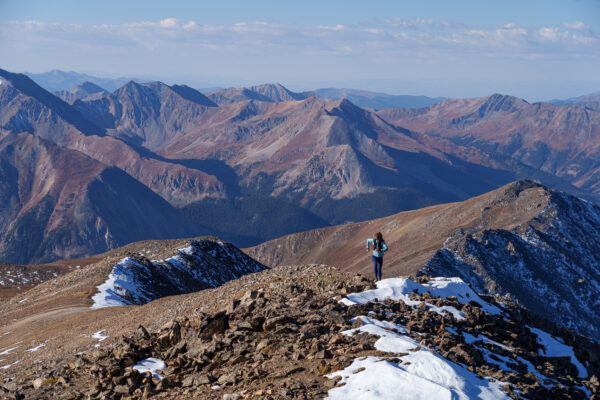 After crossing the finish line of my big 100-mile race this summer, I expected pure joy. Instead, I found myself in that quiet, disorienting space that comes after a big goal—the moment when purpose fades and rest feels strange.
 - Do You Remember Your First Mile?
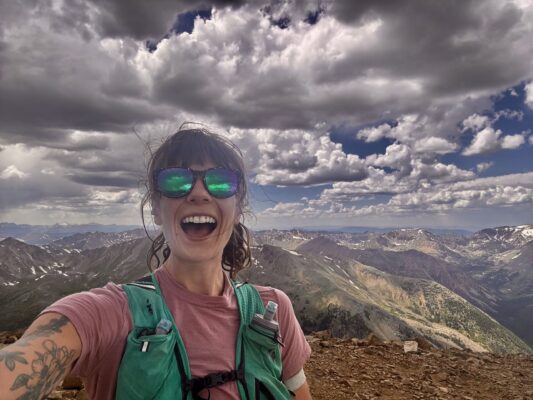 So if you’re stuck, plateauing, or overwhelmed, pause and ask: What was your mile one? Your mile ten? What did it take to get there? And what would it feel like to carry that same raw belief, or disbelief, into the next big thing?
 - I Almost Forgot This Was the Whole Point – What a 48-Minute Mile Taught Me About Joy
 One mile. Forty-eight minutes and sixteen seconds. A personal worst, possibly. A dark PR. What was I doing with my life?
 - Ability Agnostic: Because Caring is Cool
 Being ability agnostic means giving yourself the kind of care you’d give a Real Athlete™, because, plot twist, you are one.
2 comments
Luke Marshall
Fantastic. Thanks you!
Scott Sedlik
Completely agree Zoe! I approach my running and training as journeys in exploring the world. Trying new places, trails, experiences are all part of that discovery process vs a strict regimen on track and road workouts. BTW can you share the Tuscany race/trail?