
From packing, planning, and prepping, here’s everything you need to know to get ready for your first, or your next stage race.
Stage races are part ultramarathon, part expedition, part traveling circus. Each day brings a new start line, a new stretch of trail, and a new set of logistics to navigate, tents, drop bags, gear, meals, and recovery all while you’re slowly running yourself into the ground.
The running itself is only half the work. The rest is planning, packing, and adapting on the fly. “These races are crazy logistically,” says writer and multi-time TransAlpine finisher Nick Triolo. “Doing all the homework on stage profiles, accommodations, bag shuttling, well in advance can really make for a more relaxing experience come race week.”
Whether you’re headed to the Alps, the desert, or the jungle, the same rule applies: the more dialed your systems are, the more room you’ll have to actually enjoy it.
Here’s how to prepare.
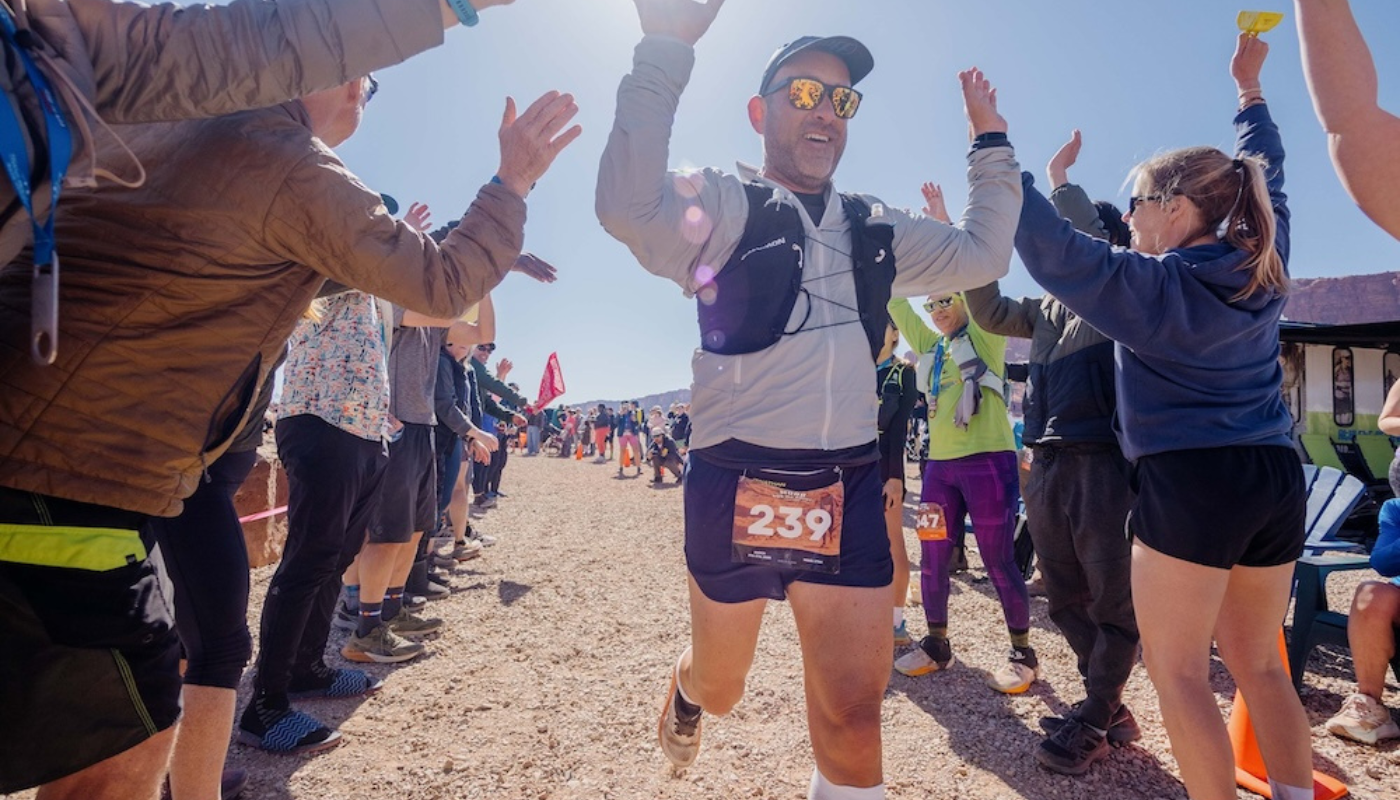
Photo of Moab Run the Rocks by TransRockies Running
Know What Kind of Stage Race You’re Signing Up For
Every event runs on its own ecosystem of rules, comforts, and chaos. Some stage races, like Marathon des Sables, require full self-sufficiency where runners carry all their food, clothes, and sleeping gear for the week. Others, like TRAVERSE Tanzania, are all-inclusive, with tents, luggage transport, and hot meals waiting at camp.
“The key is knowing exactly what the event provides,” says Brett Harrison, who directs TRAVERSE. “Some stage races are stripped-down; others are luxury. But in either case, runners should bring the personal items that keep them comfortable, shoes they trust, a solid foot-care kit, maybe a recovery food they love.”
Harrison’s team handles everything from tent setup to hot coffee and cold beer. But he says, even in the most organized events, small mistakes add up fast. “Not reapplying sunscreen, letting a hot spot turn into a blister, or neglecting hydration will end a race faster than tired legs,” he says.
Meanwhile, in the American Southwest, Steve Aderholt, race director for the Cocodona 250, sees runners underestimate just how much coordination goes into each day. “Expect the unexpected,” he says. “From time to time, what you expect at an aid station, food, drop bags, whatever, might not be there. If there’s an item that would ruin your race if it’s missing, carry it with you.”
👉 What Is A Stage Race? We can answer that.
👉 Here’s everything you need to know to train for a stage race.
The Packing Equation
If ultrarunning is about minimalism, stage racing is about precision. You don’t need more stuff — you need the right stuff, in the right place, every single day.
“Most runners don’t train with their full race pack setup,” says Aderholt. “That can have disastrous effects. When you’re tired, any small barrier between you and food or water can cause a major issue.”
Test everything you plan to carry, from your hydration vest to your blister tape. Practice where things live in your pack so you can find them in seconds when you’re thirsty, tired, bonking, running in the dark, or all of the above.
Overpacking is common, especially for first-timers. “People bring gear like they’re solving every problem in advance,” says Harrison. “But you can’t insulate yourself from discomfort. The best approach is simple and familiar. Bring gear you know and trust, pare it down to the essentials, and let the race environment shape the rest.”
Bringing too many “emotional support” items, as tempting as it may be, might actually be less safe. Weight adds up fast, and before you know it, seventeen Snickers bars, space blankets, and a puffy vest might make it harder for you to find the gear and food you actually need. Decide what you really need to carry, and how you’re going to carry it. If you can, pack heavier or bulkier items at the back and bottom of your pack, and lighter items near the top, with things like a shell that you might need to snag quickly.
His non-negotiables? “A foot-care kit, I’ll say that twice, and a few small comforts that make you happy,” he says.
John Hardin, who directs the Cumberland Plateau Stage Race in Tennessee, agrees that a bit of over-prep is better than the alternative. Before each of his events, he gathers participants for a pack review. “We go through every item together and talk about its purpose,” he says. “Some things people don’t want to give up, you should have a few custom comforts. But follow the suggested list closely, and always bring anything you truly think you might need.”
Hardin’s must-haves include toilet paper, Benadryl (“I’m allergic to bees”), and plenty of lube. “And a water filter,” he adds. “Always bring a water filter.”
Self-Sufficiency vs. Support
Knowing what the race provides, and what it doesn’t, is one of the most important forms of prep. Make sure you’ve read through any available literature like a runners’ guide, and reach out to the race organizer if you have any questions. Connecting with athlete’s online who have run the race in previous years can be helpful for getting beta, too.
Aderholt says, “Balance what will ruin your race versus what would ruin everyone’s race. If a race fails to provide water, that’s everyone’s problem. But if you must have a Snickers bar to get through an aid station, that’s on you. Bring the Snickers bar.”
In other words, carry your emotional support snacks, your favorite gels, and the one electrolyte drink that doesn’t destroy your stomach. Stage races often restock aid stations daily, but conditions change. In hot, remote, or international locations, supply chains can be unpredictable.
Harrison’s TRAVERSE has aid stations every ten kilometers stocked with fruit, chocolate, hydration mix, and local favorites like avocados and handmade energy bites. But even he encourages runners to take ownership of their systems. “We take care of the logistics so runners can focus on what matters, running, recovery, and community,” he says. “But comfort looks different for everyone.”
Managing the Move
Each day of a stage race is a logistical dance: packing up camp, catching shuttles, retrieving drop bags, setting up recovery spaces. Aderholt recommends creating a checklist system, one for morning prep and one for post-stage recovery, and laminating it or taping it to your duffel.
The morning list might include tasks like taping hot spots, refilling soft flasks, restocking gels, reapplying sunscreen, and getting your duffel to the luggage truck before the cutoff. The post-stage checklist should cover recovery priorities: eat within 30 minutes, rehydrate with electrolytes, soak or stretch, clean and treat feet, charge watches and headlamps, make sure your gear and shoes are dry as much as possible, and lay out the next day’s kit before dinner.
Triolo, who calls stage races “a self-care festival disguised as a run,” adds that how you transition between stages is just as important as the running itself. “The second you finish, it’s like a pit stop,” he says. “Eat immediately, soak in cold water, and start recovery. The next day starts the moment today’s stage ends.”
That rhythm becomes the scaffolding for your week. Harrison says that for most runners, the moment they learn to flow with the race, to accept the repetition, is when it becomes fun. “Once people stop fighting the routine, the whole event starts to feel like camp,” he says.
Recovery
The most important part of your stage race might be how well you recover between stages.
“Recovery is the cornerstone of stage racing. Athletes need to refuel quickly, rehydrate effectively, and prioritize sleep and mobility. We practice this during simulation weekends and every day training: have your recovery nutrition prepped and dialed, get horizontal as soon as possible, and avoid the temptation to stay ‘busy’ after the run,” says Pittman.
Make sure you use training to hone in on the recovery modalities that work best for you. Practice your post-run nutrition, hydration, mobility, and chillaxing so that when you get to the stage race, your routine is dialed in. The most successful runners treat those hours like part of the race itself, managing food, hydration, and sleep with the same discipline they bring to pacing.
“Recovery starts mid-race from a fueling perspective,” says Pittman. “If you finish an early stage in a big deficit, whether it be too low on carbohydrates or poor hydration status, that impacts how adequately you recover.”
Start with a plan for the finish line. Pack recovery nutrition and fluids where you can grab them immediately after crossing, think a pre-mixed bottle of carb drink, a small sandwich, or even a thermos of soup. Changing into dry clothes right away keeps body temperature stable and helps prevent chafing or skin irritation that can spiral over multiple days.
At camp, small comforts pay off big. Bring a lightweight recovery mat or inflatable pad so you can lie down anywhere, and a small towel or buff to wipe dust and salt off your skin before crawling into your sleeping bag. A cheap plastic basin or foldable bucket doubles as a foot soak, laundry bin, and morale booster. Runners who sleep well recover better, so earplugs, an eye mask, and a pillowcase stuffed with spare clothes (or maybe even a nice pillow) are worth their weight in gold.
In hot or high-altitude environments, recovery means cooling down and rehydrating before you eat. In cold climates, it means layering up fast and getting calories in early. Either way, organization beats improvisation: lay out your next day’s gear before dinner, refill soft flasks and charge devices, then get horizontal.
Most stage racers say their best recovery secret isn’t a supplement or device, it’s routine. The more automatic your post-stage ritual becomes, the less energy you waste deciding what to do next. That’s the real win: turning recovery into muscle memory so your body can focus on what it came to do, run again tomorrow.
Stay Flexible
Even the best-laid plans will fall apart at some point. Bags get lost. Tents leak. Meals run late. “Expecting chaos is part of preparation,” says Hardin.
Aderholt’s advice for low moments applies to logistics too: the “three-hour rule.” When things go wrong, fix what you can, eat something, and wait. “If you take care of yourself, food, water, electrolytes, slow down, the situation usually turns around,” he says.
The runners who thrive in stage races aren’t necessarily the fittest; they’re the most adaptable. “Stage races reward curiosity and flexibility,” Triolo says. “You learn to solve problems and stay curious about what the next day will bring.”
The Payoff
Ask any veteran and they’ll tell you: the magic of stage racing isn’t the finish line, it’s everything that happens between them. It’s waking up sore but excited, the 5 a.m. coffee line, the chatter of duct tape and blister kits, the creak of zippers and shuffling duffels.
“The runners who finish the event are not the same as those who began it,” Harrison says. “Voluntarily doing hard things changes you, and that transformation happens as much in camp as it does on the course.”
Stage Race Packing List
The essentials for keeping your week running smoothly 👇
Running Gear
- Primary shoes you’ve logged at least 100 miles in (plus a backup pair if allowed)
- Two to three pairs of socks per stage — rotate and dry daily
- Hydration pack or vest with easy-access pockets
- Soft flasks or bottles (label them with your name; they get mixed up fast)
- Hat, sunglasses, and buff for sun, dust, or cold mornings
- Lightweight shell or windbreaker for variable weather
- Trekking poles (if permitted and trained with)
Camp & Recovery
- Sleeping pad, inflatable pillow, and lightweight sleeping bag
- Earplugs and eye mask, essential for group sleeping areas
- Small towel, wet wipes, and a pack of tissues
- Plastic basin or foldable bucket for foot or leg soaks
- Recovery sandals or Crocs
- Portable charger and spare charging cables
- Headlamp + spare batteries (keep one in your duffel and one in your race pack)
- Mini foam roller or massage ball (or a lacrosse ball)
Health & Foot Care
- Foot-care kit (bandages, tape, scissors, blister pads, small tube of lube)
- Sunscreen and lip balm
- Electrolyte tabs or drink mix
- Anti-chafing balm
- Basic meds: ibuprofen, antihistamine, antacid, anti-diarrheal
- Hand sanitizer
- Hand warmers if cold
Food & Fuel
- Gels, chews, or drink mix you’ve tested in training
Recovery snacks (instant oatmeal, protein powder, or bars) - Salted nuts, jerky, or easy comfort snacks
- Reusable utensils, mug, and a small bowl if meals aren’t provided
Miscellaneous (but worth it)
- Extra zip-top bags (trash, wet clothes, snack organization)
- Duct tape wrapped around your trekking pole or soft flask
- Laminated checklists for morning prep and post-stage recovery
- Small notebook or phone notes app for tracking what works each day
Pro tip: Practice packing before you travel. The less you have to think about where things are, the more energy you’ll have for the miles ahead.