
By Jim Rutberg, CTS Coach
Heat acclimation or heat training is one of the most effective, economical, and popular training interventions for trail and ultramarathon runners. In a world where socioeconomic factors can restrict which athletes have access to the latest wearable devices, recovery tools, and high-tech gear, heat training is an accessible tool almost anyone can benefit from. You just need a hot environment, whether that’s the great outdoors, a heated room, or a few layers of warm clothing. The more nuanced aspects of heat training are scheduling heat exposures for maximum effect and determining the best time to start and end your heat training protocols.
As with so many areas of sports science and training, you can explore the basics of heat training or do a deep dive into the grittiest of details. I’m going to aim for the middle between those extremes by answering the questions CTS Coaches get most frequently about heat training.
What does heat acclimation do?
Heat acclimation is the process of adapting the body’s cooling mechanisms to overcome the challenge of dissipating heat in a hot environment. Most of the adaptations relate to sweat:
- Start sweating sooner: To stay ahead of rising core temperature, your body kicks your primary cooling system (sweat) into action earlier.
- Sweat more profusely: Your body learns to open the floodgates to get more fluid onto the skin surface for evaporative cooling.
- Sweat more evenly: You have sweat glands all over, and your body needs to increase evaporative cooling, so you’ll start sweating from everywhere.
- Retain more sodium: Your sweat glands adapt to retain more sodium and electrolytes even as sweat rate and fluid losses increase. This, along with regulation from your kidneys, helps maintain sodium concentrations in the body.
- Increase plasma volume: Your blood is what’s transporting heat from your core to your skin for radiant cooling as well as evaporative cooling. Increased plasma volume increases your capacity for heat transfer and provides fluid for sweat.
Some adaptations that aren’t related to sweat include:
- Increased oxygen-carrying capacity: This will be covered in more detail in another question, but for some athletes, heat acclimation may be similar to altitude training in terms of stimulating improvements in oxygen-carrying capacity.
- Resilience to thermal stress: Motivation to exercise, cognitive function, and decision-making abilities decline when people feel hot. Heat acclimation can reduce an athlete’s sensitivity to thermal stress, allowing them to persevere despite the heat. It’s not that they don’t feel the heat. They just learn to cope with it better.
- Confidence: Heat training can reduce the anxiety athletes experience before races that may feature high temperatures. By training in the heat or sitting through passive heat exposures, athletes gain confidence from knowing they’ve acclimated and can tolerate the heat and sustain their race pace because they’ve practiced it already in training.
How does heat acclimation improve running performance?
Heat is the enemy of endurance performance. As you’re running, muscles generate a lot of heat that must be dissipated so your core temperature doesn’t rise out of control. For optimal health and performance, core temperature is tightly maintained within a narrow range, approximately 36-40 degrees Celsius (97-104 degrees Fahrenheit). Bad things happen when athletes overheat, including confusion, agitation, slurred speech, nausea, and vomiting. And that’s before you reach the level of heat stroke, characterized by both high core and skin temperatures and often a cessation of sweating. At body temperatures above 104 degrees F people can suffer from organ damage or even die. Right from the beginning of the hellish descent to heat stroke, just at the point of mildly overheating, running performance diminishes dramatically.
Heat acclimation ramps up the body’s cooling mechanisms and adaptations that make athletes more resilient in hot environments. The adaptations listed earlier improve performance by allowing runners to adequately dissipate heat while sustaining moderate to high intensities in hot conditions.
Is Heat Training the Same as Altitude Training for Runners?
One of the most interesting new ideas in sports science is the opportunity to use heat training as “the poor person’s altitude training”. It is so termed because altitude training is typically an expensive venture, requiring a prolonged trip (3 weeks minimum) to a destination above 2000 meters elevation or the purchase of an altitude tent. In contrast, heat training can be accomplished at home with a space heater and/or a few layers of clothes.
A potential reason heat training and altitude training may result in similar increases in oxygen-carrying capacity starts with blood plasma volume. Increased plasma volume is one of the first responses to exposure to either heat or high altitude. This increase in plasma volume causes a reduction in hematocrit, which is the number of red blood cells in a given volume of blood. The kidneys are sensitive to red blood cell concentration and read the increased plasma volume as a dilution of the blood. They respond by releasing more EPO to stimulate red blood cell production, no matter whether the stimulus came from altitude or heat exposure. (Rønnestad et al., 2021; Oberholzer et al., 2019).
Is heat training as effective as a prolonged exposure to altitude? That’s a harder question. Individual responses vary for either intervention, meaning some people experience a bigger boost in red blood cell count than others. Altitude training can also be disruptive to an athlete’s progress because training intensity must be reduced to account for slower recovery at altitude.
How do I improve my heat acclimation?
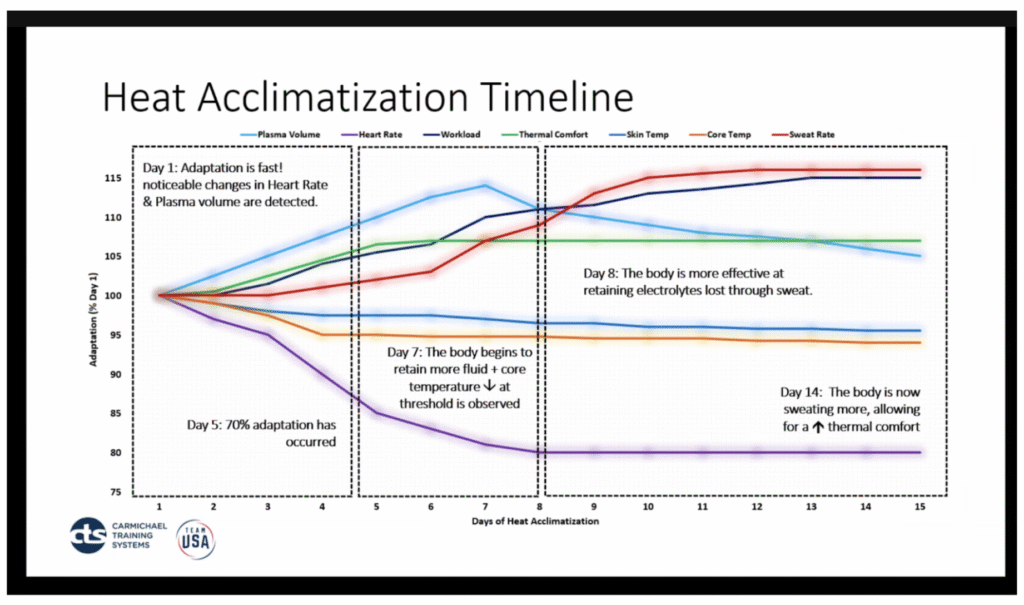
The short answer is you need to spend time in hot conditions. The process of heat acclimation takes about 10-14 days, as illustrated in the figure below from a presentation by CTS Coach and US Olympic Committee physiologist Lindsay Golich. This will mean daily exposures lasting as little as 15-30 minutes.
In terms of a hierarchy of preferred heat exposure methods, my CTS Ultrarunning colleague Jason Koop recommends a dry sauna as his first choice, followed by a hot water immersion bath, and finally a wet sauna. For active heat exposures, he recommends exercising in a heated room over exercising in multiple layers of clothing.
When should I start heat training?
If you only have time for one round of heat training, start about three weeks out from your event. The protocol below incorporates daily passive sauna exposures for 10 days, followed by “maintenance sessions” every few days. The reason there are no sauna sessions in the final week is because heat exposure is a stress, and in the final week it can hinder an athlete’s taper.
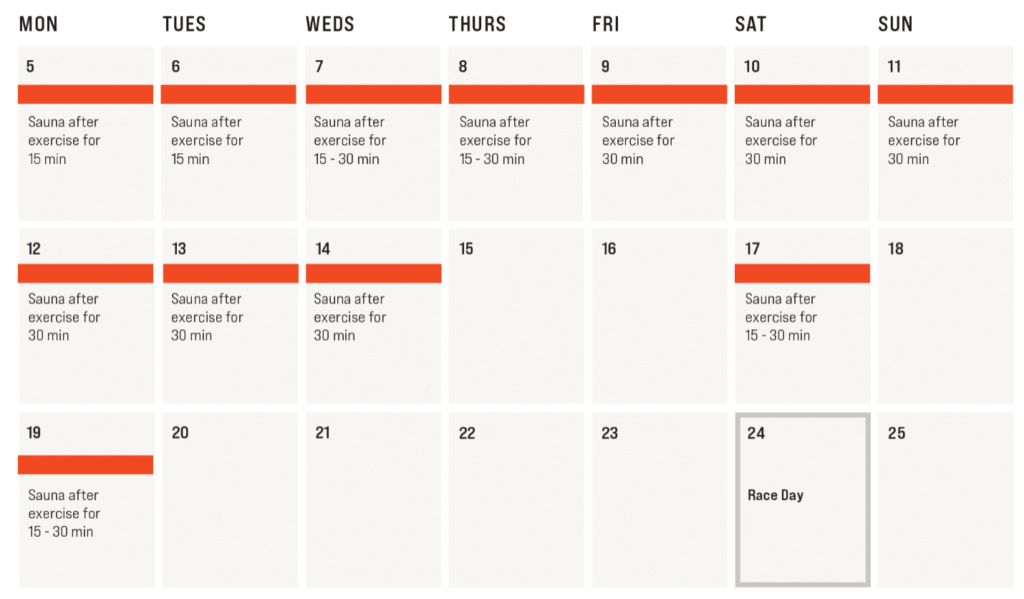
If you have more time to start a heat acclimation protocol earlier, you can use this “Repeated Exposure Protocol” that starts about 6 weeks before an event. The benefit of this approach is that there is less risk of an adverse effect on your training or recovery in the immediate leadup to your event.
How long do the effects of heat training last?
Emerging research shows that the physiological adaptations to heat acclimation gradually decay in two weeks after the cessation of heat training (Cubel et al., 2024). In this study, subjects achieved the maximum adaptations to heat training after three weeks of daily heat exposures, and a subsequent two weeks of additional heat training did not result in additional benefits. In other words, more is not necessarily better and there doesn’t appear to be compelling evidence for ongoing heat training. It’s best completed as a timely intervention with subsequent maintenance sessions about once every three days.
References:
Cubel C, Fischer M, Stampe D, Klaris MB, Bruun TR, Lundby C, Nordsborg NB, Nybo L. Time-course for onset and decay of physiological adaptations in endurance trained athletes undertaking prolonged heat acclimation training. Temperature (Austin). 2024 Aug 1;11(4):350-362. doi: 10.1080/23328940.2024.2383505. PMID: 39583901; PMCID: PMC11583594.
Oberholzer L, Siebenmann C, Mikkelsen CJ, Junge N, Piil JF, Morris NB, Goetze JP, Meinild Lundby AK, Nybo L, Lundby C. Hematological Adaptations to Prolonged Heat Acclimation in Endurance-Trained Males. Front Physiol. 2019 Nov 1;10:1379. doi: 10.3389/fphys.2019.01379. PMID: 31749713; PMCID: PMC6842970.
Périard JD, Racinais S, Sawka MN. Adaptations and mechanisms of human heat acclimation: Applications for competitive athletes and sports. Scand J Med Sci Sports. 2015 Jun;25 Suppl 1:20-38. doi: 10.1111/sms.12408. PMID: 25943654.
Rønnestad BR, Hamarsland H, Hansen J, Holen E, Montero D, Whist JE, Lundby C. Five weeks of heat training increases haemoglobin mass in elite cyclists. Exp Physiol. 2021 Jan;106(1):316-327. doi: 10.1113/EP088544. Epub 2020 Jul 4. PMID: 32436633.
Read More
-
Fueling for Ultras Can Be Complicated: Here’s How I Finally Made it Work for Me
-
-
Running an Ultra Through the Night: Staying Awake, Alert, and Mostly Sane
-
-
-
Dirty Dozen: 12 of the Best Trail Shoes for Running in the Mud
RELATED: Your Quick Guide to Tapering: Frequently Asked Questions
RELATED: Isometric Strength Training: A Safe, Simple, and Effective Path to Better Running
RELATED: What is Capacity Discrepancy?