Brian Morrison wrote a candid book and got closure 20 years after his near-miss at Western States.
It took 20 years, but Brian Morrison is finally fully telling the remarkable stories behind his improbable and heartbreaking near-miss at the 2006 Western States 100.
After running for 18 hours on the second hottest day in the race’s history, Morrison, then a 27-year-old running store employee from Seattle, reached the Placer High School track in Auburn, California, within a few hundred meters of victory, only to collapse numerous times and be unable to even walk to the finish line.
What turned the effort into ultrarunning lore was the dramatic conclusion. His mentor and pacer, Scott Jurek—coming off an unprecedented seventh straight Western States victory the year before—instinctively helped him across the line. But because race rules require runners to finish unassisted, the act resulted in Morrison’s disqualification, creating one of the most memorable and debated finishes in the race’s history.
Soon after Morrison’s collapse, he was taken by ambulance to the hospital, where he received IV fluids and remained overnight for observation. In the meantime, Graham Cooper, a 36-year-old runner from Oakland, California, entered the track and crossed the finish line to claim the win in 18 hours, 17 minutes, and 28 seconds.
Now, 20 years on, Morrison both relives those moments and tells considerably more about how it all played out.
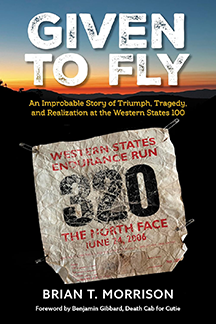
Given to Fly: An Improbable Story of Triumph, Tragedy, and Realization at the Western States 100 (Within Sight Press) follows Morrison’s breakthrough performance in the legendary race across the Sierra Nevada as he pushed himself to the limit in pursuit of a defining finish.
But the book reaches far beyond a single race. It’s ultimately a story about resilience, growth, and the realization that the most meaningful victories often unfold long after the finish line fades. With humility and hard-earned perspective, Morrison reflects on ambition, mentorship, public failure, and the razor-thin margin between success and collapse.
He also writes about the friendships, music, and the supportive running community that helped him regain his footing after the most painful moment of his athletic life. The title references a Pearl Jam song about overcoming adversity, maintaining personal freedom, and spreading love and joy in the face of negativity. (Morrison said the biggest thrill of writing the book is that someone gave Pearl Jam guitarist Mike McCready a copy to read and he posted a photo on social media.)
That’s exactly how Morrison has lived his life since 2006—as a husband, father, managing partner of a running store, and a runner unburdened by his past—and how he transformed what might have been an overwhelming tragedy into a life-affirming triumph.
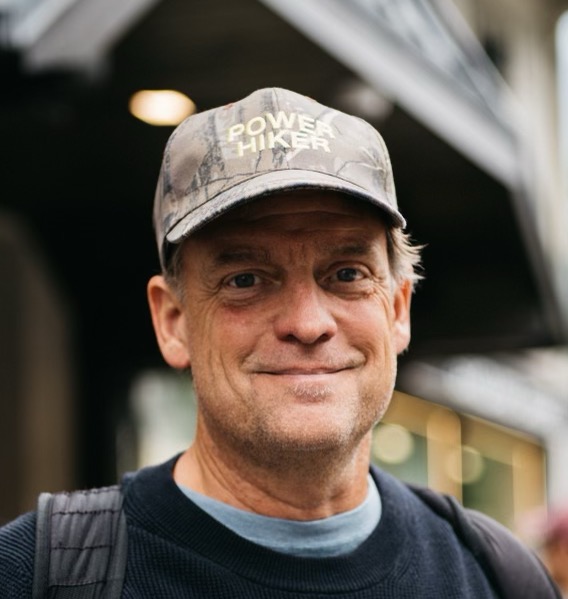
“I don’t have any regrets at all about how that race unfolded,” said Morrison, now 47, who still lives in Seattle. “I had initially subtitled the book ‘An Improbable Story of Triumph, Tragedy and Redemption at the Western States 100.’ But then it occurred to me, and I was probably on a run, that it’s not really a redemption story. I’ve realized what a gift that whole tragedy actually turned out to be.”
RELATED: Tahoe Week 2026
Rising Runner
Morrison started working at the Seattle Running Company in 2004, which at the time was a hub of not only the Seattle trail running scene but also one of the epicenters of the sport in the U.S. In addition to Jurek, who had worked at the store and was a practicing physical therapist, the shop and its band of trail runners helped inspire the rise of top runners Hal Koerner, Krissy Moehl, William Emerson, Brandon Sybrowsky, and Morrison, among others. It also served as the headquarters of the Montrail-Patagonia trail running team.
Morrison had been bitten by the trail running bug and, inspired by his colleagues and friends, finished the Cascade Crest 50-miler in both 2004 and 2005. Naturally, he applied to get into Western States both years, even though he had never finished a 100-miler. Back then, a runner could qualify by finishing a 50-miler, and Western States had a “two-time loser” rule that allowed anyone who had missed getting in an automatic entry the following year.
“I applied for Western States both years, despite having never run a 100,” Morrison recalls. “I just wanted to go straight to the big show—the biggest 100-mile race in the country.”
Jurek, then 32, had decided not to pursue an eighth straight victory in 2006, choosing instead to defend his Badwater 135 title (which he’d won just 16 days after the 2005 Western States). Instead, he mentored and trained Morrison, giving him the knowledge and confidence that took him to the brink of victory.
Morrison’s hard luck didn’t end there. After his collapse at the finish line in 2006, he trained even harder in 2007 — perhaps too hard, he says now—and didn’t finish. Finally in 2008, he felt grounded and as fit as he’d ever been, but the race was canceled that summer due to wildfires. (Cooper, meanwhile, returned in 2007 to finish third, placed 19th in 2009, and seventh in 2011.)
Candid Confessions
In the book, Morrison revisits those experiences years later, reflecting on the emotional aftermath and the lessons they revealed about ambition, resilience, and the meaning of endurance. More than a race recap, Given to Fly explores the fragile boundary between triumph and heartbreak in ultrarunning, and how moments of failure can ultimately lead to deeper perspective and growth.
“I almost called the book ‘Winner-ish,’ but I didn’t want to take anything away from Graham,” Morrison says. “I did almost win, but I don’t feel like anything was taken away from me. With the notion of the growth mindset, I think I’m better adjusted, with a more character-rich life for having experienced that failure.”
Morrison ultimately didn’t finish the Western States 100 until 2016—a full decade after he came within a few hundred meters of winning it. He crossed the finish line in 27:26 with his family by his side, including his wife, Andrea, his mom, his sister, and his 5-year-old son. But, he said, it took the book to really give him closure.
Morrison also reflects candidly on his complicated relationship with his father and the lasting influence it had on his life. He describes a childhood shaped by emotional distance and unmet expectations, portraying his father as someone who was often critical and difficult to connect with. Throughout the book, he revisits those memories through an adult lens, examining how that strained relationship helped shape both his personality and his drive as an athlete—and ultimately contributed to his resilience.
The need for validation and the urge to push beyond perceived limits became powerful motivators in his running, particularly in a relentless pursuit of goals that sometimes bordered on self-punishment.
“I don’t think I realized until I started writing just how much my dad’s absence drove me—how much I wanted to distance myself from the man he was, and how running became an outlet for that,” Morrison said. “We didn’t really have a relationship, and he passed away a couple of years ago. It occurred to me while writing that I feel more comfortable sharing this knowing he’s never going to read it. There are just things you realize through the process—turns you weren’t quite expecting.”
These days, Morrison runs more for the love of it than anything else. The consistency is still there, but life looks different now. There’s a family to be present for, and the pull toward racing just isn’t what it used to be. He left the running store and now works as a manager at REI, but he still makes time to hit the trails a couple of times a week. Lately, there have been thoughts of racing beginning to creep back in.
“I would really like for that fire to come back, and I still have some,” Morrison said. “I’m kind of to the point where I could definitely see trying to get back in the best shape I can be at 47. I’ve been working threshold runs back into my training—not just going out and running. We’ll see where it goes, but I’m healthy and enjoying it, and that’s the best thing for me.”
Find Your Next Race: UltraSignup’s Event Finder
RELATED: 10 Great New Running Books of 2026
RELATED: Everything You Need to Know About Western States 2026
RELATED: Top Contenders in the Western States 100 Women’s Field
RELATED: Top Contenders in the Western States 100 Men’s Field
- UltraSignup’s David Callahan joins the Unrationed Podcast
- The Art of Taking Running Seriously, But Not Too Seriously
- UltraSignup Hosts 2026 US Trail Running Conference in Nashville, Launching New Registration Platform
- How Andrea Moore Became a Prolific 200-Miler
- 20 Great Fall Trail Running Races You Will Love

- Trail Tested: Teva TrailPeak